

Thursday 20 March 2025
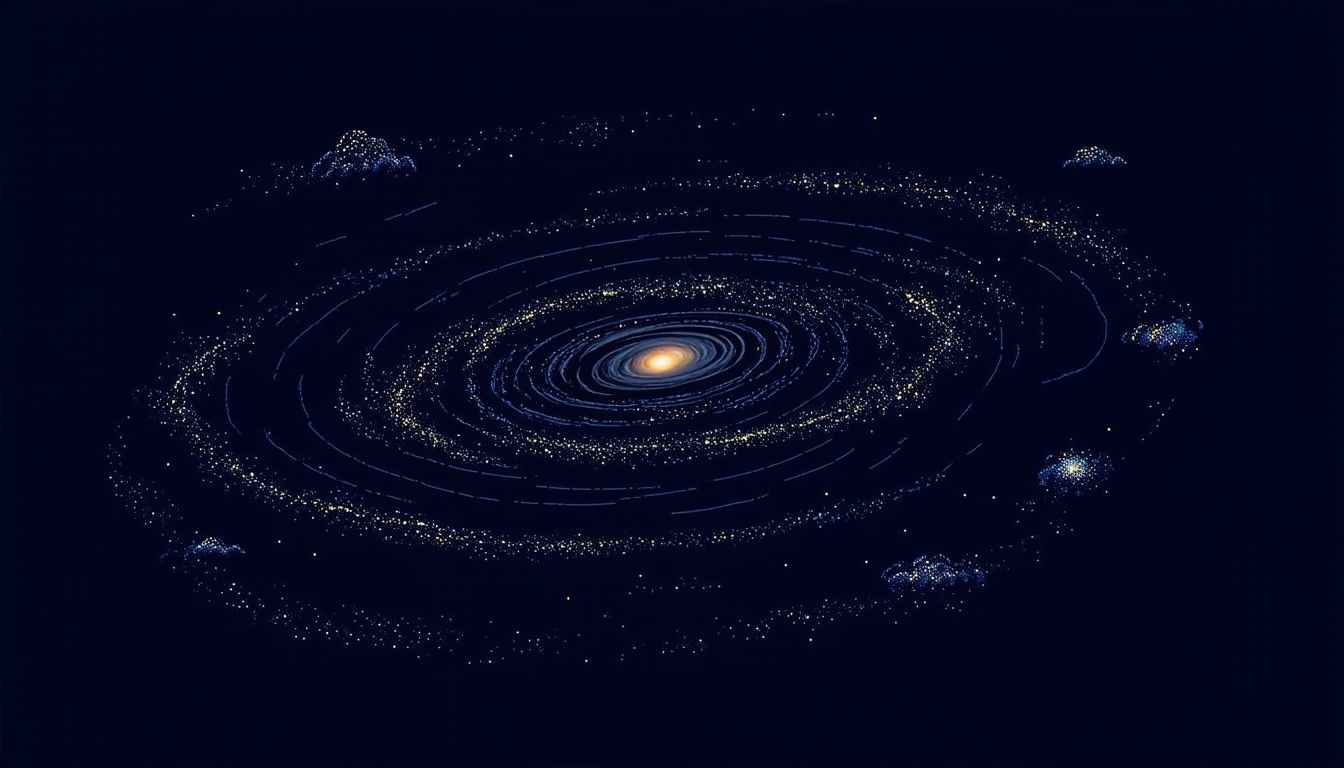
A new study has shed light on the mysterious movement of stars in the Milky Way galaxy, revealing a surprising connection between their orbits and the shape of our cosmic home.
Researchers have long been fascinated by the peculiar motion of stars within our galaxy. Some zip along at high speeds, while others trudge along at a snail’s pace. But why? The answer lies not with the stars themselves, but with the complex dance between our galaxy and its gravitational partners.
The Milky Way is part of a larger cosmic ensemble, bound together by gravity alongside other galaxies and vast clouds of gas and dust. As these objects move through space, they exert subtle influences on one another, shaping the orbits of nearby stars in ways that can take millions of years to unfold.
Using powerful computer simulations, scientists have recreated the intricate ballet between the Milky Way and its neighbors. By tracing the paths of thousands of virtual stars, they’ve discovered a striking pattern: the stars that move quickly through space are often those that find themselves near the galactic center, where the gravitational pull of supermassive black holes is strongest.
But what about the slower-moving stars? It turns out they’re more likely to be found in the outer reaches of our galaxy, far from the bustling hub. Here, the gentle tug of neighboring galaxies and clouds of gas can subtly nudge their orbits, slowing them down over time.
This study offers a fresh perspective on the Milky Way’s evolution, revealing how its shape and structure have been shaped by interactions with other galaxies over billions of years. By better understanding these dynamics, scientists hope to gain insights into the formation and fate of our cosmic home – and perhaps even uncover hidden secrets about the universe beyond.
The research has also sparked new questions about the role of gravitational forces in shaping the orbits of stars within other galaxies. As our knowledge of the cosmos continues to expand, it’s clear that there’s still much to be discovered about the intricate dance between galaxies and their celestial inhabitants.
Cite this article: “Galactic Rhythm: The Surprising Connection Between Star Orbits and Galaxy Shape”, The Science Archive, 2025.
Stars, Milky Way Galaxy, Gravitational Partners, Orbits, Black Holes, Galactic Center, Neighboring Galaxies, Gas Clouds, Cosmic Home, Universe





