

Thursday 20 March 2025
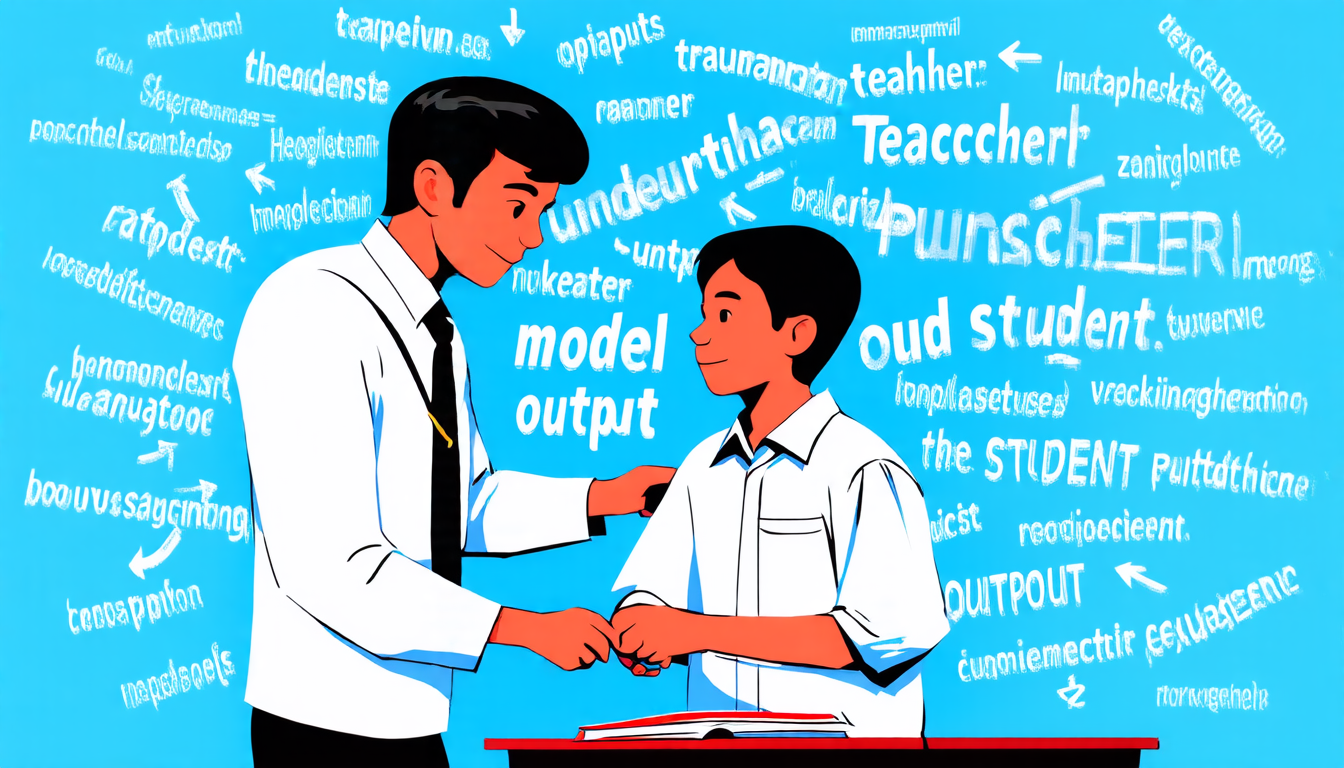
The language model distillation process, a technique used to train smaller models that mimic the performance of larger ones, has been found to have a previously unknown flaw: teacher hacking. This phenomenon occurs when the student model over-optimizes its training data, leading to degraded performance on the true objective.
Researchers have long known that large language models can be prone to overfitting, where they become overly specialized in their training data and struggle to generalize to new situations. However, a recent study has identified a related issue that can occur during distillation: teacher hacking. This occurs when the student model is trained on a dataset that is generated by the teacher model, which can lead to the student model becoming overly dependent on patterns in the teacher’s output rather than learning more generalizable skills.
The researchers found that this phenomenon can have significant consequences for the performance of the distilled model. In some cases, the student model may produce outputs that are highly similar to those generated by the teacher model, but lack the nuance and complexity of human language. This can lead to degraded performance on tasks such as translation, summarization, and instruction following.
The researchers used a combination of offline and online data sources to study this phenomenon. They found that when using offline data alone, the student model was more likely to exhibit teacher hacking behavior. However, when they combined offline and online data, the student model performed significantly better and was less prone to teacher hacking.
These findings have important implications for the development of language models. In order to ensure that these models are able to generalize well to new situations, it is essential to use a diverse range of training data and to avoid over-reliance on patterns in the teacher’s output. The researchers suggest that using online data sources, such as web scraping or crowdsourcing, can help to mitigate the effects of teacher hacking.
The study also highlights the importance of monitoring the performance of distilled models during training. By tracking metrics such as the student model’s loss function and its ability to generalize to new situations, developers can identify when teacher hacking is occurring and take steps to correct it.
Overall, this research underscores the need for careful consideration of the training data used in language model distillation. By taking a more nuanced approach to distillation, developers can create models that are better equipped to handle real-world tasks and provide more accurate results.
Cite this article: “Teacher Hacking: A Hidden Flaw in Language Model Distillation”, The Science Archive, 2025.
Language Model Distillation, Teacher Hacking, Overfitting, Large Language Models, Student Model, Training Data, Generalizability, Nuance, Complexity, Human Language





