

Thursday 20 March 2025
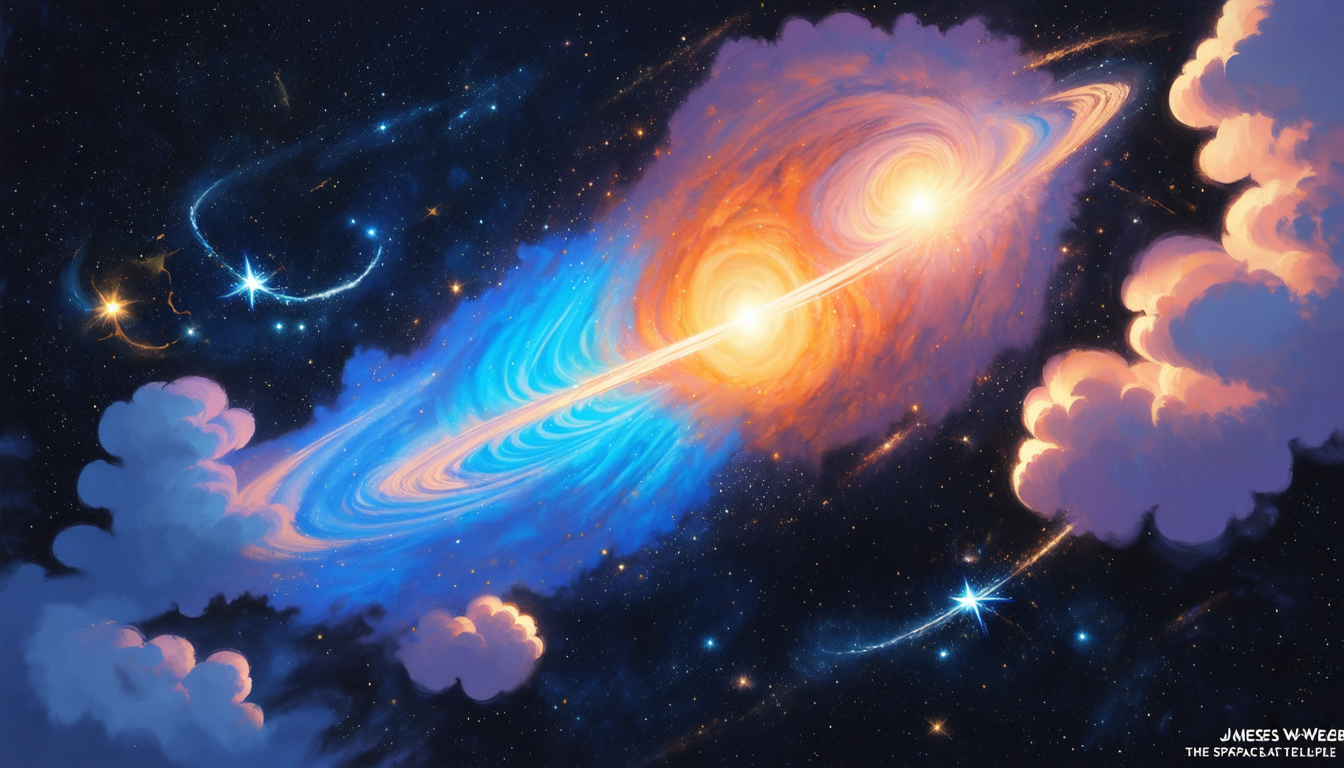
Deep in space, a cosmic dance is taking place between two stars that are destined to collide. This dramatic event will create a burst of dust and gas, which will be blown into space at incredible speeds, carrying with it the secrets of the universe.
At the heart of this spectacular display lies a binary star system, known as WR 140. Comprising two massive stars, one carbon-rich and the other oxygen-rich, they are locked in a gravitational dance that is slowly bringing them closer together. As they orbit each other, their intense radiation and strong winds create powerful shockwaves that compress and heat up nearby gas and dust.
The resulting explosion of energy has created an intricate network of swirling clouds, which have been observed by astronomers using the James Webb Space Telescope. This remarkable instrument has captured stunning images of the system, revealing the delicate patterns and shapes of the dusty tendrils as they writhe and twist through space.
But what’s truly remarkable about this observation is that it marks the first time scientists have been able to directly measure the motion of dust particles within a binary star system. By tracking the movement of these tiny grains over time, researchers can gain valuable insights into the physics of stellar evolution and the creation of new stars.
The data collected by the James Webb Space Telescope shows that the dust particles are moving at incredible speeds, some reaching up to 2,500 kilometers per second. This is remarkably fast, equivalent to about 10% of the speed of light. The sheer velocity of these particles suggests that they are being propelled by powerful forces within the system.
One of the most fascinating aspects of this study is the opportunity it provides to test our understanding of the physics governing the behavior of dust in extreme environments. By comparing the observed motion of the dust particles with theoretical predictions, scientists can refine their models and gain a deeper understanding of how stars interact with their surroundings.
As WR 140 hurtles towards its final collision, astronomers are eagerly awaiting the spectacular display that will soon unfold. The creation of new stars is a fundamental process in the universe, shaping the course of cosmic evolution and influencing the development of galaxies. By studying this remarkable system, scientists can gain valuable insights into the workings of the cosmos and the mysteries that lie within.
The James Webb Space Telescope has provided astronomers with an unparalleled view of WR 140’s dusty dance.
Cite this article: “Cosmic Dance: A Binary Star Systems Fiery Finale”, The Science Archive, 2025.
Binary Star System, James Webb Space Telescope, Wr 140, Dust Particles, Stellar Evolution, Cosmic Dance, Shockwaves, Gravitational Dance, Binary Stars, Astronomy





