

Thursday 20 March 2025
Scientists have long been fascinated by the intricate structures of crystals, those repeating patterns of atoms that give rise to a wide range of materials with unique properties. From diamonds and rubies to semiconductors and superconductors, crystals are the building blocks of many of the world’s most important technologies.
But understanding the behavior of these complex systems is no easy feat. Crystals are governed by strict rules, known as symmetry operations, that dictate how their atoms arrange themselves. These patterns can be incredibly subtle, with tiny changes in atomic position having a profound impact on the material’s properties.
To tackle this challenge, researchers have developed sophisticated computer models that simulate the behavior of crystals at the atomic level. These simulations are crucial for designing new materials with specific properties, but they’re also limited by their reliance on simplified assumptions about how atoms interact.
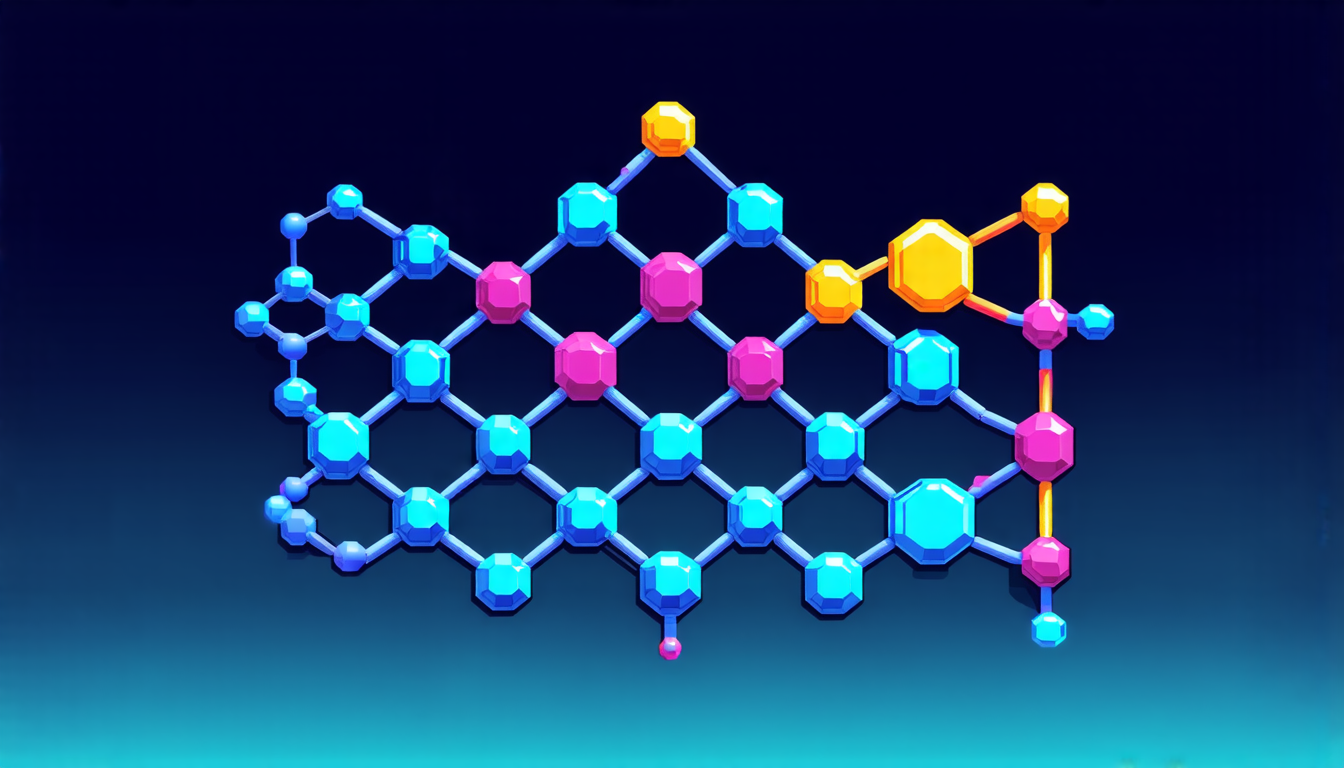
Enter Reciprocal Geometry Network (ReGNet), a novel approach to crystal modeling that incorporates both short-range and long-range interactions in a single framework. Unlike previous methods, which focus solely on local atomic arrangements or neglect the importance of distant interactions, ReGNet seamlessly integrates these two perspectives to generate more accurate predictions of crystal behavior.
The key innovation behind ReGNet is its use of reciprocal space, a mathematical construct that represents the spatial frequencies associated with a crystal’s repeating pattern. By mapping the complex interplay between atoms in this higher-dimensional space, researchers can capture the intricate relationships between local and global properties that govern crystal behavior.
In practical terms, this means that ReGNet can accurately predict the properties of crystals with unprecedented precision, from their mechanical strength to their electronic conductivity. This is particularly significant for materials scientists, who rely on accurate predictions to design new compounds with specific applications in fields like energy storage, electronics, and medicine.
But what’s perhaps most remarkable about ReGNet is its computational efficiency. Unlike other methods that require vast amounts of computing power, ReGNet can be trained on relatively modest hardware, making it a game-changer for researchers working with limited resources.
The implications of this work are far-reaching, from the development of new materials to the refinement of existing manufacturing processes. By enabling more accurate predictions of crystal behavior, ReGNet has the potential to accelerate scientific discovery and drive innovation in fields where precision matters most.
Cite this article: “Cracking the Code of Crystal Behavior with Reciprocal Geometry Network”, The Science Archive, 2025.
Crystals, Materials Science, Computer Modeling, Reciprocal Geometry Network, Atomic Interactions, Symmetry Operations, Crystal Behavior, Property Predictions, Computational Efficiency, Scientific Discovery





