

Thursday 20 March 2025
Mathematicians have been fascinated by a peculiar property of certain numbers for decades, known as Mahler’s measure. This concept has led to some remarkable discoveries and insights into the nature of mathematics itself.
At its core, Mahler’s measure is a way to quantify the complexity of a polynomial equation. Polynomials are expressions that contain variables raised to different powers, like x^2 + 3x – 4. For a long time, mathematicians were interested in finding polynomials with specific properties, such as having all their roots (solutions) inside a particular circle.
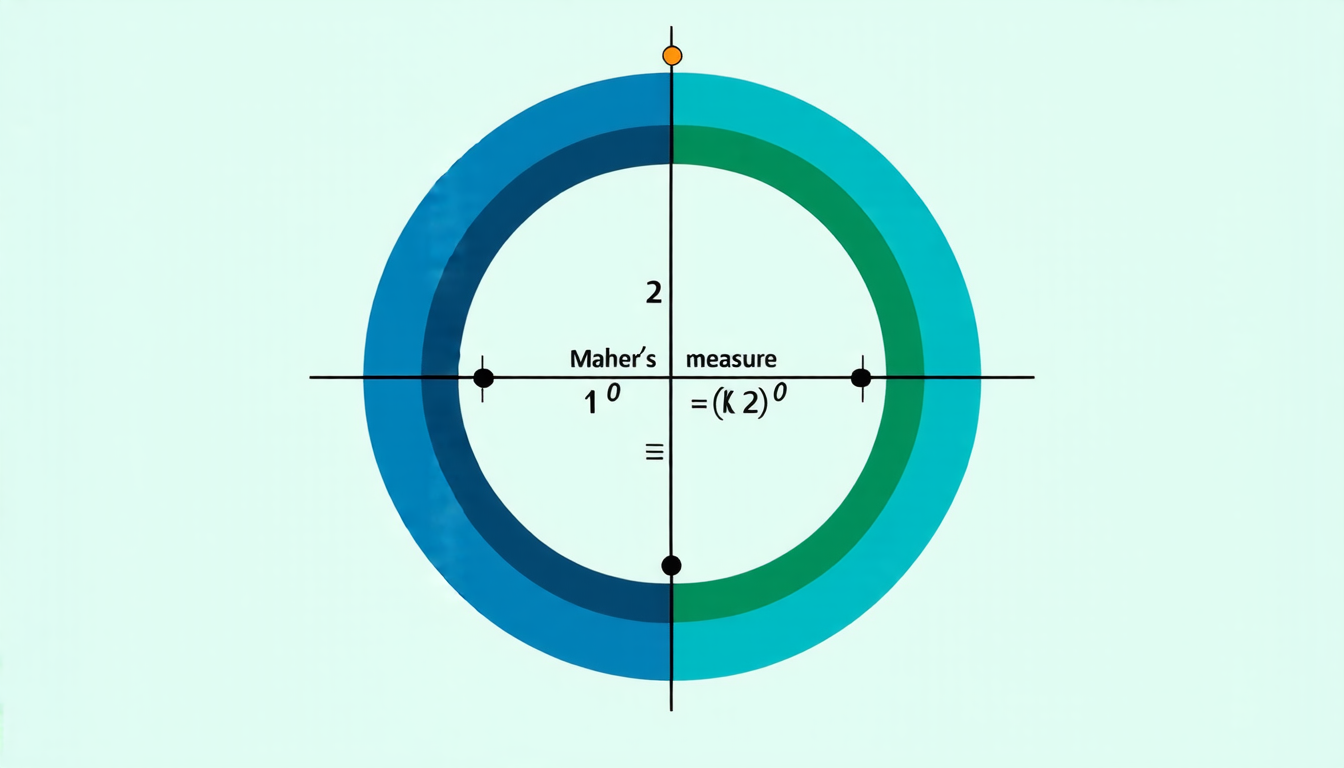
One approach to tackle this problem was to analyze the behavior of polynomials near the unit circle, which is the circle with radius 1 centered at the origin. This led to the development of Mahler’s measure, which assigns a value between 0 and 1 to each polynomial based on its roots’ distribution around the unit circle.
Recently, researchers have made significant progress in understanding Mahler’s measure for polynomials in multiple variables. In essence, they’ve been trying to figure out how many zeros (or solutions) a polynomial has inside the unit circle when it’s raised to different powers.
The new findings suggest that certain patterns emerge when examining these polynomials. For instance, some researchers have discovered that the number of zeros inside the unit circle follows a predictable trend as the degree of the polynomial increases.
One intriguing aspect of this research is its connection to other areas of mathematics, such as algebraic dynamics and Salem numbers. These concepts might seem unrelated at first glance, but they’re actually linked through Mahler’s measure.
The study of Mahler’s measure has far-reaching implications for various fields, including cryptography, coding theory, and even the analysis of complex systems. By better understanding the behavior of polynomials with specific properties, researchers can develop new algorithms and models that have practical applications in these areas.
In recent years, advances in computational power and numerical methods have enabled mathematicians to tackle previously unsolvable problems related to Mahler’s measure. This has led to a deeper understanding of the underlying mathematics and opened up new avenues for research.
The exploration of Mahler’s measure is an ongoing effort that continues to yield exciting discoveries. As researchers delve deeper into this fascinating topic, they’re uncovering hidden patterns and connections that have far-reaching implications for our understanding of mathematics and its applications.
Cite this article: “Unraveling Mahlers Measure: A Window into Mathematics Hidden Patterns”, The Science Archive, 2025.
Mathematics, Polynomials, Mahler’S Measure, Algebraic Dynamics, Salem Numbers, Cryptography, Coding Theory, Complex Systems, Computational Power, Numerical Methods
Reference: Dragan Stankov, “The alternative to Mahler measure of a multivariate polynomial” (2025).





