

Thursday 20 March 2025
The pursuit of quantum entanglement has long been a Holy Grail for physicists, offering a glimpse into a realm where the principles of classical physics no longer apply. In recent years, researchers have made significant strides in harnessing this phenomenon, particularly in the field of optomechanics. Now, a new study takes things a step further by demonstrating that quantum entanglement can be achieved between an oscillator and continuous fields, even when noise is present.
The concept of optomechanics revolves around the interaction between light and mechanical systems, such as mirrors or nanoscale oscillators. When light is shone onto these systems, it causes them to vibrate, creating a phenomenon known as radiation pressure. This force can be used to entangle the system with continuous fields, effectively linking two distant objects in a way that’s difficult to achieve with classical systems.
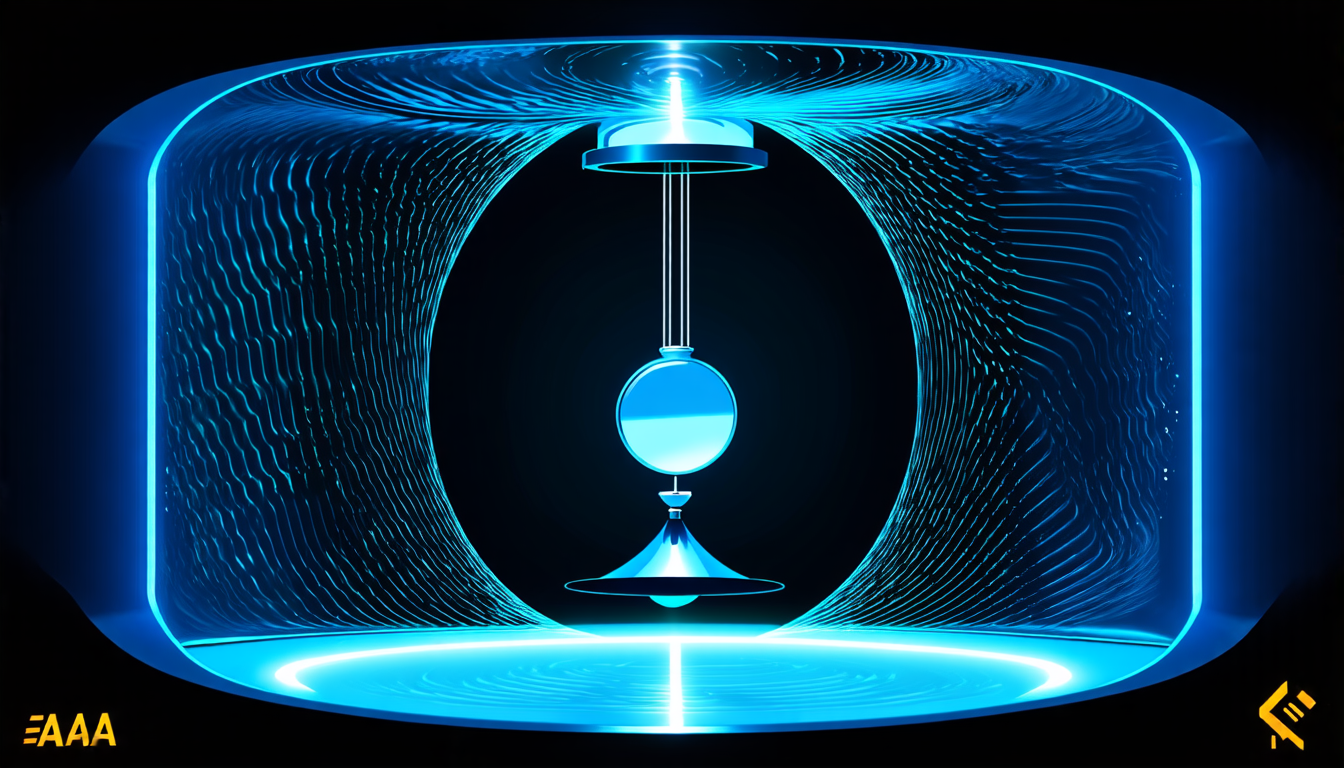
The researchers behind this study employed a setup involving a mechanical oscillator and a light field, which was modulated by an optical phase modulator. The team found that when the input light field is squeezed, or reduced in uncertainty, the entanglement between the oscillator and continuous fields becomes more robust. This squeezing can be achieved using techniques such as frequency-dependent squeezing, which involves modifying the input optics to reduce noise.
The study’s findings have significant implications for the development of quantum technologies, particularly those involving gravitational wave detectors and precision measurement. By demonstrating that entanglement can be achieved in noisy environments, researchers may be able to improve the sensitivity of these systems, allowing them to detect smaller signals and make more accurate measurements.
One of the key challenges facing researchers is the presence of non-Markovian noise, which can disrupt the delicate balance required for quantum entanglement. In this study, the team addressed this issue by incorporating passive losses into their model, effectively simulating the effects of real-world noise on the system. This approach allowed them to explore the robustness of entanglement in noisy environments and identify optimal conditions for achieving it.
The results of this study open up new avenues for research in optomechanics and its applications. By further exploring the boundaries of quantum entanglement, scientists may be able to develop more precise measurement tools and improve our understanding of the fundamental laws governing the behavior of particles at the quantum level.
In the pursuit of this goal, researchers will likely continue to push the limits of what is possible with optomechanics.
Cite this article: “Quantum Entanglement Achieved in Noisy Environments”, The Science Archive, 2025.
Quantum Entanglement, Optomechanics, Noise, Squeezing, Uncertainty, Radiation Pressure, Mechanical Oscillators, Continuous Fields, Non-Markovian Noise, Quantum Technologies





