

Thursday 20 March 2025
Mathematicians have long been fascinated by the properties of non-associative algebras, where the usual rules of arithmetic don’t apply. These mysterious structures can be used to model complex phenomena in physics and other fields, but they’re notoriously difficult to work with.
Recently, a team of researchers has made significant progress in understanding these algebras. By studying central orders – essentially, patterns that emerge when you embed these algebras within larger mathematical frameworks – they’ve been able to crack the code on some long-standing problems.
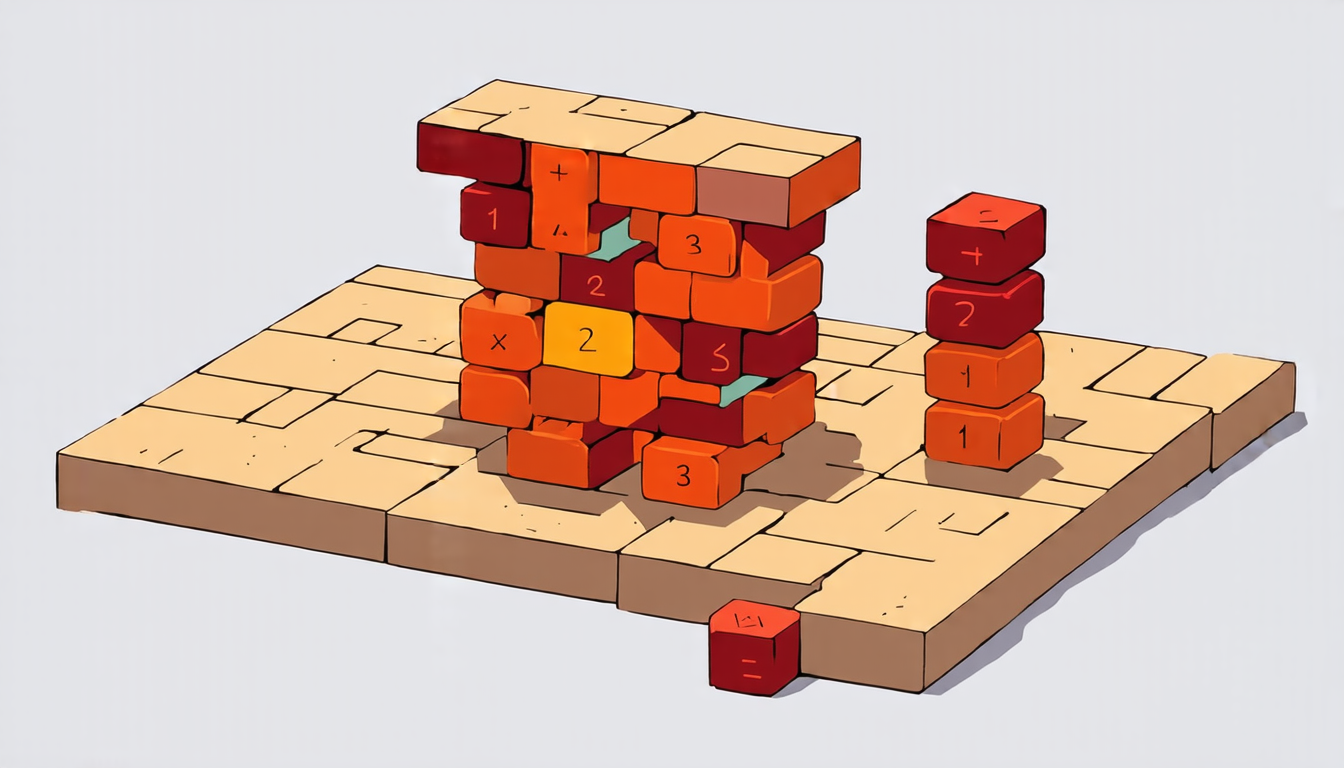
One such problem is the classification of simple finite-dimensional right-alternative superalgebras. These are algebras where the usual rules of arithmetic don’t apply, but in a way that’s consistent with certain symmetries. Think of it like a game of algebraic Jenga: you start with a set of blocks (the algebra) and then remove some of them according to certain rules.
The problem is that these algebras can be very tricky to work with. They don’t have the same nice properties as more traditional algebras, like associativity or commutativity. And yet, they’re incredibly important in many areas of physics, from particle theory to quantum mechanics.
The researchers’ breakthrough comes from their discovery of a new way to embed these algebras within larger mathematical frameworks. By doing so, they’ve been able to identify certain patterns that emerge when you look at the algebra’s central orders.
These patterns are crucial because they allow us to classify the simple finite-dimensional right-alternative superalgebras in a way that was previously thought impossible. Essentially, it’s like finding a hidden code within the algebra that helps us understand its structure and behavior.
The implications of this work are far-reaching. For one thing, it opens up new avenues for research into the properties of these algebras. By studying their central orders, researchers can gain insights into the underlying symmetries that govern the algebra’s behavior.
Moreover, this breakthrough has significant potential applications in physics and other fields. By using these algebras to model complex phenomena, scientists may be able to make new predictions or gain deeper insights into the fundamental laws of the universe.
Ultimately, this work represents a major milestone in our understanding of non-associative algebras. It’s a testament to the power of human ingenuity and the importance of pushing the boundaries of mathematical knowledge.
Cite this article: “Cracking the Code on Non-Associative Algebras”, The Science Archive, 2025.
Non-Associative Algebras, Central Orders, Simple Finite-Dimensional Right-Alternative Superalgebras, Algebraic Jenga, Particle Theory, Quantum Mechanics, Mathematical Frameworks, Symmetries, Classification Problem, Non-Associative Algebra





