

Thursday 20 March 2025
A team of researchers has made a significant breakthrough in understanding the behavior of evaders and pursuers in pursuit-evasion games, which have important applications in fields such as target defense and autonomous systems.
These types of games involve a pursuer trying to capture an evader, who is attempting to avoid being caught. The research focuses on the concept of dominance regions, which are areas that the evader cannot leave without being captured by the pursuer. Understanding these regions is crucial for designing effective strategies in pursuit-evasion games.
The study shows that there are certain conditions under which the pursuer can guarantee prevention of the evader entering its initial dominance region before being captured. However, this guarantee only holds if the pursuer has access to the evader’s current velocity. Without this information, the evader may be able to exploit a loophole and escape capture.
The researchers also identified a specific scenario where the pursuer cannot guarantee prevention of the evader entering its initial dominance region. This occurs when there are obstacles on the plane that can be used by the evader to hide from the pursuer.
To better understand the behavior of evaders and pursuers, the team developed a new mathematical framework. This framework allows them to analyze the geometry of pursuit-evasion games and identify key properties of dominance regions.
One of the key findings is that the boundary of the dominance region is a continuously differentiable, simple, closed curve. This means that it can be easily modeled and analyzed using standard mathematical techniques.
The research has important implications for the design of autonomous systems such as drones and robots. By understanding how evaders and pursuers behave in pursuit-evasion games, developers can create more effective strategies for controlling these systems.
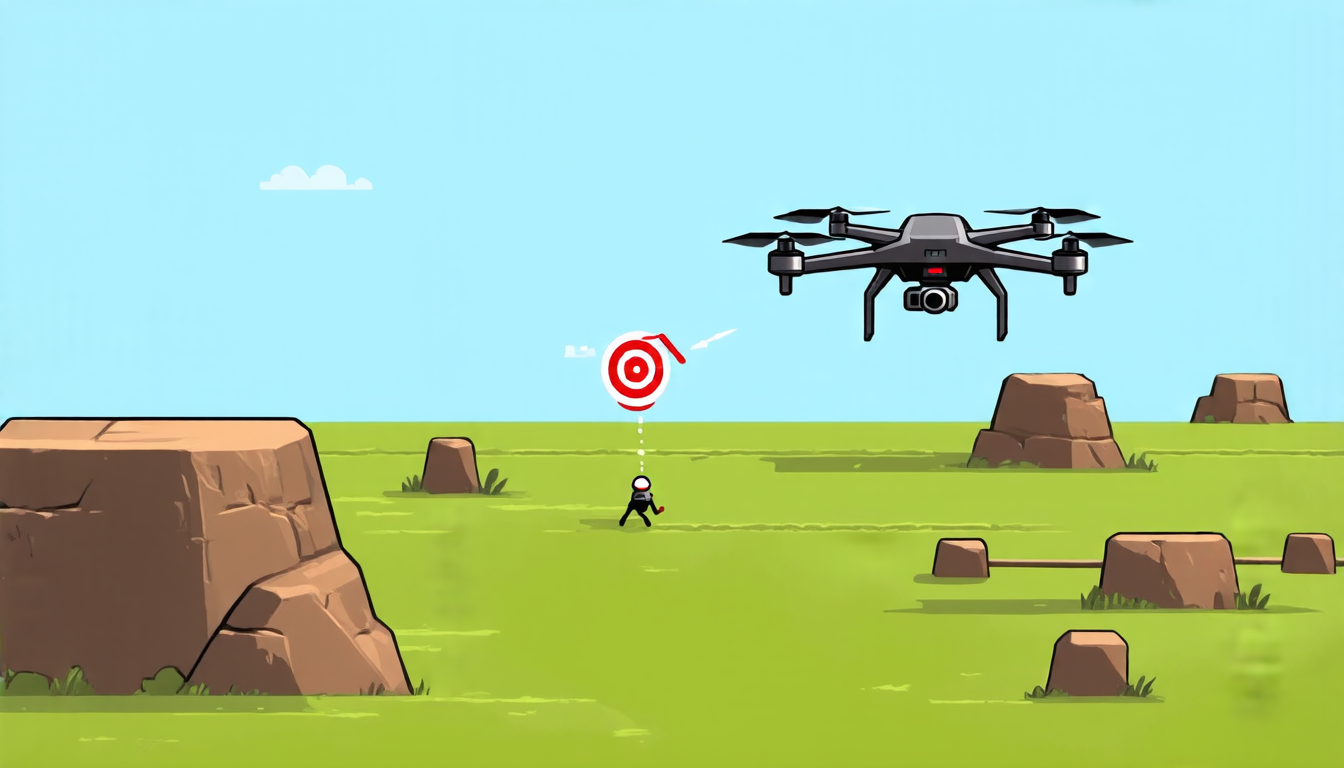
For example, a drone designed to capture an enemy target could use the dominance region concept to identify areas where the target is most likely to be located. The drone could then adjust its trajectory accordingly to increase its chances of capturing the target.
In addition, the research has applications in fields such as target defense and cybersecurity. By understanding how evaders and pursuers behave, security experts can design more effective strategies for protecting against cyber attacks and defending against enemy targets.
Overall, this study represents a significant advance in our understanding of pursuit-evasion games and has important implications for a range of fields.
Cite this article: “Guaranteeing Capture in Pursuit-Evasion Games: A Breakthrough in Understanding Dominance Regions”, The Science Archive, 2025.
Pursuit-Evasion, Game Theory, Dominance Regions, Evaders, Pursuers, Autonomous Systems, Drones, Robots, Cybersecurity, Target Defense.





