

Thursday 20 March 2025
For centuries, astronomers have been fascinated by the explosive events that occur when two stars collide or merge in a cosmic dance. These cataclysmic occurrences can produce some of the most intense and spectacular displays of energy in the universe, shaping the very fabric of space-time around them.
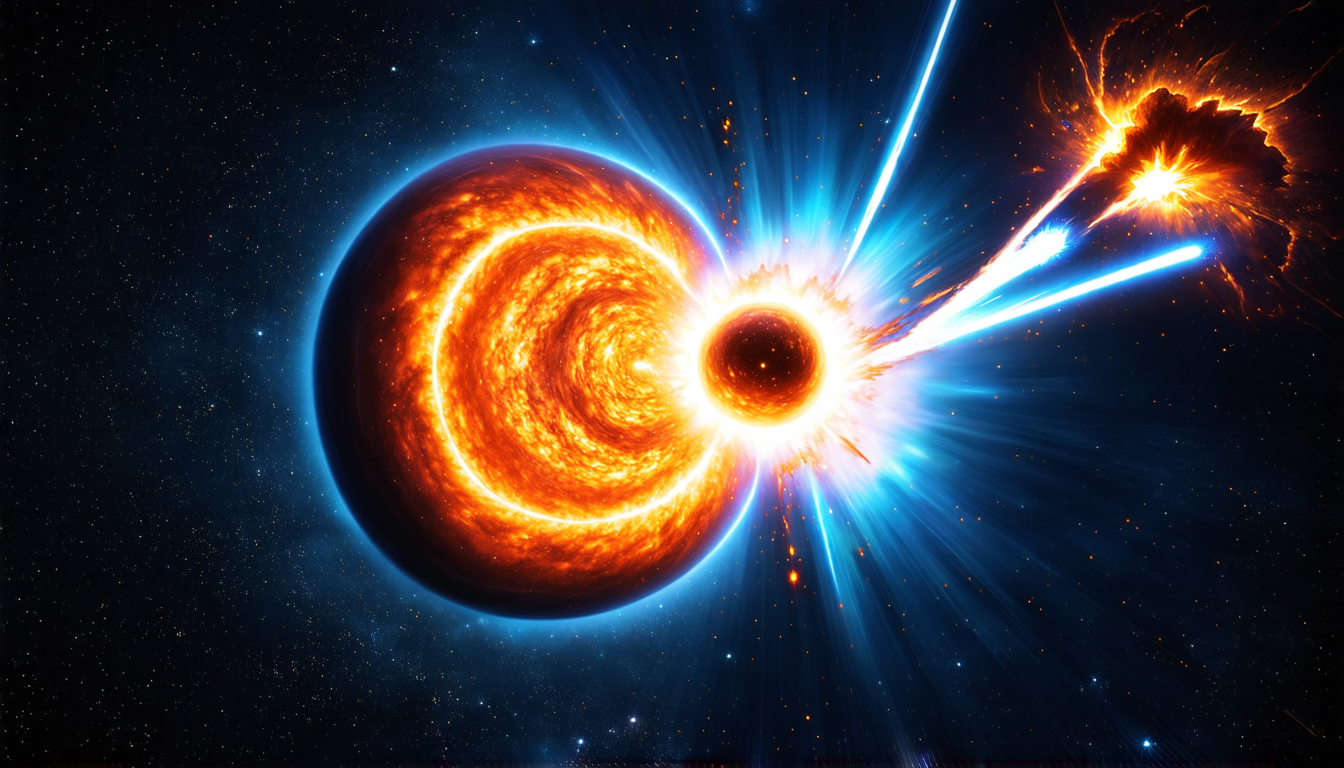
Recently, scientists have been studying one such event with unprecedented precision: the merger of a massive star and its companion neutron star. This union is thought to occur when the more massive star exhausts its fuel and collapses under its own gravity, sending its core hurtling towards its neutron star partner.
Researchers have long sought to understand the intricacies of this process, as it holds the key to unlocking secrets about the behavior of matter at extreme temperatures and densities. However, simulating such events in a laboratory setting is essentially impossible due to their immense energy requirements.
Enter the realm of computational simulations, where scientists can recreate these cosmic collisions using advanced algorithms and powerful supercomputers. A new study published in the journal Publications of the Astronomical Society of Australia has taken this approach to unprecedented heights, shedding light on the previously mysterious processes that occur when a massive star and its neutron star companion merge.
The research team used a sophisticated computer model to simulate the merger of a 7-solar-mass red supergiant and a 1.4-solar-mass neutron star. They found that the resulting accretion disk, which forms around the neutron star, grows to an astonishing size of approximately 40 times the radius of our sun.
This massive disk is thought to play a crucial role in shaping the ultimate fate of the merged stars, potentially leading to the formation of a black hole or even a burst of gamma radiation. The study’s findings also suggest that the merger could produce a powerful jet of energy, which could have significant implications for the surrounding environment.
What makes this research particularly noteworthy is its attention to detail and precision. The team carefully modeled various aspects of the simulation, including the thermal properties of the accretion disk and the effects of different physical parameters on the outcome of the merger.
The study’s findings have far-reaching implications for our understanding of these extreme cosmic events and their potential impact on the surrounding environment. By combining cutting-edge computational simulations with advanced theoretical models, scientists are one step closer to unlocking the secrets of the universe’s most violent and awe-inspiring displays of energy.
Cite this article: “Unlocking the Secrets of Cosmic Collisions: A New Study on Star Mergers”, The Science Archive, 2025.
Star Merger, Neutron Star, Massive Star, Accretion Disk, Black Hole, Gamma Radiation, Computational Simulations, Supercomputers, Astrophysics, Cosmic Events





