

Thursday 20 March 2025
The humble speaker has come a long way since its inception. From bulky, boxy devices that only played scratchy records to sleek, portable units that can stream high-fidelity audio to our ears, speakers have evolved significantly over the years. But despite their advancements, speakers still rely on a fundamental principle: the conversion of electrical signals into sound waves.
In a recent experiment, researchers explored this process in a unique way. By creating a simple speaker setup using everyday materials like copper wire and neodymium magnets, they aimed to understand how different parameters affect the output intensity of the speaker. The results were fascinating, offering valuable insights into the workings of a speaker and providing a DIY manual for enthusiasts.
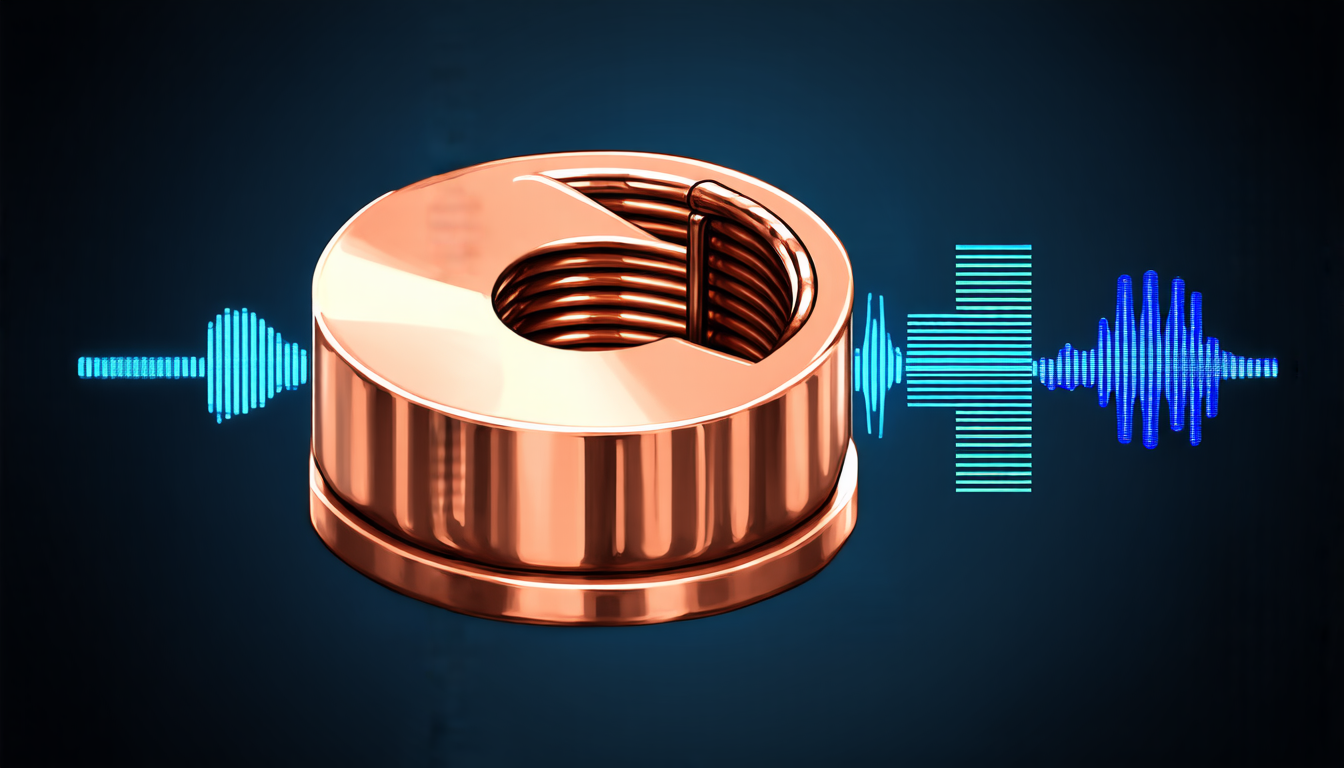
The setup consisted of a hollow cylinder made from high-density polyethylene (HDPE), which was chosen for its acoustic properties. The cylinder was surrounded by a coil of copper wire, and a neodymium magnet was placed at one end to create a magnetic field. When an electric signal was applied to the coil, the magnet interacted with it, causing the coil to vibrate. These vibrations created pressure waves in the surrounding air, producing sound.
To analyze their setup, the researchers used heat maps to visualize how sound propagated through the cylinder. The maps revealed that the intensity of the sound decreased as the distance from the source increased, but only up to a certain point. Beyond that point, the sound level remained relatively constant. This phenomenon was attributed to the absorption and scattering of sound waves by the HDPE material.
The researchers also developed a theoretical model based on the forced harmonic oscillator (FHO) equation to describe their setup. The FHO equation is commonly used to describe the motion of an object under the influence of a periodic driving force, such as the vibrations caused by an electric signal in a speaker. By solving this equation for different parameters, they were able to predict the output intensity of their speaker and compare it with experimental results.
The comparison between theory and experiment showed remarkable agreement, indicating that the FHO model was a good approximation of the real-world behavior of the speaker. The researchers found that the damping coefficient, which describes the rate at which the vibrations decay over time, had a significant impact on the output intensity. As expected, higher damping coefficients resulted in lower output intensities.
The study’s findings have implications for the development of more efficient and effective speakers.
Cite this article: “Unlocking the Secrets of Sound: A Study on Speaker Design and Efficiency”, The Science Archive, 2025.
Speaker, Sound Waves, Electrical Signals, Copper Wire, Neodymium Magnets, Hdpe Material, Forced Harmonic Oscillator, Damping Coefficient, Output Intensity, Acoustic Properties
Reference: Md Hossen Mondal, Ramkrishna A. Joshi, “The physics of oscillating surfaces and sounds” (2025).





