

Thursday 20 March 2025
Scientists have made a significant breakthrough in their quest to detect gravitational waves, ripples in the fabric of spacetime that were first predicted by Albert Einstein a century ago. A new study has shown that a lunar-based detector could be used to detect these waves and potentially uncover secrets about the universe.
Gravitational waves are created when massive objects, such as black holes or neutron stars, collide or merge. These events release an enormous amount of energy, which travels through spacetime in the form of ripples. The detection of gravitational waves has been a major goal for physicists since Einstein first proposed their existence.
Traditionally, scientists have used Earth-based detectors to search for gravitational waves. These detectors are incredibly sensitive and can detect tiny distortions in spacetime caused by passing waves. However, they are limited by the noise and vibrations generated by the Earth’s atmosphere and human activity.
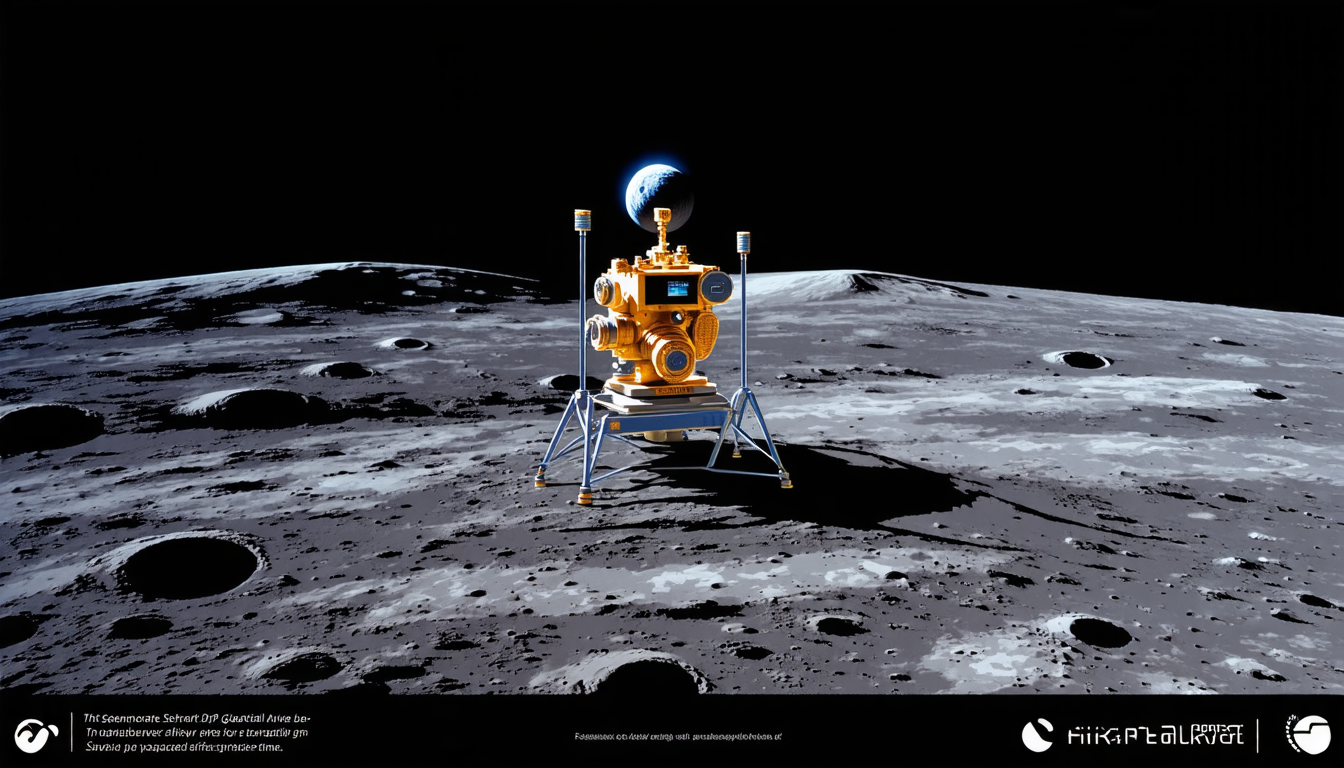
Enter the lunar detector. By placing a highly sensitive seismometer on the Moon’s surface, scientists believe they could create a much more effective way to detect gravitational waves. The Moon’s lack of atmosphere means that it is much quieter than the Earth, allowing for a much clearer signal to be detected.
The new study used advanced computer simulations to model the performance of the lunar detector. They found that it would be able to detect gravitational waves with frequencies as low as 1 millihertz, which is many times more sensitive than current Earth-based detectors.
But what does this mean? The detection of gravitational waves could potentially reveal secrets about the universe that are currently beyond our grasp. For example, scientists believe that massive black holes may have formed in the early universe and merged to create even larger ones. The detection of these events could provide insight into how the universe evolved over billions of years.
The lunar detector is not just a theoretical concept – it’s already being planned for development. NASA and other space agencies are working on a mission to deploy a network of seismometers on the Moon’s surface in the coming years. This would allow scientists to test the technology and make the first-ever detection of gravitational waves from space.
The potential implications of this breakthrough are enormous. By detecting gravitational waves, scientists could gain a deeper understanding of the universe and its many mysteries. And with the lunar detector, they may be able to do it in a way that’s more effective and accurate than ever before.
Cite this article: “Lunar Detector Could Revolutionize Gravitational Wave Research”, The Science Archive, 2025.
Gravitational Waves, Spacetime, Einstein, Black Holes, Neutron Stars, Lunar Detector, Seismometer, Moon, Nasa, Space Agencies.





