

Thursday 20 March 2025
Scientists have made a significant breakthrough in understanding the behavior of tiny light pulses, known as dark pulses, which can be used to generate extremely pure microwave signals. These signals are crucial for many modern technologies, including wireless communication systems and navigation.
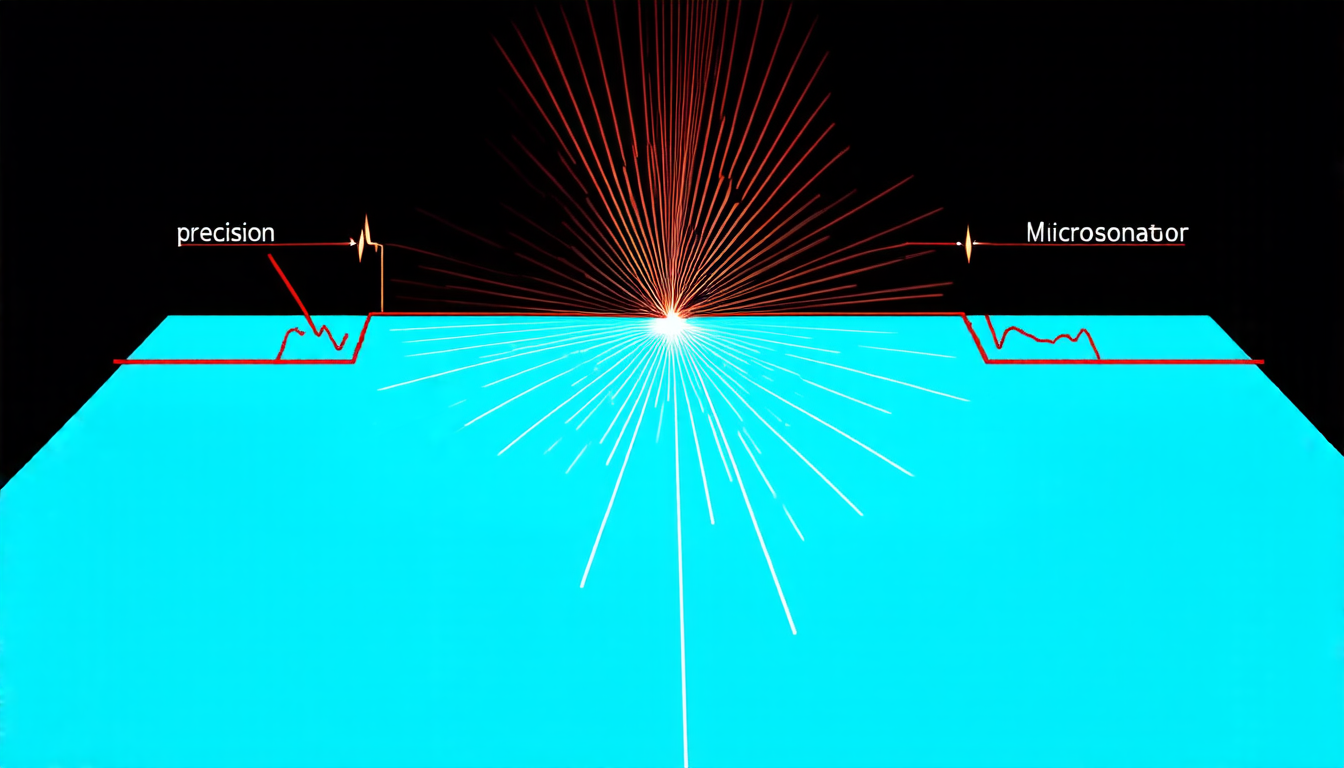
The researchers studied the interaction between a laser and an optical microresonator, a device that confines light within its boundaries. By carefully tuning the frequency of the laser, they were able to create dark pulses that oscillate at incredibly precise frequencies.
One of the most fascinating aspects of this discovery is the phenomenon of noise quenching. Noise quenching occurs when the dark pulse repetition rate becomes synchronized with the natural frequency of the microresonator. This synchronization has a remarkable effect on the phase noise of the microwave signal, effectively reducing it to nearly zero.
The significance of this finding cannot be overstated. Phase noise is a major limiting factor in many applications that rely on precise timing and frequency control. By eliminating or significantly reducing phase noise, researchers can develop more accurate and reliable systems for wireless communication, navigation, and other fields.
To achieve this synchronization, the team used a technique called self-injection locking (SIL), which involves coupling the laser to the microresonator in such a way that the light pulses are amplified and re-emitted at the same frequency as the microresonator. This process is repeated multiple times, allowing the dark pulse repetition rate to become synchronized with the natural frequency of the microresonator.
The researchers demonstrated their technique using three different laser-microresonator combinations, each with a distinct resonance frequency. In every case, they observed the noise quenching phenomenon and measured the resulting reduction in phase noise.
The implications of this discovery are far-reaching. For instance, it could enable the development of more accurate timing systems for wireless communication networks, allowing for faster data transfer rates and more reliable connections. Similarly, it could improve the precision of navigation systems like GPS, enabling better location tracking and reduced errors.
Furthermore, this breakthrough has the potential to revolutionize the field of optics and photonics. By understanding how dark pulses interact with microresonators, scientists can develop new devices that harness the power of these interactions to generate even more precise microwave signals.
In summary, researchers have made a significant advancement in the study of dark pulses and their applications.
Cite this article: “Unlocking the Power of Dark Pulses: A Breakthrough in Microwave Signal Generation”, The Science Archive, 2025.
Dark Pulses, Microwave Signals, Laser-Microresonator, Noise Quenching, Phase Noise, Wireless Communication, Navigation, Optical Microresonator, Self-Injection Locking, Optics And Photonics





