

Thursday 20 March 2025
Scientists have made a significant breakthrough in understanding the mysterious rings of light that surround black holes. By analyzing the visibility function, which is the mathematical representation of the interference pattern created by the combination of signals from different telescopes, researchers have been able to determine the size and shape of these rings with unprecedented accuracy.
The study focused on the event horizon telescope (EHT), a network of radio telescopes that work together to form a virtual Earth-sized telescope. The EHT is capable of capturing high-resolution images of black holes, but its resolution is limited by the quality of the data it collects. By analyzing the visibility function, researchers were able to improve the resolution of the EHT’s images and gain new insights into the nature of black holes.
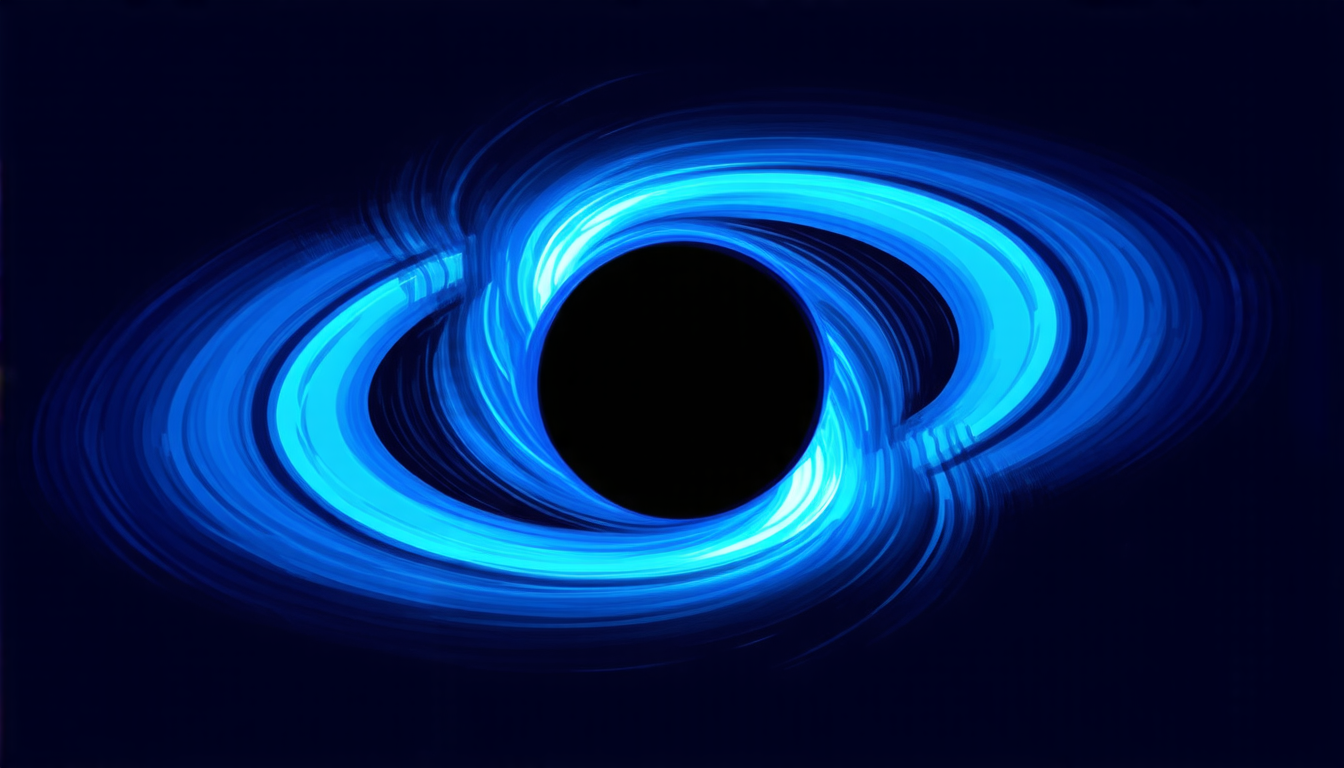
One of the key findings of the study was that the rings of light surrounding black holes are much larger than previously thought. In fact, they can be thousands of times larger than the event horizon itself, which is the point of no return around a black hole. This has significant implications for our understanding of how black holes interact with their surroundings and how they affect the formation of stars and galaxies.
The study also found that the rings are not uniform in shape or size, but rather have complex structures that vary depending on the orientation of the telescope and the properties of the black hole. This complexity is due to the way that light behaves as it approaches a black hole, with different frequencies of light being affected by the strong gravitational field in different ways.
The researchers used a combination of theoretical modeling and computer simulations to analyze the visibility function and determine the size and shape of the rings. They found that the accuracy of their measurements was limited by the quality of the data they collected, but that further improvements in telescope technology could lead to even more precise measurements in the future.
The study has significant implications for our understanding of black holes and the behavior of light in strong gravitational fields. It also highlights the potential of the EHT to make new discoveries about these enigmatic objects, which are still poorly understood despite being studied extensively by astronomers for decades.
In the future, researchers plan to use the EHT to study a variety of different black holes, including those at the centers of galaxies and those that are thought to have formed in the early universe. They hope to gain new insights into the properties of these objects and how they affect their surroundings, which could ultimately help us better understand the formation and evolution of the universe as a whole.
Cite this article: “Unlocking the Secrets of Black Hole Rings”, The Science Archive, 2025.
Black Holes, Event Horizon Telescope, Eht, Visibility Function, Rings Of Light, Gravitational Field, Strong Gravity, Telescope Technology, Computer Simulations, Astrophysics





