

Thursday 20 March 2025
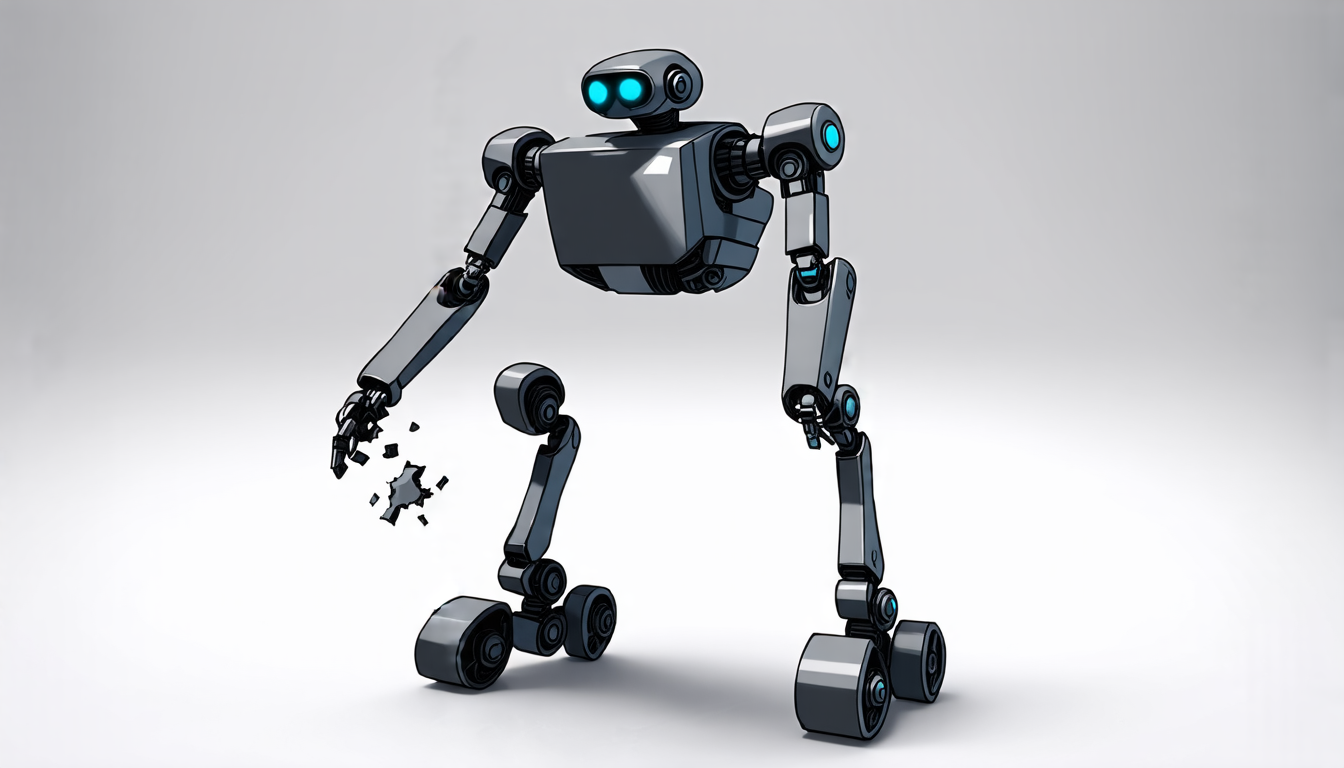
As robots become increasingly sophisticated, their ability to adapt to unexpected malfunctions is crucial for their effective deployment in real-world applications. A new approach has been developed to enhance the resilience of legged robots against joint malfunctions.
Legged robots are designed to mimic human movement and have gained popularity in various fields such as search and rescue, healthcare, and entertainment. However, they are prone to damage due to their complex mechanical structure and exposure to harsh environments. When a legged robot suffers from a malfunction, its ability to perform tasks is significantly compromised.
Researchers have been working on developing methods to improve the robustness of legged robots against joint malfunctions. One approach is to train robots in multiple scenarios to prepare them for unexpected events. However, this method has limitations as it requires extensive data and computational resources.
A more promising solution involves a novel training framework called Unified Malfunction Controller (UMC). UMC is designed to enable legged robots to adapt to joint malfunctions by incorporating a masking mechanism that prevents the robot from relying on malfunctioning limbs. This allows the robot to adjust its movement patterns and ensure successful task completion.
The effectiveness of UMC was tested in various damage scenarios, including sensor failures, motor limitations, and velocity constraints. The results showed significant improvements in task completion rates compared to traditional methods. For instance, in a scenario where a robot’s joint is damaged, UMC enabled the robot to complete tasks with an average success rate of 95%, whereas traditional methods achieved only 60%.
The UMC framework has several advantages over existing approaches. It requires minimal additional computational resources and can be easily integrated into existing robotic systems. Moreover, it allows robots to adapt to a wide range of damage scenarios, making it more versatile than other methods.
While the development of UMC is a significant step towards improving the resilience of legged robots, there are still challenges to overcome. For instance, the framework requires precise monitoring and control of joint malfunctions, which can be complex in real-world environments.
In the future, researchers plan to further develop and refine the UMC framework to enable it to work seamlessly with different robotic systems and environments. This will involve testing the framework in various scenarios and refining its algorithms to ensure optimal performance.
The development of UMC has significant implications for the field of robotics and beyond. As robots become increasingly integrated into our daily lives, their ability to adapt to unexpected events is crucial for ensuring safe and efficient operation.
Cite this article: “Enhancing Legged Robot Resilience with Unified Malfunction Controller”, The Science Archive, 2025.
Robots, Legged Robots, Joint Malfunctions, Malfunction Controller, Unified Malfunction Controller, Umc, Robotic Systems, Resilience, Robotics, Adaptation.





