

Thursday 20 March 2025
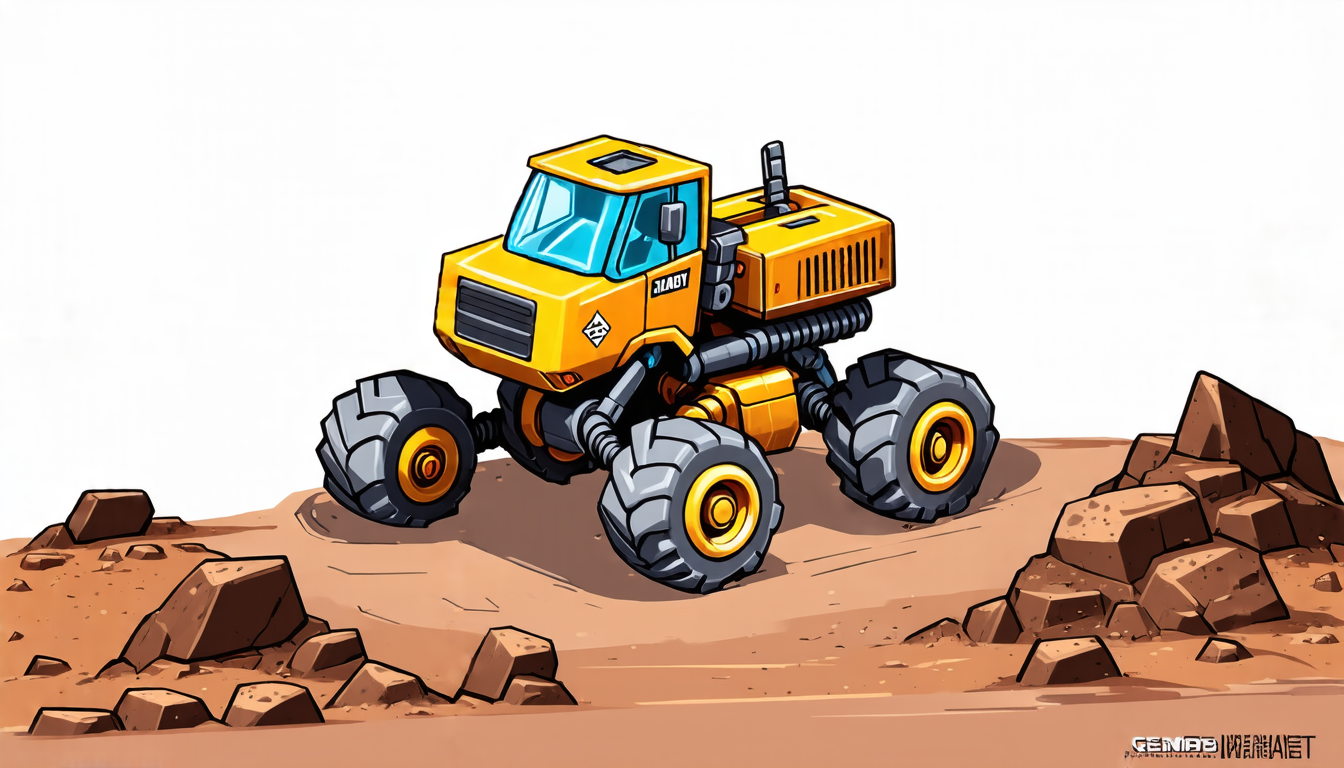
The quest for fault-tolerant control of heavy-duty wheeled mobile robots has long been a challenge in the field of robotics and automation. These behemoths are designed to operate in harsh environments, navigating rough terrain and handling heavy loads, but their complexity and interconnectedness also make them prone to failures. When one or more components malfunction, the entire system can come crashing down, putting operators at risk.
To mitigate this issue, researchers have developed a model-free hierarchical control with fault accommodation (MFHCA) framework that’s specifically designed for hydraulically powered heavy-duty wheeled mobile robots with independently controlled wheels. In other words, they’ve created a robust control strategy that can adapt to and compensate for various faults in real-time.
The MFHCA framework works by generating appropriate power efforts in each wheel to accommodate the adaptive isolation of faults. This ensures exponential stability, even when one or more components fail. The system is able to detect and respond to sensor and actuator faults, as well as hydraulic system failures, by leveraging a novel mathematical representation of the motion dynamics.
The researchers demonstrated the effectiveness of their MFHCA framework through experimental analysis on a 6,500-kg hydraulic-powered heavy-duty wheeled mobile robot. They tested the system under various fault modes and rough terrain conditions, showing that it can maintain stability and control even in the face of adversity.
One of the key benefits of this approach is its ability to adapt to unknown faults without requiring prior knowledge or training data. This makes it an attractive solution for applications where failures are unpredictable or rare, but catastrophic when they occur.
The MFHCA framework also offers significant improvements over traditional fault-tolerant control strategies, which often rely on complex modeling and simulation. By eliminating the need for precise mathematical models of the system, the researchers have developed a more practical and scalable approach that can be applied to a wide range of robotic systems.
While this research has far-reaching implications for the development of heavy-duty wheeled mobile robots, its applications extend beyond these specialized vehicles. The MFHCA framework could also be used in other areas where fault-tolerant control is critical, such as aerospace, automotive, and industrial automation.
Overall, the MFHCA framework represents a significant step forward in the quest for reliable and robust control of complex robotic systems. By providing a flexible and adaptive solution to fault tolerance, it has the potential to improve safety, efficiency, and overall performance across a range of industries and applications.
Cite this article: “Fault-Tolerant Control Framework for Heavy-Duty Wheeled Mobile Robots”, The Science Archive, 2025.
Heavy-Duty Wheeled Mobile Robots, Fault-Tolerant Control, Model-Free Hierarchical Control, Hydraulic Systems, Adaptive Isolation, Exponential Stability, Sensor Faults, Actuator Faults, Robotic Systems, Automation.





