

Thursday 20 March 2025
The pursuit of formal proof generation has long been a holy grail for mathematicians and computer scientists alike. For years, researchers have been working on developing algorithms that can automatically prove mathematical theorems, but progress has been slow-going. That is, until recently.
A team of researchers has made significant strides in this field by combining two seemingly disparate technologies: large language models and formal proof generation. The result is a system that can not only generate proofs for simple mathematical statements but also scale up to tackle more complex problems.
The key innovation here lies in the use of large language models, specifically ChatGPT, which are typically used for natural language processing tasks like text generation or translation. By fine-tuning these models on a dataset of formal mathematics, the researchers were able to adapt them to generate proofs that adhere to strict mathematical rules and conventions.
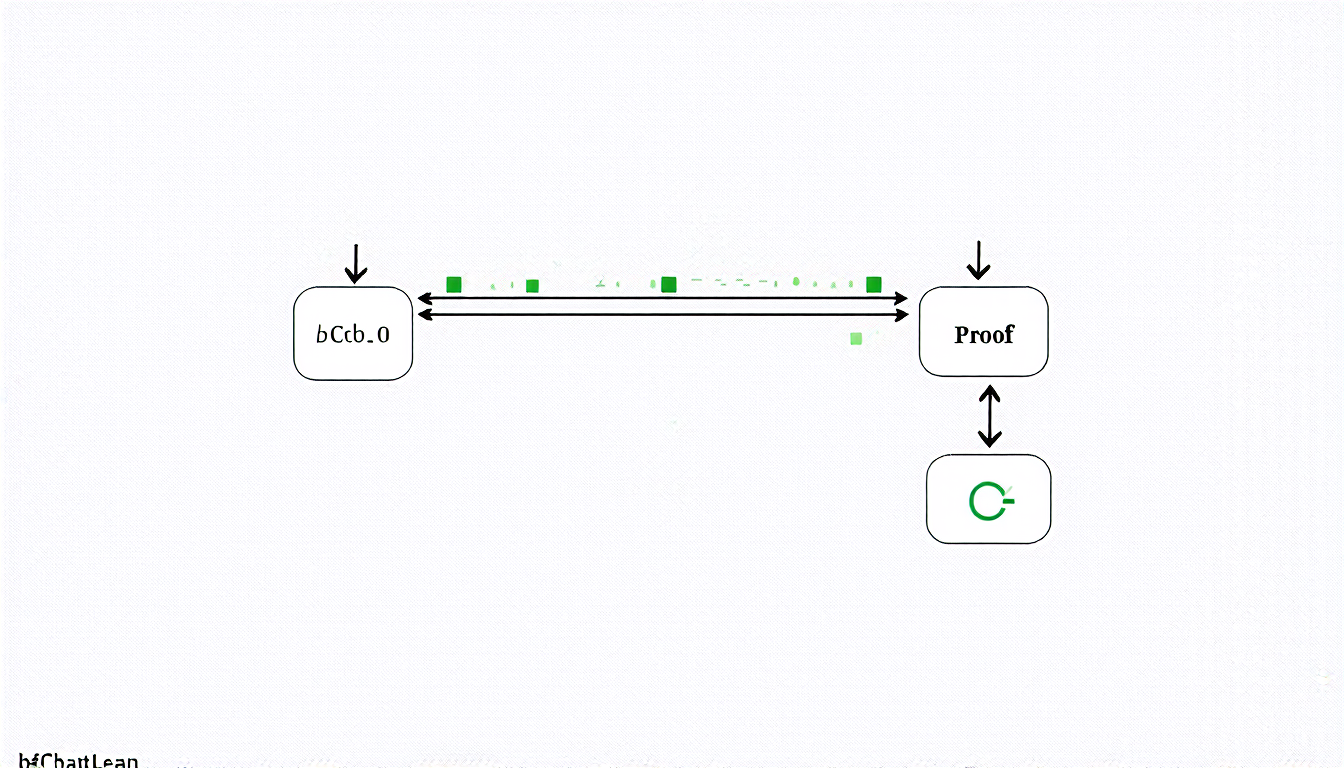
The system, dubbed bChatLean, works by first generating a proof sketch – a high-level outline of the proof – using the language model. This is then fed into a second stage, where a proof search algorithm refines the proof sketch into a complete, formal proof.
One of the most impressive aspects of this system is its ability to scale up to tackle more complex problems. By leveraging the strengths of both the language model and the proof search algorithm, bChatLean is able to generate proofs for mathematical statements that would be challenging or even impossible for humans to prove by hand.
But what does this mean in practical terms? For one, it has significant implications for education. Imagine being able to use a tool like bChatLean to help students learn and understand complex mathematical concepts more easily. No longer would they have to struggle through lengthy proofs or rely on rote memorization – instead, they could focus on the underlying ideas and principles.
Another potential application is in the field of artificial intelligence itself. As AI systems become increasingly sophisticated, they will need to be able to reason about and prove mathematical statements in order to make informed decisions. bChatLean represents a significant step towards achieving this goal.
Of course, there are still many challenges to overcome before bChatLean can be deployed in real-world settings. For one, the system is currently limited to generating proofs for relatively simple mathematical statements – more complex problems will require further development and refinement.
Additionally, there are concerns about the potential biases and limitations of large language models like ChatGPT.
Cite this article: “Formal Proof Generation with Large Language Models”, The Science Archive, 2025.
Mathematics, Artificial Intelligence, Proof Generation, Formal Proof, Natural Language Processing, Large Language Models, Chatgpt, Bchatlean, Education, Ai Systems





