

Thursday 20 March 2025
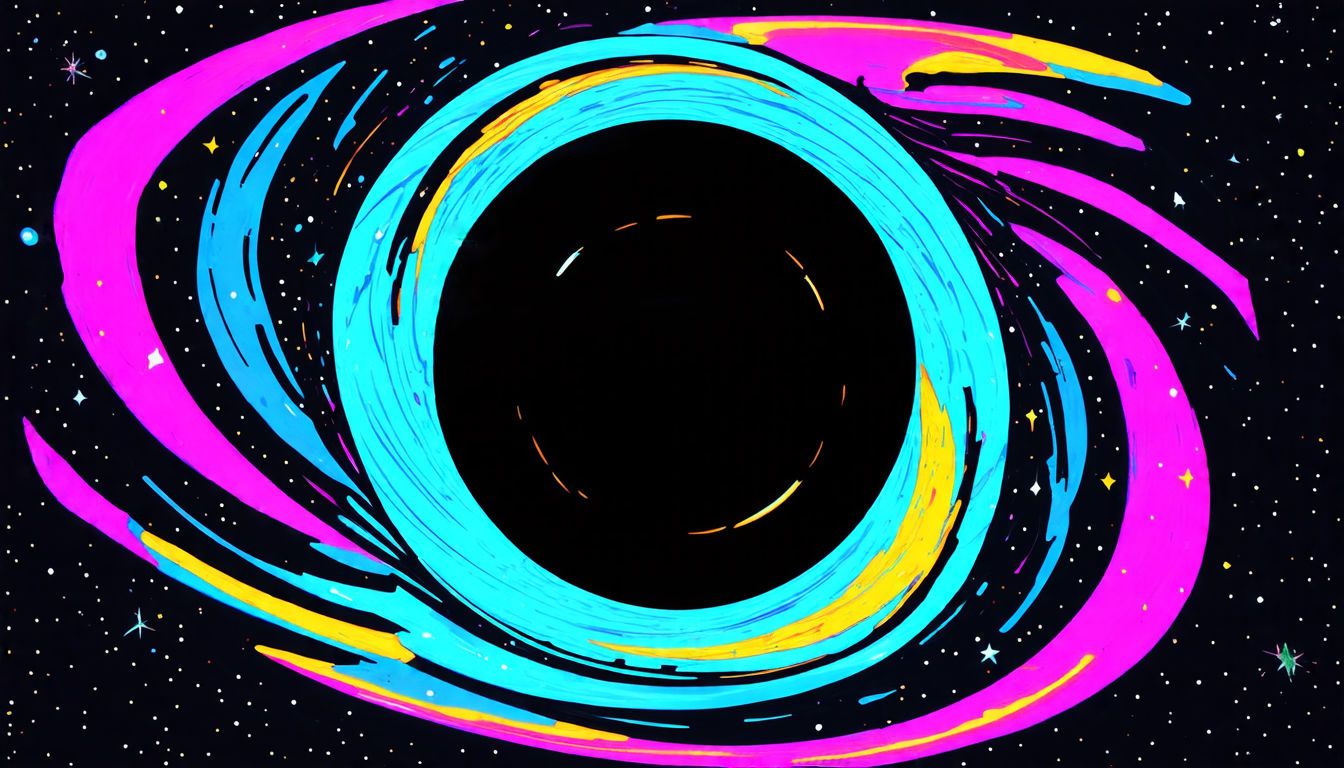
Scientists have long been fascinated by the mysteries of black holes, those regions of spacetime where gravity is so strong that nothing, not even light, can escape once it gets too close to the event horizon. Now, a new study has shed some light on the nature of these cosmic monsters, revealing that they may be more flexible than previously thought.
Researchers used a mathematical technique called noncommutative geometry to explore the properties of black holes in greater detail. Noncommutative geometry is a way of describing spacetime using mathematical objects called algebras, which can be thought of as abstract representations of the fundamental laws of physics. By applying this technique to the study of black holes, scientists were able to gain insight into their internal structure and behavior.
One of the key findings of the study was that noncommutative geometry allows for a greater range of possibilities in the description of black hole spacetime than traditional methods. This means that scientists may be able to describe more complex and nuanced behaviors in these objects, which could have important implications for our understanding of the universe as a whole.
For example, the researchers found that their noncommutative approach revealed new types of black holes that are not possible within the framework of traditional geometry. These new black holes have different properties than those described by Einstein’s theory of general relativity, and they may be able to provide new insights into the nature of spacetime itself.
Another important discovery made by the scientists was that noncommutative geometry can help to explain some of the strange phenomena observed in the vicinity of black holes. For example, it has long been known that the gravity of a black hole warps the fabric of spacetime around it, creating a region known as the ergosphere where the curvature is so strong that any object entering this region will be pulled inexorably towards the event horizon.
However, traditional geometry was unable to fully explain why this happens. The noncommutative approach, on the other hand, revealed that the ergosphere is actually a result of the interplay between the gravity of the black hole and the properties of spacetime itself. This discovery could have important implications for our understanding of the behavior of objects in strong gravitational fields.
The study also highlighted the potential for noncommutative geometry to provide new insights into the behavior of matter and energy in extreme environments, such as those found near black holes or neutron stars.
Cite this article: “Unlocking the Secrets of Black Holes with Noncommutative Geometry”, The Science Archive, 2025.
Black Holes, Noncommutative Geometry, Spacetime, Gravity, Event Horizon, Ergosphere, General Relativity, Neutron Stars, Cosmic Monsters, Mathematical Technique





