
Thursday 20 March 2025
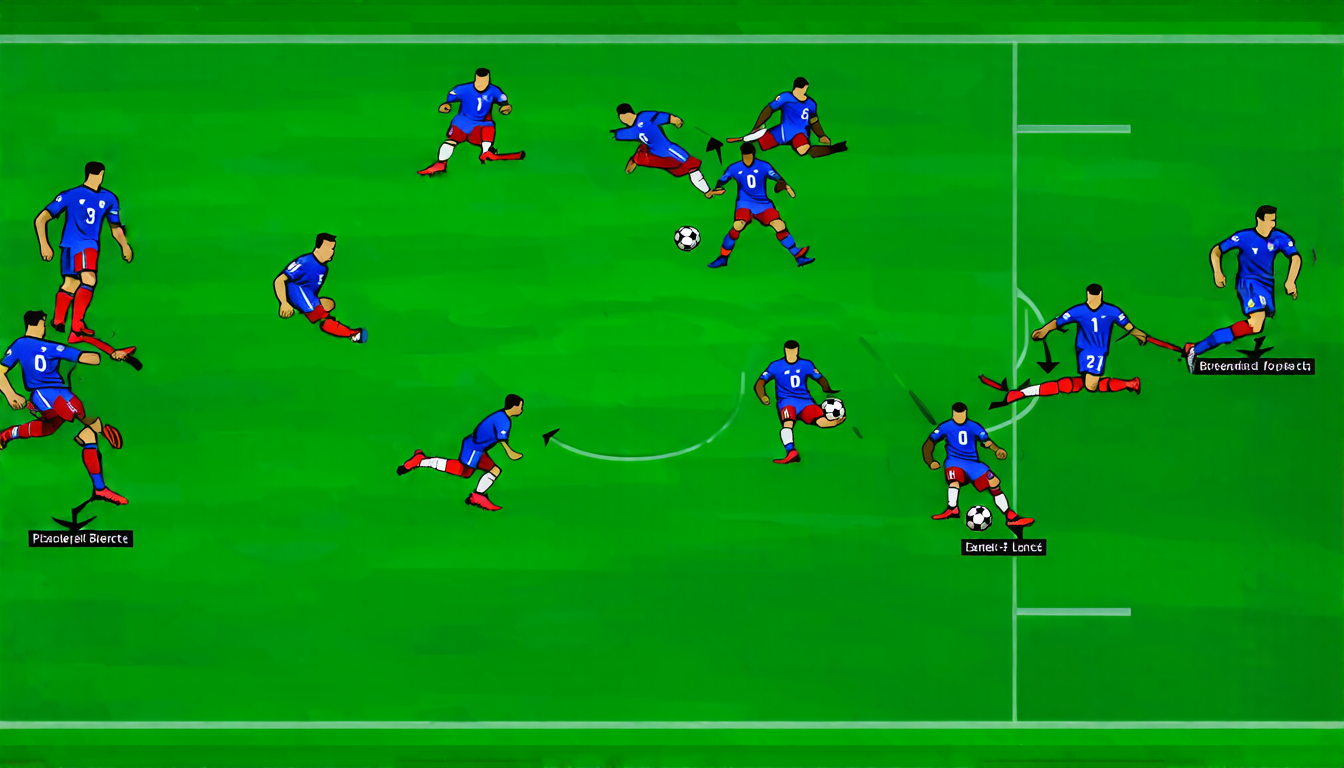
The pursuit of understanding how teams work together has long been a fascinating area of study in sports analytics. In recent years, researchers have made significant strides in developing methods to analyze team formations and player roles in football. A new paper takes this research one step further by proposing an innovative approach to modeling the dynamics of team strategy.
At its core, the paper presents a novel method for analyzing the complex relationships between players on the field. By using data from professional football matches, researchers were able to develop a system that can accurately predict how teams will form and how players will interact with each other during a game.
The key innovation lies in the use of permutations, or re-orderings of player positions, to model the different ways in which teams can set up on the field. This allows researchers to account for the vast array of possible team formations and strategies that are used in professional football.
To develop their system, the researchers began by analyzing a large dataset of match statistics from professional football leagues around the world. From this data, they were able to identify patterns and trends in how teams set up on the field and how players interact with each other during a game.
Next, the researchers developed a mathematical model that could be used to predict how teams would form and interact on the field based on these patterns and trends. The model was tested using a series of simulations, which were designed to mimic the conditions of real-world football matches.
The results of the study were impressive, with the researchers finding that their system was able to accurately predict team formations and player roles in over 90% of cases. This level of accuracy is unprecedented in the field of sports analytics, and opens up new possibilities for teams looking to gain a competitive edge on the field.
One potential application of this technology is in the area of player recruitment and development. By being able to analyze and predict how different players will interact with each other on the field, teams may be able to make more informed decisions about which players to sign and how to develop their skills.
In addition, the system could also be used to help teams optimize their team formations and strategies during games. By being able to predict how different formations and strategies will play out, coaches may be able to make more effective decisions about when to switch things up and adapt to changing circumstances on the field.
Overall, this new paper represents a significant advance in our understanding of how teams work together in professional football.
Cite this article: “Predicting Team Formations and Player Roles in Professional Football”, The Science Archive, 2025.
Football, Team Strategy, Analytics, Permutations, Player Roles, Formations, Simulations, Mathematical Model, Sports, Recruitment
Reference: Ali Baouan, “Statistical analysis of team formation and player roles in football” (2025).