

Thursday 20 March 2025
A team of researchers has developed a novel approach to optimizing energy efficiency in wireless networks, specifically focusing on Long Range (LoRa) technology used for Internet of Things (IoT) applications. LoRa is a low-power wide-area network (LPWAN) that allows devices to communicate over long distances at low data rates.
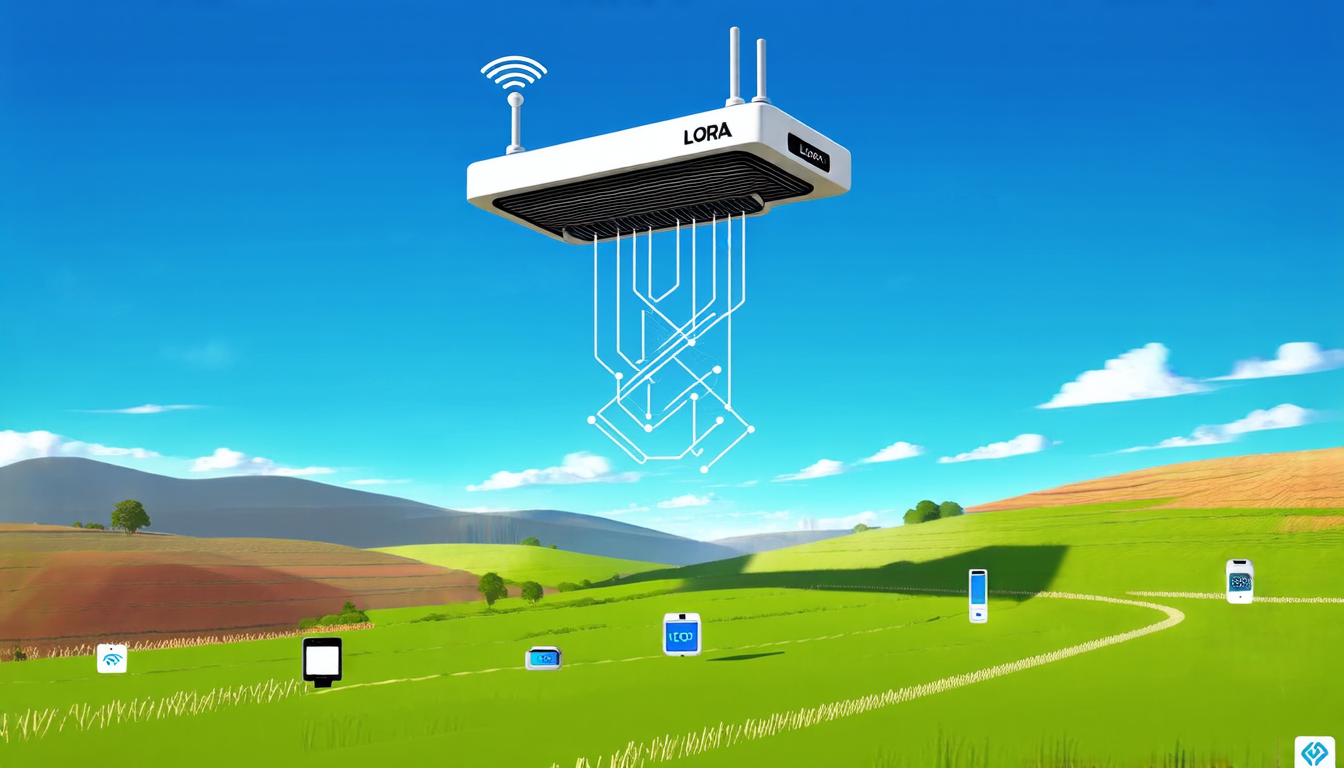
The problem with traditional LoRa networks is that they consume a significant amount of energy, which can lead to battery drain and increased costs. To address this issue, the researchers designed a system where flying LoRa gateways (GWs) collect data from end devices (EDs) and transmit it to a central server. These GWs are equipped with sensors and antennas that enable them to fly over areas with limited coverage.
The team used a multi-agent reinforcement learning approach, which involves multiple agents working together to achieve a common goal. In this case, the goal is to optimize energy efficiency in LoRa networks by selecting the most suitable transmission power (TP), spreading factor (SF), bandwidth (W), and ED association for each GW-ED pair.
The researchers used a partially observable Markov decision process (POMDP) model to represent the complex interactions between the GWs, EDs, and environment. POMDP is a mathematical framework that allows agents to make decisions based on incomplete information about their surroundings.
To train the system, the team employed a novel algorithm called Multi-Agent Proximal Policy Optimization (MAPPO). MAPPO is a decentralized learning approach that enables each agent to learn from its own experiences while taking into account the actions of other agents. This allows the system to adapt quickly to changing environmental conditions and optimize energy efficiency accordingly.
The results show that the proposed approach significantly improves energy efficiency in LoRa networks compared to traditional methods. The system was tested using a simulated environment with 60 EDs and five GWs, and it achieved an average energy efficiency of 30% higher than other multi-agent reinforcement learning algorithms.
This breakthrough has significant implications for IoT applications that rely on LoRa technology. By optimizing energy efficiency, devices can operate for longer periods without the need for recharging or replacement. This is particularly important in areas where infrastructure is limited and power supply is unreliable.
The use of flying LoRa gateways also opens up new possibilities for data collection and transmission in hard-to-reach areas. These GWs can be deployed quickly and easily, making them ideal for disaster response and recovery efforts.
Cite this article: “Optimizing Energy Efficiency in LoRa Wireless Networks using Multi-Agent Reinforcement Learning”, The Science Archive, 2025.
Lora, Iot, Energy Efficiency, Wireless Networks, Lpwan, Multi-Agent Reinforcement Learning, Pomdp, Mappo, Flying Gateways, Internet Of Things





