

Thursday 20 March 2025
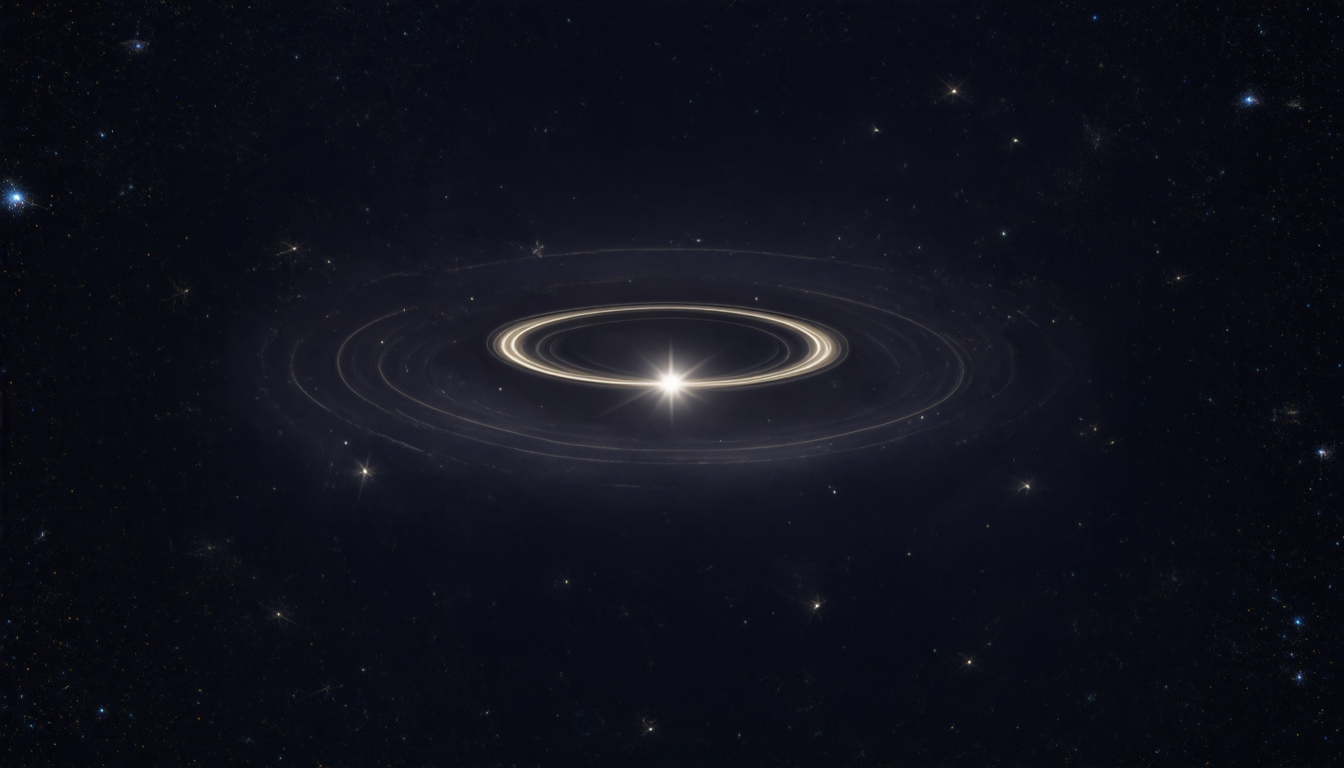
Astronomers have long been fascinated by the mysterious disks of debris that surround many stars, known as exoplanetary systems. These rings of dust and rock can provide valuable clues about how planets form and evolve, but they’re often shrouded in mystery due to their distant location and faint signals.
Recently, a team of researchers made a significant breakthrough in understanding these enigmatic disks by studying the effects of the interstellar medium (ISM) on nearby debris systems. The ISM is the material that fills the space between stars, including gas and dust that can affect the formation and evolution of planetary systems.
The study focused on 295 nearby FGK dwarf stars, which are similar to the Sun, using data from the Herschel Space Observatory’s DUNES and DEBRIS surveys. By analyzing the infrared light emitted by these stars at 100 and 160 micrometers, the team was able to detect the presence of debris disks around many of them.
The researchers found that the occurrence rate of debris disks decreased as the speed of the star increased. In other words, stars with higher space velocities were less likely to have debris disks surrounding them. This suggests that the ISM plays a significant role in shaping the formation and evolution of these systems.
The team also discovered that the fractional luminosity of debris disks – a measure of how much energy they emit relative to their host star – decreased as the speed of the star increased. This implies that the ISM can strip away material from the disk, reducing its overall brightness.
Furthermore, the study revealed correlations between the orientation and inclination of debris disks and the direction of their host stars’ space velocities. This could be due to the gravitational influence of nearby stars or the ISM itself, which can cause the disk to tilt or become distorted over time.
The findings have significant implications for our understanding of exoplanetary systems and the role of the ISM in shaping them. By studying debris disks and their interactions with the ISM, scientists can gain insights into the formation and evolution of planets, as well as the potential for life beyond Earth.
The research also highlights the importance of considering the ISM’s influence when searching for signs of life or studying the properties of exoplanetary systems. As astronomers continue to explore the universe, understanding the effects of the ISM on nearby debris disks will be crucial in uncovering the secrets of planetary formation and evolution.
Cite this article: “Shedding Light on Debris Disks: The Impact of Interstellar Medium on Exoplanetary Systems”, The Science Archive, 2025.
Exoplanetary Systems, Debris Disks, Interstellar Medium, Ism, Star Velocity, Planetary Formation, Evolution, Infrared Light, Herschel Space Observatory, Dunes And Debris Surveys





