

Thursday 20 March 2025
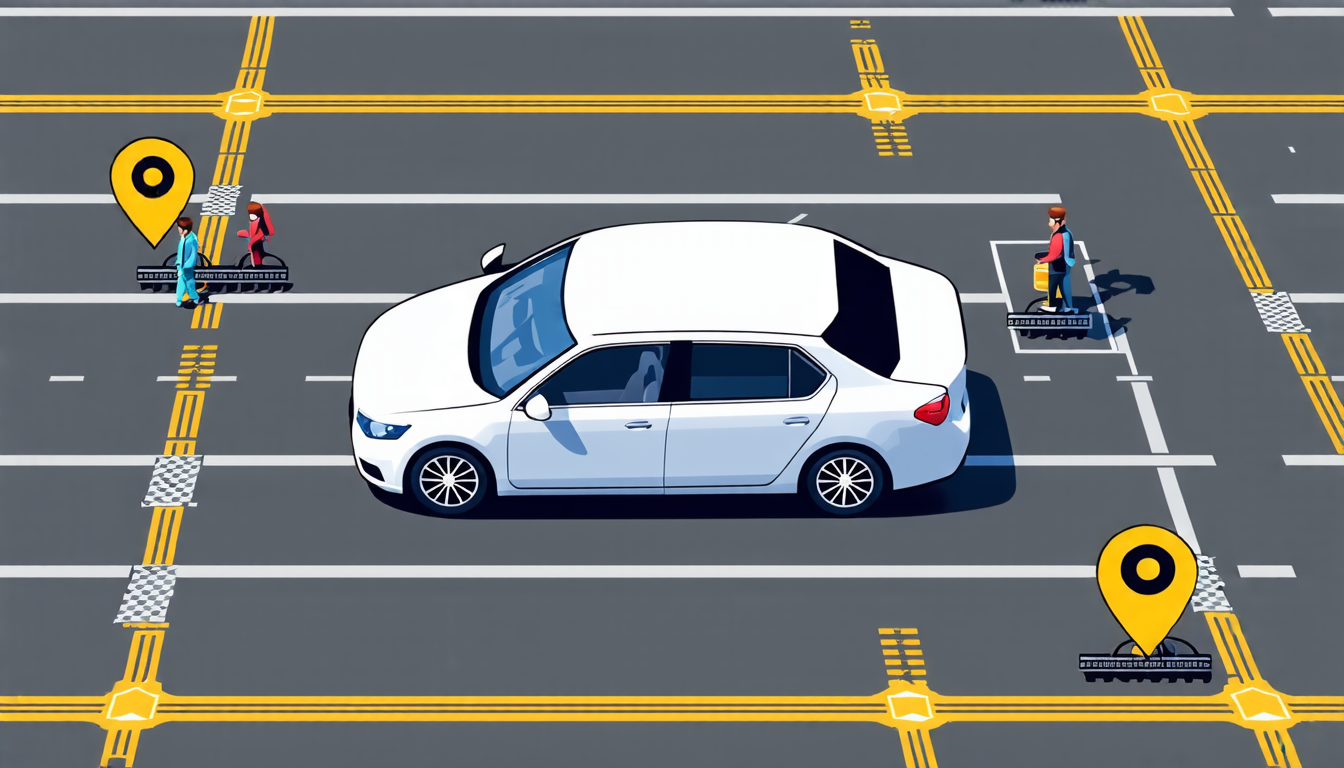
The era of semi-autonomous driving is upon us, where vehicles are gradually being introduced with varying levels of autonomy. This phase of partial automation is expected to persist for several decades due to technological and infrastructure constraints. However, researchers have been working on developing algorithms that can optimize the routing of these semi-autonomous vehicles, leading to significant cost savings.
One such algorithm, called the Vehicle Routing Problem in a Semi-Autonomous Environment (VRP-SA), has been developed to minimize the total routing cost of service in this environment. The algorithm takes into account the availability of roads suitable for autonomous vehicles and the limited resources available for real-time remote control.
The VRP-SA is based on a mixed-integer linear program that formulates the problem as an optimization problem. The program uses binary decision variables to indicate whether each edge in the road network is selected in the route, and continuous variables to represent the timestamp of the vehicle visiting each node. The objective is to find the minimum-cost tour that visits all customers exactly once.
The algorithm has been tested on a set of benchmark instances tailored for the VRP-SA, which include stratified grid road networks. The results show that the algorithm can reduce the routing cost by up to 37.5% if the fleet actively exploits the autonomous vehicle-enabled roads in the environment.
Another aspect of the research focuses on the flexibility of travel time for autonomous vehicles. In this scenario, the algorithm allows for adjusting the travel time on each road segment within a certain threshold, which further enlarges the temporal feasible space of the problem. This flexibility can lead to more efficient re-scheduling and re-routing strategies.
The VRP-SA has been tested on various scenarios, including instances with different numbers of vehicles, customers, and road segments. The results show that the algorithm is effective in reducing the routing cost and improving the efficiency of the fleet.
Overall, the VRP-SA offers a promising approach to optimizing the routing of semi-autonomous vehicles, which can lead to significant cost savings and improved efficiency. As the era of semi-autonomous driving continues to evolve, researchers will continue to develop new algorithms and strategies to optimize the performance of these fleets.
The algorithm’s effectiveness is also demonstrated by its ability to handle situations where the fleet encounters infeasible time intervals due to constraints on remote control resources. In such cases, the algorithm can re-route the vehicles to avoid these intervals, ensuring that the fleet operates efficiently despite these constraints.
Cite this article: “Optimizing Routing for Semi-Autonomous Vehicles: A Novel Algorithmic Approach”, The Science Archive, 2025.
Semi-Autonomous Driving, Vehicle Routing Problem, Mixed-Integer Linear Program, Autonomous Vehicles, Road Networks, Optimization Algorithm, Cost Savings, Fleet Management, Route Planning, Remote Control Resources.





