

Thursday 20 March 2025
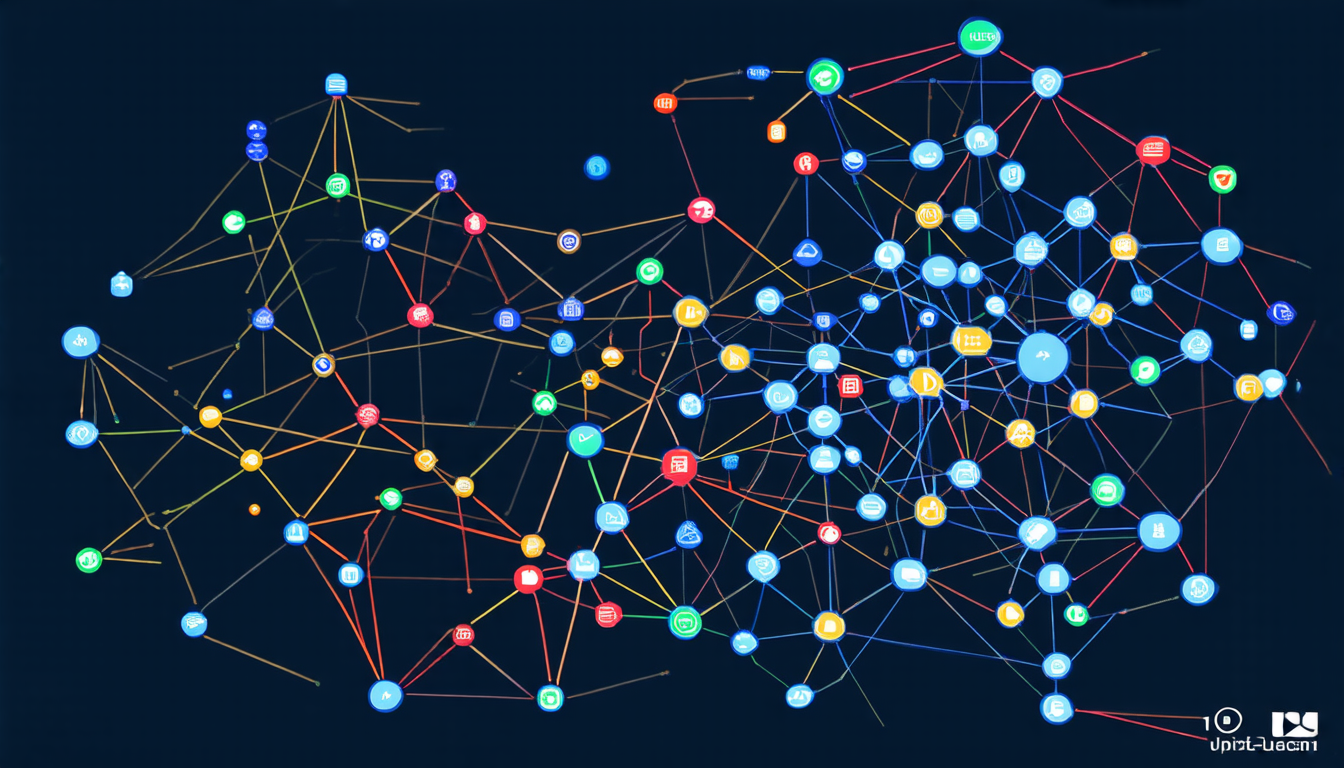
The quest for synthetic networks that mimic real-world communities has been a longstanding challenge in network science. Researchers have long sought to generate artificial networks that capture the intricate structures and patterns found in empirical networks, such as social media platforms or biological systems. A new approach, dubbed EC-SBM (Edge-Connected Stochastic Block Model), promises to deliver more realistic synthetic networks with community structure.
The EC-SBM method is designed to simulate real-world networks by generating clusters of nodes that are connected in a way that mirrors the edges found in empirical networks. The model takes into account not only the degree sequence of each node (the number of edges it has) but also the edge connectivity of each cluster, which is a key feature that sets EC-SBM apart from other synthetic network generation methods.
To generate these artificial networks, researchers first identify the clusters within an empirical network and then use a novel algorithm to create a spanning subnetwork for each cluster. This ensures that each node in the cluster has at least one edge connecting it to another node within the same cluster. The edges are then added randomly to fill out the network, while maintaining the desired degree sequence and edge connectivity.
The EC-SBM method has been tested on several real-world networks, including social media platforms and biological systems, with impressive results. The generated synthetic networks show a remarkable similarity to their empirical counterparts, with community structures that are more accurate than those produced by other methods.
One of the key benefits of EC-SBM is its ability to generate networks with realistic edge connectivity patterns. This is particularly important in fields such as sociology and biology, where understanding the relationships between nodes (or individuals or organisms) is crucial for making predictions about network behavior. By capturing these edge connectivity patterns accurately, EC-SBM provides a more nuanced picture of how real-world networks function.
The implications of this new approach are far-reaching. Synthetic networks generated using EC-SBM can be used to test community detection algorithms, evaluate the performance of clustering methods, or even simulate the spread of diseases through social networks. By providing a more realistic representation of network structures, EC-SBM has the potential to revolutionize our understanding of complex systems and how they function.
The development of EC-SBM is a significant step forward in synthetic network generation, and its applications are likely to be diverse and widespread.
Cite this article: “Simulating Realistic Networks with Edge-Connected Stochastic Block Model”, The Science Archive, 2025.
Network Science, Synthetic Networks, Community Structure, Edge Connectivity, Stochastic Block Model, Ec-Sbm, Network Generation, Clustering Methods, Social Networks, Complex Systems.





