

Friday 21 March 2025
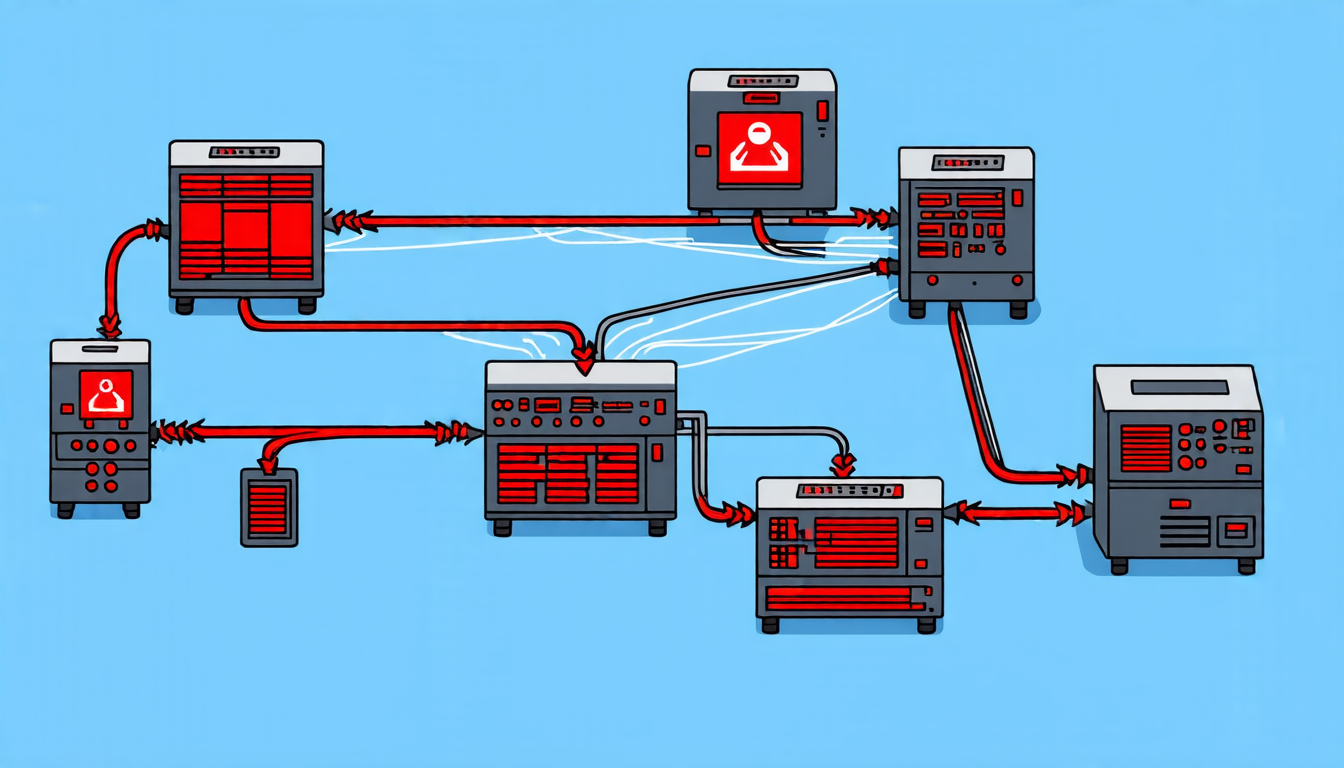
In a world where machines and humans are increasingly interconnected, ensuring that these systems function smoothly is crucial. Networked control systems (NCSs) are a prime example of this trend, where sensors, actuators, and controllers communicate over networks to manage complex processes in industries such as manufacturing, healthcare, and transportation.
However, NCSs often face challenges when it comes to data loss and limited communication capacity. In these scenarios, traditional scheduling logic can fail to ensure the stability of the system. A new study published in a recent issue of a prominent scientific journal tackles this problem head-on by designing a static scheduling logic that can stabilize NCSs under limited capacity and lossy communication networks.
The researchers tackled this complex challenge using tools from switched systems theory and graph theory. They characterized the stability of NCSs under worst-case data loss using an inequality associated with a cycle on a graph, which is then formulated as a feasibility problem to solve for certain parameters (T-factors) used to design a periodic scheduling logic.
The team’s approach involves partitioning the network into smaller sub-networks and designing separate contractive cycles within each partition. By stacking these cycles together, they created an overall contractive cycle that ensures global asymptotic stability for all plants in the network under all admissible data losses.
To illustrate this concept, consider a manufacturing system where multiple machines are connected over a shared communication network to manage production processes. Traditional scheduling logic might fail to ensure the stability of the system when data is lost or the network becomes congested. The researchers’ approach would allow for the design of a static scheduling logic that can adapt to these challenges and maintain the stability of the system.
The study’s findings have significant implications for industries that rely heavily on NCSs, such as manufacturing, healthcare, and transportation. By developing a scheduling logic that can stabilize NCSs under limited capacity and lossy communication networks, engineers can design more resilient systems that can adapt to changing conditions and ensure smooth operation.
In addition to its practical applications, the study’s innovative approach has also shed new light on the theoretical foundations of switched systems theory and graph theory. By combining these two fields, researchers can develop new insights and tools for designing complex control systems that are both efficient and stable.
Overall, this study demonstrates the importance of interdisciplinary research in addressing the challenges posed by NCSs.
Cite this article: “Stabilizing Networked Control Systems Under Limited Capacity and Lossy Communication Networks”, The Science Archive, 2025.
Networked Control Systems, Scheduling Logic, Data Loss, Limited Communication Capacity, Switched Systems Theory, Graph Theory, Feasibility Problem, Contractive Cycles, Global Asymptotic Stability, Manufacturing, Healthcare, Transportation





