

Friday 21 March 2025
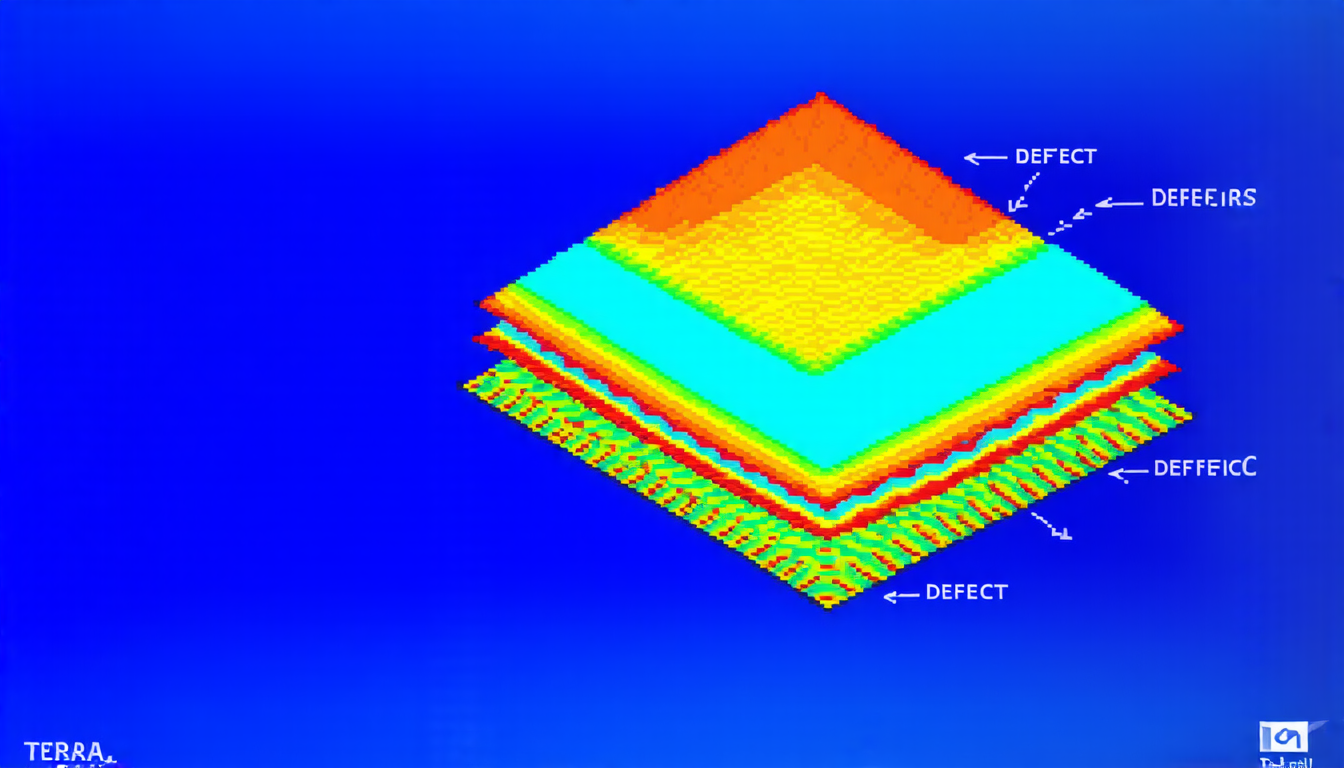
Researchers have made a significant breakthrough in developing a new technique for detecting defects in multi-layer materials, such as those used in aircraft and spacecraft. This innovative approach uses terahertz waves to identify imperfections within complex structures, allowing for more efficient and accurate inspections.
The team behind this discovery employed a unique method called echo labeling, which relies on the properties of Euclidean distance matrices. By analyzing these matrices, they were able to map higher-order reflections from defects back to their original sources. This process enabled them to pinpoint the location of imperfections with remarkable accuracy.
In traditional defect detection methods, researchers rely on single-shot techniques that emit a pulse and measure its reflection. However, this approach can be limited by noise and interference, making it difficult to accurately identify defects. The new technique, on the other hand, uses high-power laser pulses to generate terahertz radiation, which interacts with the material being inspected.
As the terahertz waves penetrate the multi-layer structure, they encounter defects and reflect back in a specific pattern. By analyzing these reflections, researchers can reconstruct the original defect locations using the echo labeling method. This approach is particularly effective for detecting imperfections that are difficult to access or visualize using traditional methods.
The significance of this breakthrough lies in its potential applications across various industries. For instance, aerospace companies can use this technique to inspect complex composite materials used in aircraft and spacecraft construction. This could lead to more efficient production processes, reduced costs, and improved safety standards.
In addition, this technology has the potential to revolutionize the field of non-destructive testing (NDT), which is crucial for ensuring the integrity of critical infrastructure such as bridges, pipelines, and buildings. By developing a more accurate and efficient method for defect detection, researchers can help prevent catastrophic failures and minimize maintenance costs.
The team’s findings have been published in a recent paper, detailing their innovative approach to multi-layer material inspection using terahertz waves. As this technology continues to evolve, it is likely to have far-reaching implications for various industries and applications. With its potential to improve safety, efficiency, and accuracy, this breakthrough has the potential to shape the future of non-destructive testing and beyond.
Cite this article: “Terahertz Waves Unlock Accurate Defect Detection in Multi-Layer Materials”, The Science Archive, 2025.
Defect Detection, Multi-Layer Materials, Terahertz Waves, Echo Labeling, Euclidean Distance Matrices, Non-Destructive Testing, Ndt, Aerospace, Composite Materials, Inspection Techniques.





