

Friday 21 March 2025
Scientists have made a significant breakthrough in developing a new way to identify and measure the energy of particles detected by high-energy physics experiments. This achievement has the potential to revolutionize our understanding of the universe and could lead to major advances in fields such as particle physics, astronomy, and medicine.
The challenge faced by physicists is that the detectors used in these experiments produce vast amounts of data, which can be difficult to analyze using traditional methods. The new approach uses a type of artificial intelligence called graph neural networks (GNNs) to identify patterns in the data and make predictions about the properties of the particles.
In traditional computer vision and machine learning applications, GNNs have been used to analyze images and videos by identifying patterns and relationships between pixels or frames. However, in particle physics, the data is fundamentally different – it’s not visual, but rather a complex network of interactions between particles.
The researchers developed a novel approach that uses proximity tables to construct graphs from the detector data. This allows the GNNs to learn about the relationships between particles and identify patterns that are difficult to detect using traditional methods.
One of the key advantages of this approach is its ability to handle irregularly shaped detectors, which are common in particle physics experiments. The researchers used a clustering algorithm called Treclus to group together nodes in the graph that are close to each other, allowing them to analyze the data more efficiently.
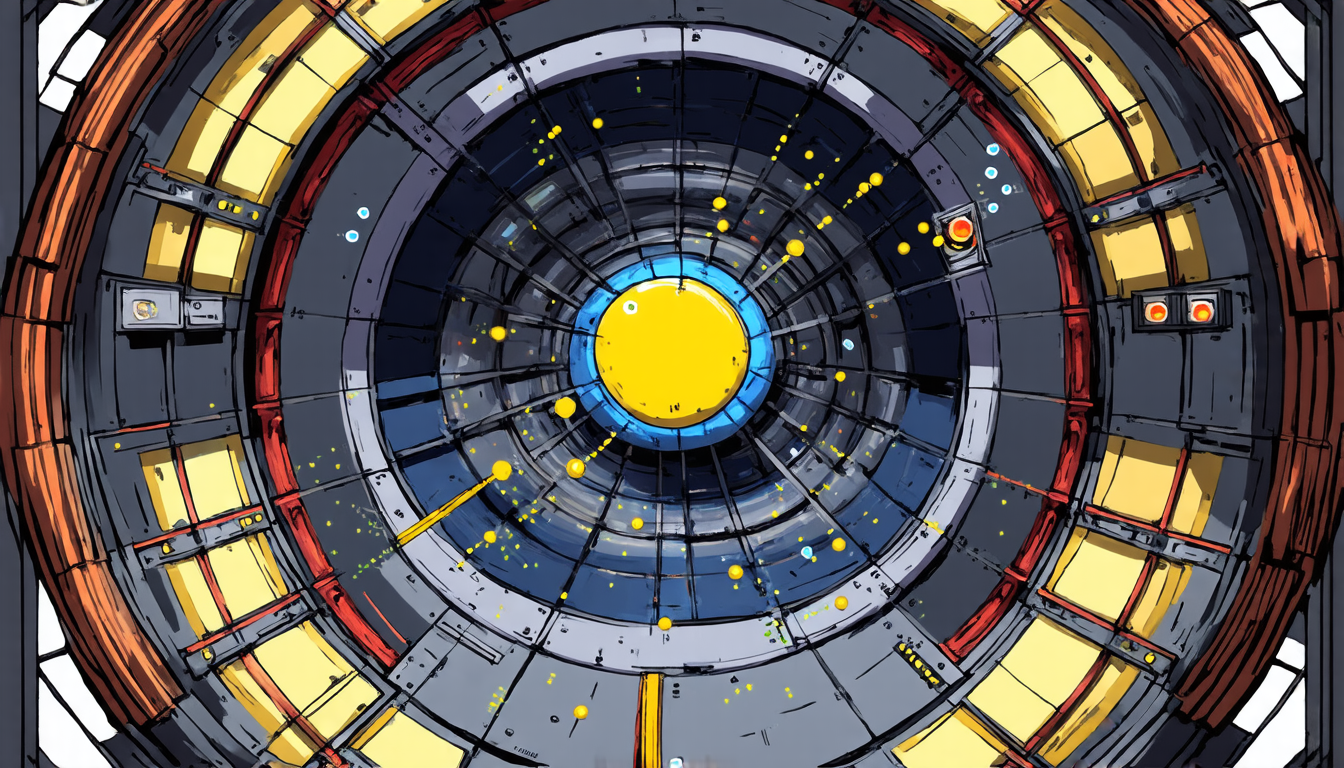
The team then trained their GNNs using a dataset of simulated particle interactions and tested them on real-world data from the CMS detector at the Large Hadron Collider. The results were impressive – the GNNs were able to accurately identify particles and measure their energy with high precision.
This breakthrough has significant implications for particle physics research. It could enable scientists to analyze large datasets more efficiently, leading to new discoveries about the fundamental nature of matter and energy. Additionally, the technology could be applied to other fields such as medicine, where it could be used to analyze complex biological data and make predictions about disease progression.
The researchers are excited about the potential of their approach and plan to continue developing and refining it. As they move forward, they will be working closely with colleagues in industry and academia to explore new applications and push the boundaries of what is possible.
This achievement highlights the power of collaboration between experts from different fields – computer science, physics, and mathematics – to tackle complex problems and make significant breakthroughs.
Cite this article: “Unlocking New Frontiers in Particle Physics with Artificial Intelligence”, The Science Archive, 2025.
Particle Physics, Artificial Intelligence, Machine Learning, Graph Neural Networks, Detector Data, Particle Interactions, Large Hadron Collider, Cms Detector, Medical Applications, Big Data Analysis.





