

Friday 21 March 2025
Scientists have made a significant breakthrough in understanding the complex behavior of networks, which are found everywhere from the internet to biological systems. By studying the currents that flow through these networks, researchers have discovered a hidden linearity that governs their behavior.
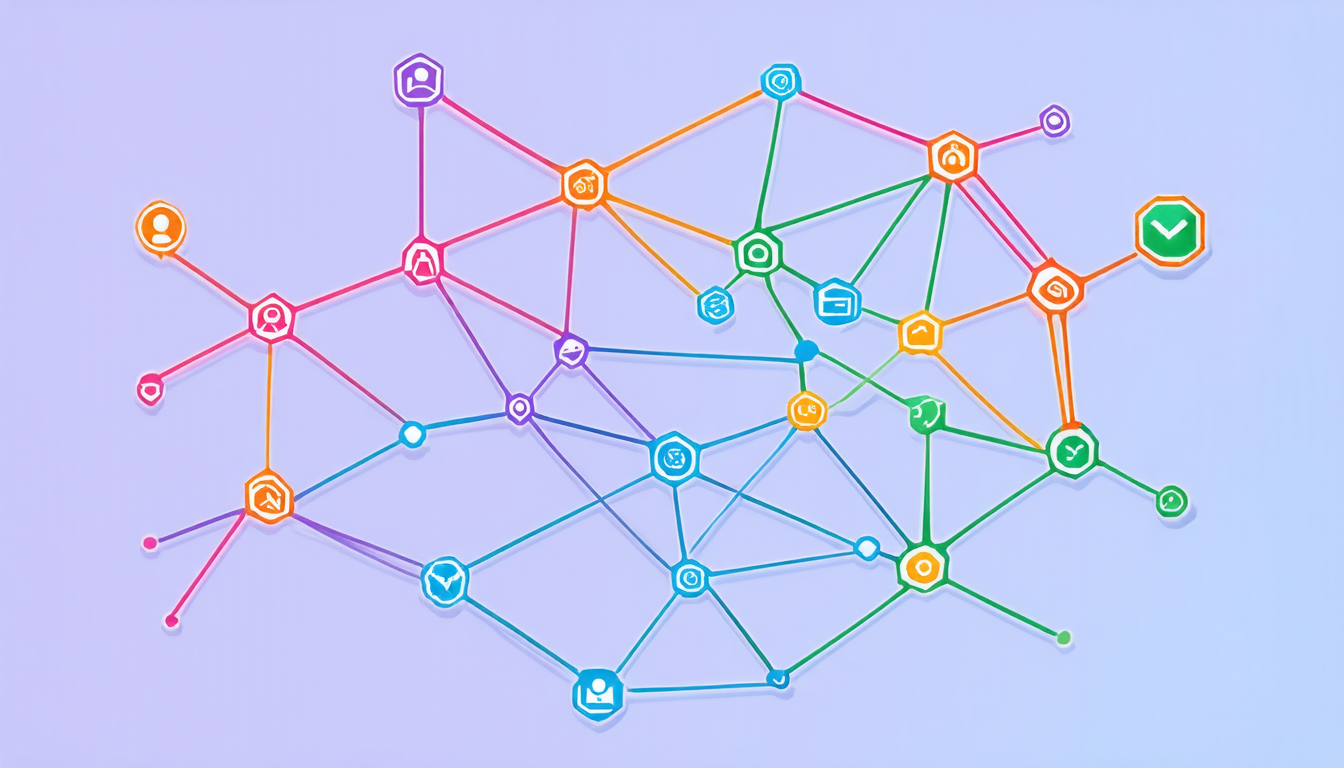
Networks are intricate structures composed of nodes and edges that connect them. When something happens at one node, it can ripple out and affect other nodes in complex ways. This is especially true for nonequilibrium systems, where the currents flowing through the network are not in balance.
In recent years, scientists have been trying to understand how these networks respond to changes. By analyzing the behavior of the currents, they’ve discovered that there’s a hidden pattern at play. When you control the current flowing through one edge, it affects the current flowing through other edges in a predictable way.
This discovery has far-reaching implications for fields like biology and computer science. In biology, networks can be used to model the behavior of complex systems like ecosystems or social networks. By understanding how these networks respond to changes, scientists can gain insights into how they function and potentially even manipulate them to achieve specific goals.
In computer science, this discovery could lead to more efficient algorithms for processing information in complex networks. By taking advantage of the hidden linearity, computers could be programmed to navigate these networks faster and more accurately.
The researchers used a combination of mathematical techniques and simulations to make their discovery. They started by analyzing the behavior of Markov chains, which are mathematical models that describe random processes. By studying how these chains interact with each other, they were able to uncover the hidden pattern.
Next, they simulated the behavior of complex networks using computer algorithms. This allowed them to test their theory and see if it held true in different scenarios. The results were striking: no matter what kind of network they looked at or how it was configured, the hidden linearity remained consistent.
This breakthrough has opened up new avenues for research into complex systems. By understanding the underlying patterns that govern their behavior, scientists can gain a deeper insight into how these systems function and potentially even manipulate them to achieve specific goals.
In the future, this discovery could have far-reaching implications for fields like biology, computer science, and physics. As researchers continue to explore the hidden linearity of complex networks, they may uncover new ways to understand and interact with these intricate systems.
Cite this article: “Uncovering Hidden Linearity in Complex Networks”, The Science Archive, 2025.
Networks, Complexity, Linearity, Currents, Nodes, Edges, Markov Chains, Simulations, Algorithms, Systems





