

Friday 21 March 2025
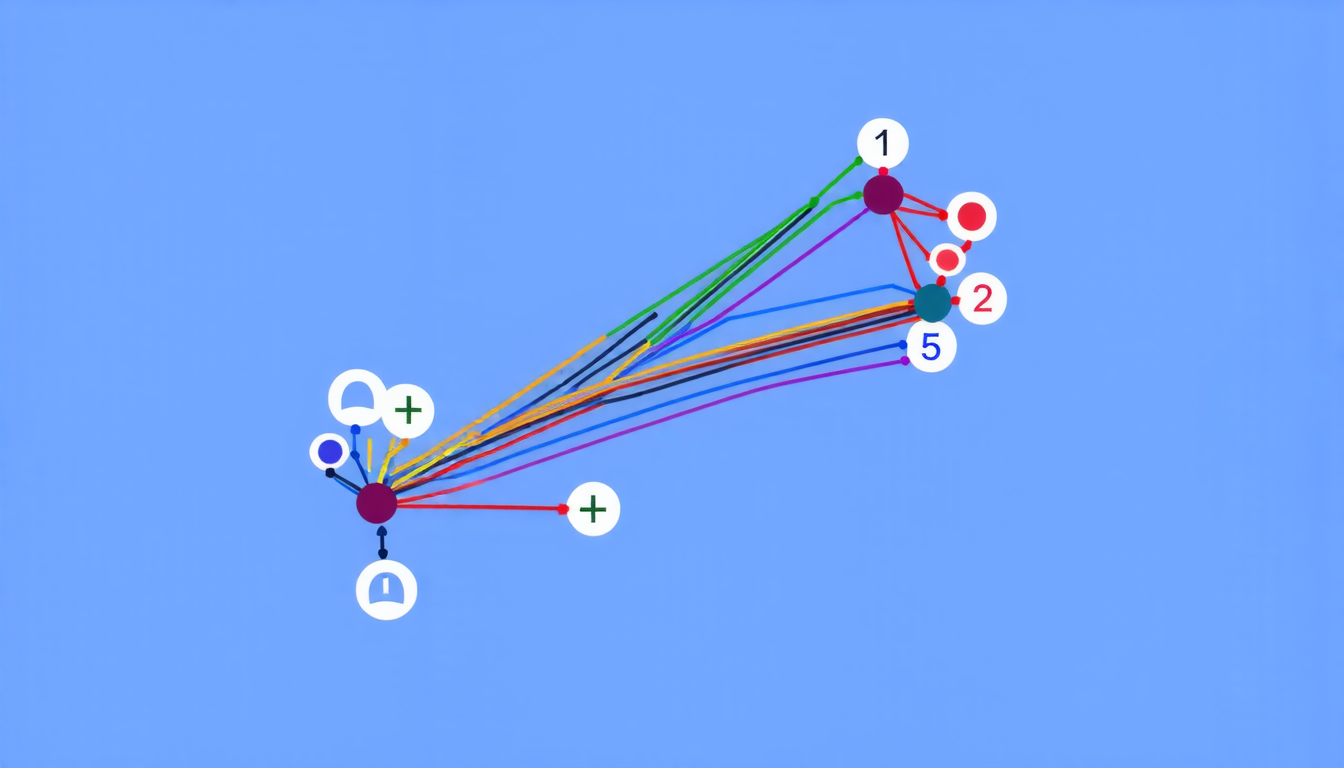
For decades, mathematicians have been fascinated by a peculiar phenomenon known as Ramsey numbers. These numbers describe how many colors are needed to ensure that any graph – a collection of dots connected by lines – cannot be colored using only those colors in a way that breaks certain rules. Sounds simple enough, but the truth is, solving these problems has proven to be an incredibly challenging task.
Recently, mathematicians have made significant progress in understanding Ramsey numbers by finding new ways to approach them. One key insight came from recognizing similarities between Ramsey theory and a concept called Galois connections. In essence, Galois connections describe how certain mathematical structures are related to each other, much like how different languages might be connected through a shared grammar.
By applying this perspective to Ramsey numbers, researchers were able to develop new tools for analyzing these complex problems. This allowed them to tackle previously intractable cases and uncover surprising patterns that had gone unnoticed before.
One of the most intriguing applications of this new approach is in understanding certain number theory problems. For instance, take the famous Twin Prime Conjecture, which states that there are infinitely many pairs of prime numbers separated by just two units (like 3 and 5, or 11 and 13). Researchers have shown that this conjecture can be rephrased as a statement about Ramsey numbers, effectively linking two seemingly unrelated areas of mathematics.
Another fascinating connection has been made between Ramsey theory and the study of prime gaps. Prime gaps refer to the differences between consecutive prime numbers (like 2 and 3, or 5 and 7). Mathematicians have long sought to understand the distribution of these gaps, with some famous results like Zhang’s theorem providing important insights.
The connection between Ramsey theory and prime gaps lies in the way that certain patterns in colorings can be used to describe the distribution of prime numbers. By analyzing these patterns, researchers hope to gain a deeper understanding of the underlying structure of prime numbers, which could have significant implications for cryptography and other areas of mathematics.
This new wave of research has also opened up exciting possibilities for exploring other long-standing problems in number theory. For example, the Polignac Conjecture – which states that there are infinitely many prime gaps of a given size – can now be reinterpreted as a statement about Ramsey numbers. This fresh perspective could lead to innovative approaches and insights that might ultimately crack these difficult problems.
Cite this article: “Unlocking Secrets: Advances in Ramsey Theory and Its Connections to Number Theory”, The Science Archive, 2025.
Mathematics, Ramsey Numbers, Graph Theory, Colorings, Galois Connections, Number Theory, Twin Prime Conjecture, Prime Gaps, Cryptography, Polignac Conjecture





