

Friday 21 March 2025
The pursuit of more efficient and adaptive artificial intelligence has led researchers to develop new techniques for fine-tuning language models. A recent paper proposes a novel approach that leverages batch-aware clustering and dynamic low-rank parameter generation to improve the performance of large language models.
Traditional fine-tuning methods, such as Low-Rank Adaptation (LoRA), involve training a model on a specific task or dataset while freezing most of its pre-trained parameters. This approach can be effective, but it has limitations when dealing with diverse input distributions or tasks. In contrast, the proposed method, dubbed ChameleonLLM, enables inference-time adaptation by generating low-rank updates based on batch statistics.
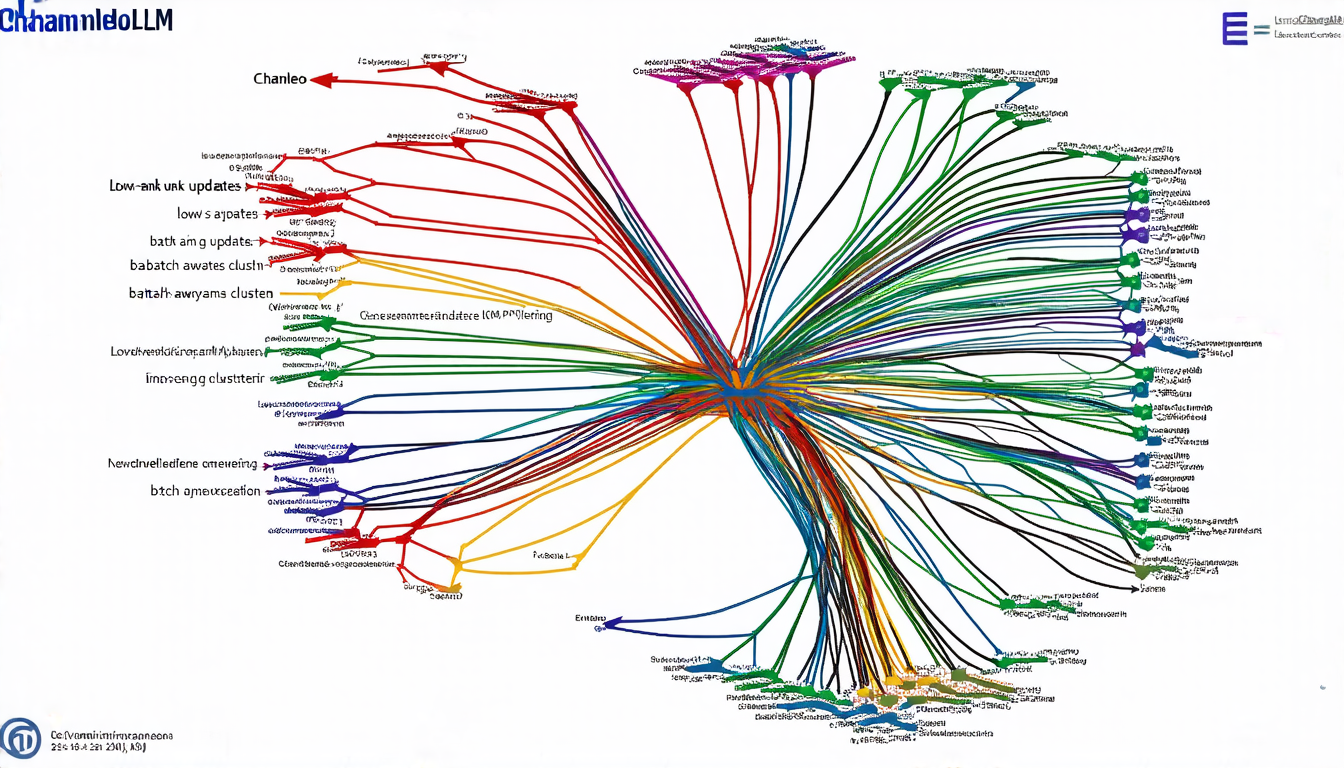
The key innovation behind ChameleonLLM lies in its ability to cluster similar inputs and generate context-aware low-rank parameters. This is achieved through a hyper-network that takes as input the mean token embeddings from a batch and outputs the necessary update matrices. By averaging token embeddings over each batch, the hyper-network becomes less sensitive to individual outliers, leading to more robust low-rank parameter generation.
In experiments on two benchmark datasets, WikiText-2 and Alpaca, ChameleonLLM consistently outperformed traditional LoRA fine-tuning methods in terms of validation loss and perplexity. The proposed approach also demonstrated improved adaptation to diverse input distributions, making it a promising solution for real-world applications where data variability is common.
One of the significant benefits of ChameleonLLM is its ability to dynamically adapt to new tasks or datasets without requiring extensive retraining or storage of pre-learned masks. This is particularly important in modern AI systems, where flexibility and scalability are crucial. By generating low-rank updates on-the-fly, ChameleonLLM reduces the need for storing multiple expert models or blending pre-defined masks.
The proposed method also offers a more efficient alternative to traditional fine-tuning approaches. While ChameleonLLM requires slightly more trainable parameters than LoRA, it achieves better performance with fewer computations during inference. This trade-off is highly favorable in many real-world applications where computational resources are limited.
In summary, ChameleonLLM represents an important advancement in the field of language model fine-tuning. By leveraging batch-aware clustering and dynamic low-rank parameter generation, this approach offers a more efficient and adaptive solution for large language models. Its ability to dynamically adapt to diverse input distributions and tasks makes it particularly well-suited for modern AI systems.
Cite this article: “Efficient Language Model Fine-Tuning with ChameleonLLM”, The Science Archive, 2025.
Artificial Intelligence, Language Models, Fine-Tuning, Batch-Aware Clustering, Dynamic Low-Rank Parameter Generation, Chameleonllm, Lora, Wikitext-2, Alpaca, Adaptation.





