

Friday 21 March 2025
Scientists have been trying to crack the code of how quarks, the building blocks of protons and neutrons, interact with each other for decades. Now, a new study has shed light on the mysterious forces that shape these interactions.
The research focuses on the short-range interactions between u/and d-quarks, which are the lightest type of quark. These interactions are crucial in determining the properties of hadrons, like protons and neutrons, but they’re also notoriously tricky to study.
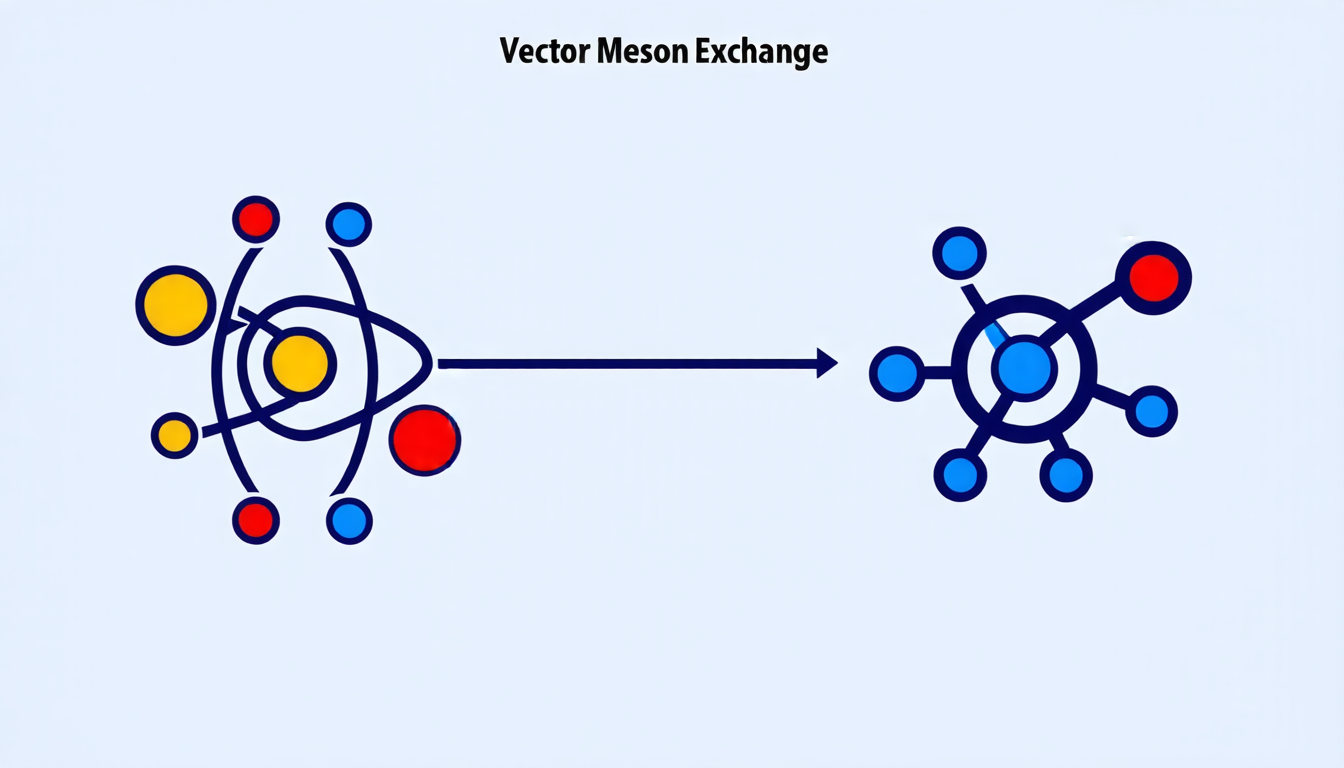
One of the biggest challenges is that quarks interact with each other through various forces, including one-gluon exchange and vector meson exchange. The former involves the exchange of a type of particle called a gluon, while the latter involves the exchange of particles like pions or rho-mesons.
For years, scientists have debated which force dominates these short-range interactions. Some thought it was the one-gluon exchange, while others believed it was the vector meson exchange. The new study aims to settle this debate once and for all.
The researchers used a quark model called chiral SU(3) to simulate the interactions between u/and d-quarks. This model takes into account not only the one-gluon exchange but also the interactions induced by scalar and pseudo-scalar nonet chiral fields.
By studying the properties of non-strange dibaryons, such as the NN, D03, and D30 systems, the researchers found that the vector meson exchange interaction plays a crucial role in shaping the short-range interactions between u/and d-quarks. In fact, they discovered that this force is responsible for binding these quarks together.
The findings have significant implications for our understanding of hadron physics. For one, they provide a natural explanation for why the empiric vector meson exchange dominance is observed in the interactions between hadrons containing light quarks. This dominance has been observed in various systems, including doubly charmed dibaryons.
Furthermore, the study opens up new avenues for exploring other types of hadronic molecules, such as those composed of a pair of charmed hadrons. These molecules could provide valuable insights into the dynamics of quark interactions and help us better understand the strong force that holds them together.
The research also has implications for our understanding of the properties of hadrons themselves.
Cite this article: “Unlocking the Secrets of Quark Interactions”, The Science Archive, 2025.
Quarks, Gluons, Vector Meson Exchange, Chiral Su(3), Dibaryons, Hadron Physics, Strong Force, Quark Interactions, Hadronic Molecules, Charmed Hadrons





