

Friday 21 March 2025
The age-old question of what happens when black holes finally meet their demise has puzzled physicists for decades. Now, a team of researchers has made significant progress in understanding the process, shedding light on the mysterious fate of these cosmic behemoths.
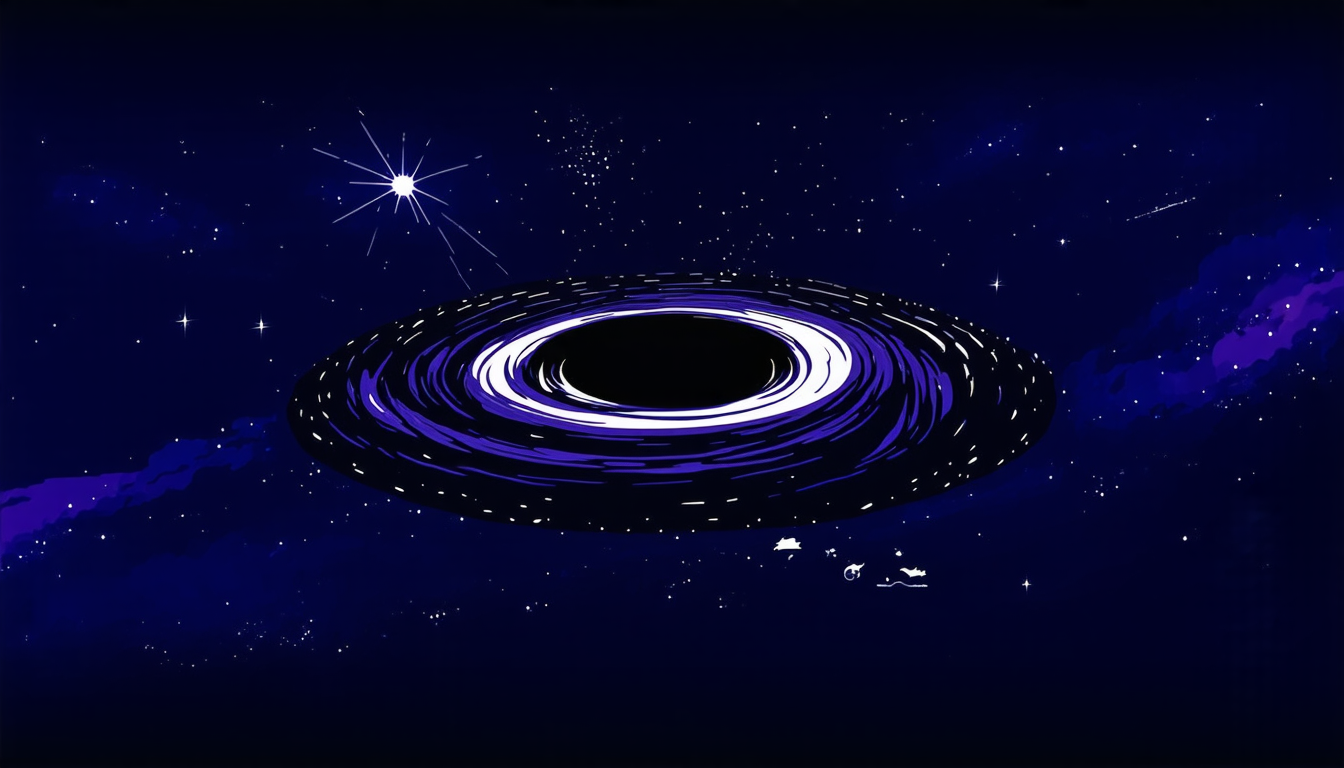
Black holes are regions of spacetime where gravity is so strong that not even light can escape once it gets too close. They form when massive stars collapse under their own weight, creating an event horizon – a point of no return. As matter and energy fall towards the event horizon, they heat up due to friction with surrounding particles, eventually emitting radiation known as Hawking radiation.
Hawking radiation was first proposed by Stephen Hawking in the 1970s, who showed that black holes emit radiation due to quantum effects near the event horizon. However, the process has been difficult to observe directly, as it occurs at extremely small scales and is masked by other astrophysical processes.
The new study focuses on a different aspect of black hole evaporation – the Page time. This is the moment when the entropy of the radiation emitted by the black hole equals its initial entropy. Before this point, the radiation appears thermal and mixed, while after it becomes more organized and coherent. The Page time marks a fundamental transition in the evolution of black holes.
To study this phenomenon, researchers used advanced computer simulations to model the behavior of black holes with different properties, such as mass and spin. They found that the Page time is sensitive to these properties, and can occur at various points during the evaporation process.
One of the key findings is that the Page time plays a crucial role in determining the fate of information contained within the black hole. Before this point, information appears lost forever, while after it becomes accessible again through the radiation emitted by the black hole. This has significant implications for our understanding of quantum mechanics and general relativity.
The study also highlights the importance of considering the effects of particle physics on black hole evaporation. Researchers found that including these effects in simulations significantly improved the accuracy of their predictions, providing a more complete picture of the process.
The findings have important implications for our understanding of the universe at its most fundamental level. Black holes are thought to play a crucial role in shaping the evolution of galaxies and stars, so understanding how they behave is essential for making accurate predictions about the cosmos.
The study’s results also open up new avenues for research into the nature of spacetime itself.
Cite this article: “Unlocking the Secrets of Black Hole Demise”, The Science Archive, 2025.
Black Holes, Hawking Radiation, Entropy, Page Time, Quantum Mechanics, General Relativity, Particle Physics, Spacetime, Event Horizon, Cosmology
Reference: Yuber F. Perez-Gonzalez, “Page Time of Primordial Black Holes: Standard Model and Beyond” (2025).





