

Friday 21 March 2025
A survey of nearly 100 M-type stars has yielded a surprising result: debris disks, thought to be common in younger star systems, are much rarer than expected in these cooler, older stars. The discovery challenges our understanding of how planetary formation and evolution occur.
M-type stars, also known as red dwarfs, are the most common type of star in the universe. They are smaller and cooler than the Sun, with surface temperatures ranging from 3,000 to 4,000 Kelvin compared to the Sun’s 5,500 Kelvin. As a result, they have longer lifetimes, burning their fuel at a slower rate.
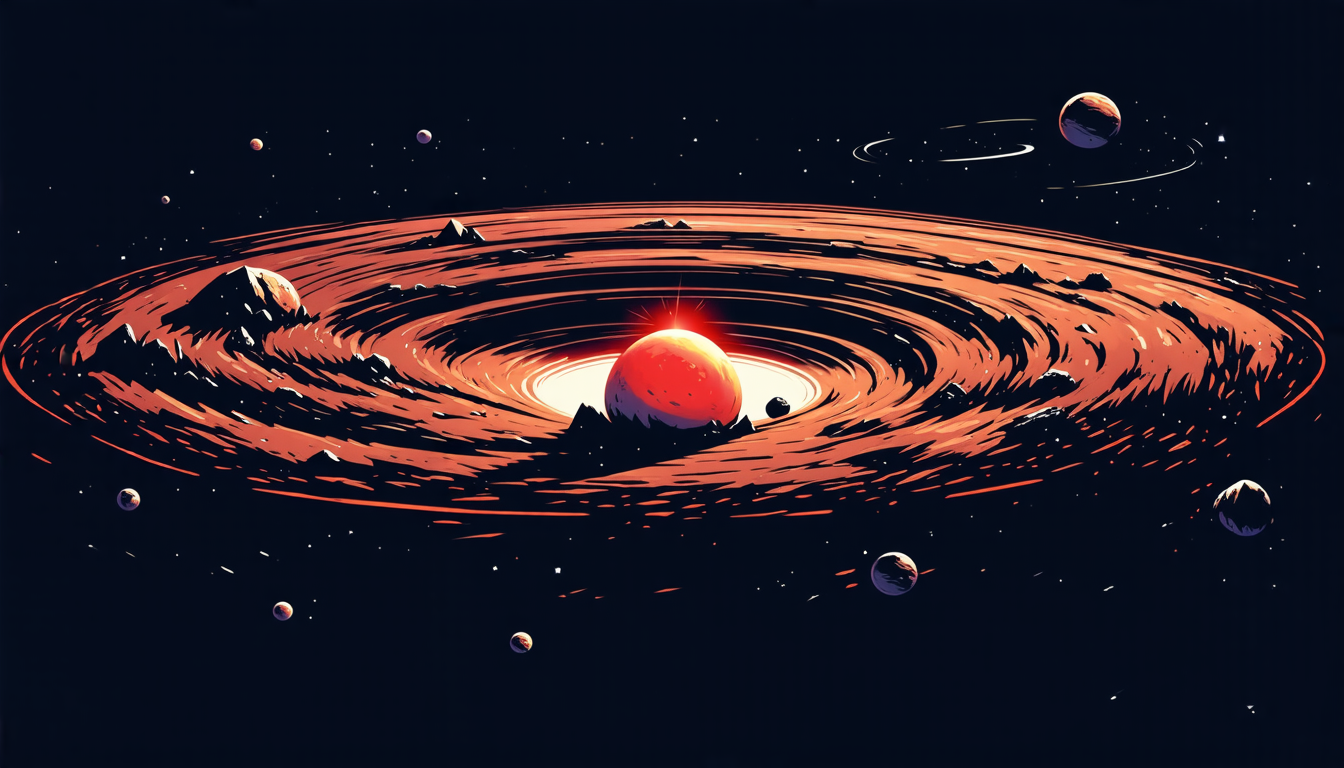
The Herschel DEBRIS survey aimed to detect debris disks around M-type stars using the European Space Agency’s Herschel space telescope. Debris disks are thought to be the remains of planetary formation, with small rocky bodies like asteroids and comets orbiting their parent star. The survey targeted 94 nearby M-type stars, observing them in infrared light to detect the faint glow of dust particles.
Only two debris disks were detected, one around GJ 581 and another around LP 876-10 (also known as Fomalhaut C). This result is surprising because debris disks are commonly found in younger star systems like those similar to our own Sun. In contrast, M-type stars are thought to have formed later in the history of the universe, when gas and dust were more scarce.
The low detection rate suggests that either debris disk formation is less common in these cooler stars or that the disks are shorter-lived than previously thought. This has implications for our understanding of planetary evolution, as debris disks are often seen as a stepping stone towards the formation of larger planets like those found in our own solar system.
One possibility is that M-type stars simply don’t form debris disks at all, instead opting for more compact systems with fewer rocky bodies. Alternatively, these disks may be shorter-lived due to interactions with nearby stars or other factors, causing them to dissipate before they can be detected.
The discovery also highlights the importance of understanding the properties of M-type stars and their planetary systems. These stars are so common that they could potentially harbor life, making their study crucial for the search for extraterrestrial intelligence.
The Herschel DEBRIS survey provides a fascinating glimpse into the mysteries of planetary formation and evolution in cooler star systems.
Cite this article: “Debris Disks Rare in Cooler Star Systems”, The Science Archive, 2025.
M-Type Stars, Red Dwarfs, Debris Disks, Planetary Formation, Evolution, Herschel Debris Survey, European Space Agency, Infrared Light, Dust Particles, Planetary Systems





