

Friday 21 March 2025
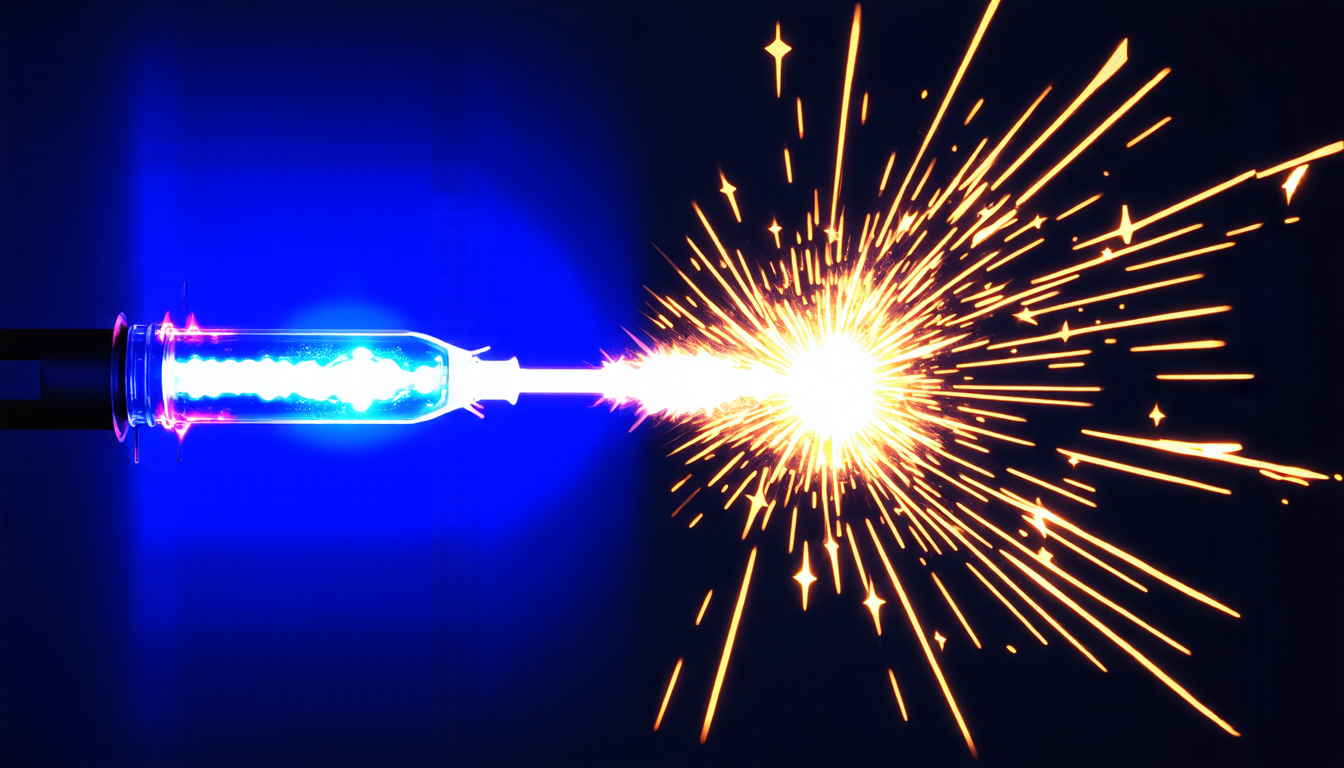
Scientists have long been fascinated by the brief, intense bursts of energy known as nanosecond discharges. These sparks of plasma can be used for a wide range of applications, from igniting fuel to sterilizing medical equipment. But understanding how they work has proven to be a complex challenge.
A new study published in Plasma Physics Reports sheds light on the intricacies of these high-speed electrical discharges. By using advanced computer simulations and laboratory experiments, researchers have gained insight into the behavior of nanosecond discharges in pure nitrogen gas.
The key to unlocking this understanding was developing a sophisticated model that could accurately simulate the complex interactions between the electrical discharge, the surrounding gas, and the particles produced by the plasma. This involved creating a detailed map of the electric field and the distribution of charged particles within the discharge tube.
Using this model, scientists were able to recreate the conditions inside the discharge tube with remarkable accuracy. They found that the nanosecond discharges propagated as fast ionization waves, traveling through the gas at speeds of up to 3 centimeters per nanosecond. This is incredibly fast, considering that the average human hair grows about 0.05 millimeters per day.
The researchers also discovered that the polarity of the discharge pulse had a significant impact on the behavior of the plasma. When the voltage was applied with negative polarity, the discharge tended to develop near the tube walls, resulting in lower electron densities and reduced emission intensity. Conversely, when the voltage was applied with positive polarity, the discharge propagated more uniformly along the center of the tube, producing higher electron densities and increased emission.
These findings have significant implications for the development of nanosecond discharges for various applications. For instance, researchers are exploring the use of these discharges to create high-temperature plasmas for industrial processes or to generate energetic particles for medical treatments.
The study’s authors note that their results could be used to optimize the design and operation of discharge tubes for specific applications. By better understanding the complex interactions within these devices, scientists can improve their efficiency, stability, and overall performance.
In a broader sense, this research highlights the importance of computational modeling in advancing our knowledge of plasma physics. By combining cutting-edge simulations with laboratory experiments, scientists can gain a deeper understanding of the intricate dynamics at play in these complex systems.
The next step for researchers will be to apply their findings to real-world applications and explore new avenues for harnessing the power of nanosecond discharges.
Cite this article: “Unlocking the Secrets of Nanosecond Discharges”, The Science Archive, 2025.
Plasma Physics, Nanosecond Discharges, Electrical Discharges, High-Speed Electrical Discharges, Nitrogen Gas, Computer Simulations, Laboratory Experiments, Plasma Modeling, Discharge Tubes, Computational Modeling





