

Friday 21 March 2025
The quest for more accurate simulations of complex quantum systems has led researchers to develop innovative techniques that can be applied to a wide range of fields, from chemistry to materials science. A recent paper presents an algorithm that can significantly reduce the computational resources required for simulating these systems, making it possible to study phenomena that were previously out of reach.
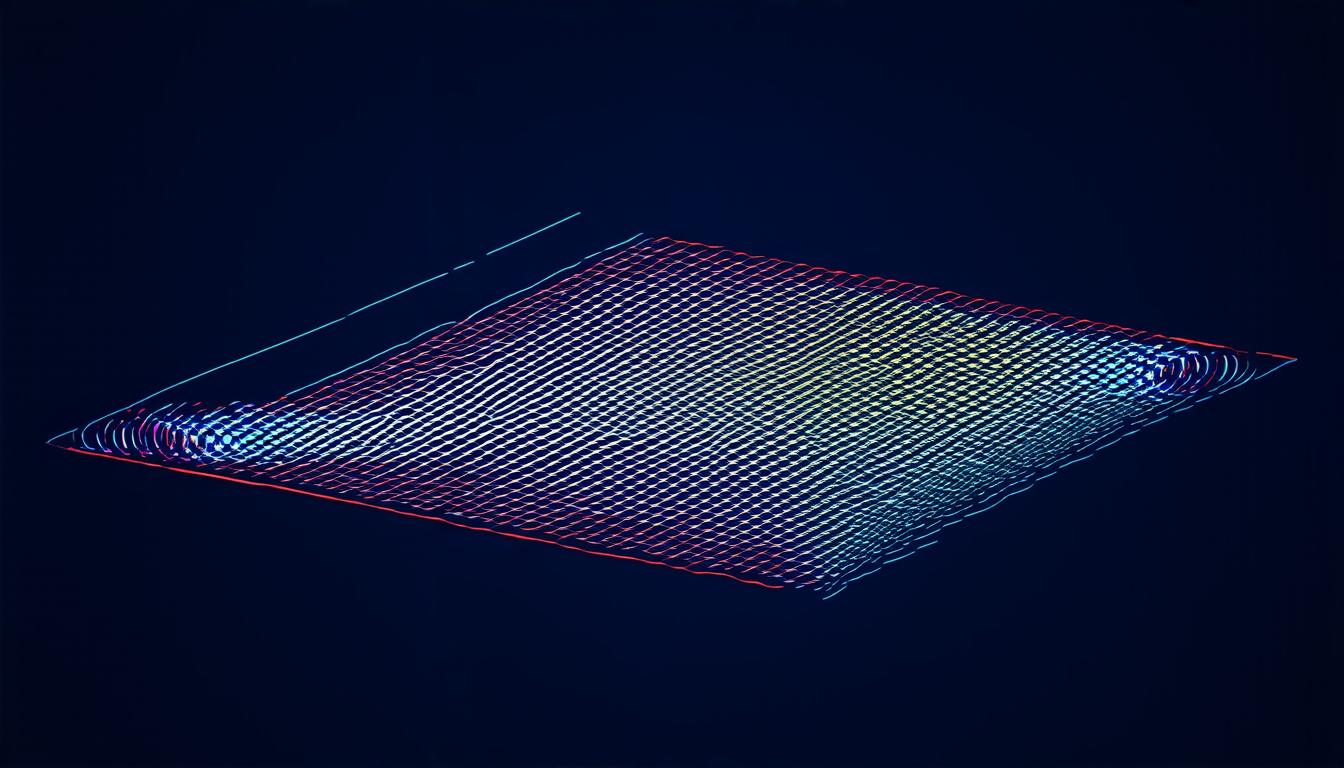
The Holstein polaron model is a theoretical framework used to describe the interaction between electrons and phonons (quantized sound waves) in solids. This model has been successful in explaining various experimental observations, but its application has been limited by the computational power required to solve it accurately. The new algorithm, called eigenvector continuation, allows researchers to construct the lowest-energy eigenstate of the Holstein polaron model for extended lattices from solutions of smaller, independent lattice segments.
The key insight behind this algorithm is that the eigenvectors of small segments of a lattice can be used to project onto a very restricted subspace without significant loss of accuracy. This allows researchers to build up the solution for larger systems by iteratively adding new segments and refining the result. The resulting energy calculations are more accurate than previous methods, which relied on approximations or simplifications.
The benefits of this algorithm extend beyond the specific problem of the Holstein polaron model. The eigenvector continuation technique can be applied to a wide range of quantum systems, including those that involve interacting particles and phonons. This makes it an attractive tool for researchers studying complex phenomena such as superconductivity, superfluidity, and charge density waves.
The algorithm’s potential impact is evident in its ability to simulate systems with thousands of sites and phonons. This level of detail is necessary for understanding the behavior of materials at the atomic scale, where subtle interactions between particles can have a profound effect on their properties. The eigenvector continuation technique opens up new avenues for research into these complex systems, enabling scientists to explore previously inaccessible regimes.
The development of this algorithm has important implications for the field of quantum simulation. As researchers continue to push the boundaries of what is possible with quantum computers and classical algorithms, techniques like eigenvector continuation will play a crucial role in unlocking new insights and understanding the behavior of complex systems.
Cite this article: “Unlocking Complex Quantum Systems with Eigenvector Continuation”, The Science Archive, 2025.
Quantum Simulation, Holstein Polaron Model, Eigenvector Continuation, Computational Resources, Quantum Systems, Phonons, Electrons, Materials Science, Charge Density Waves, Superconductivity





