

Friday 21 March 2025
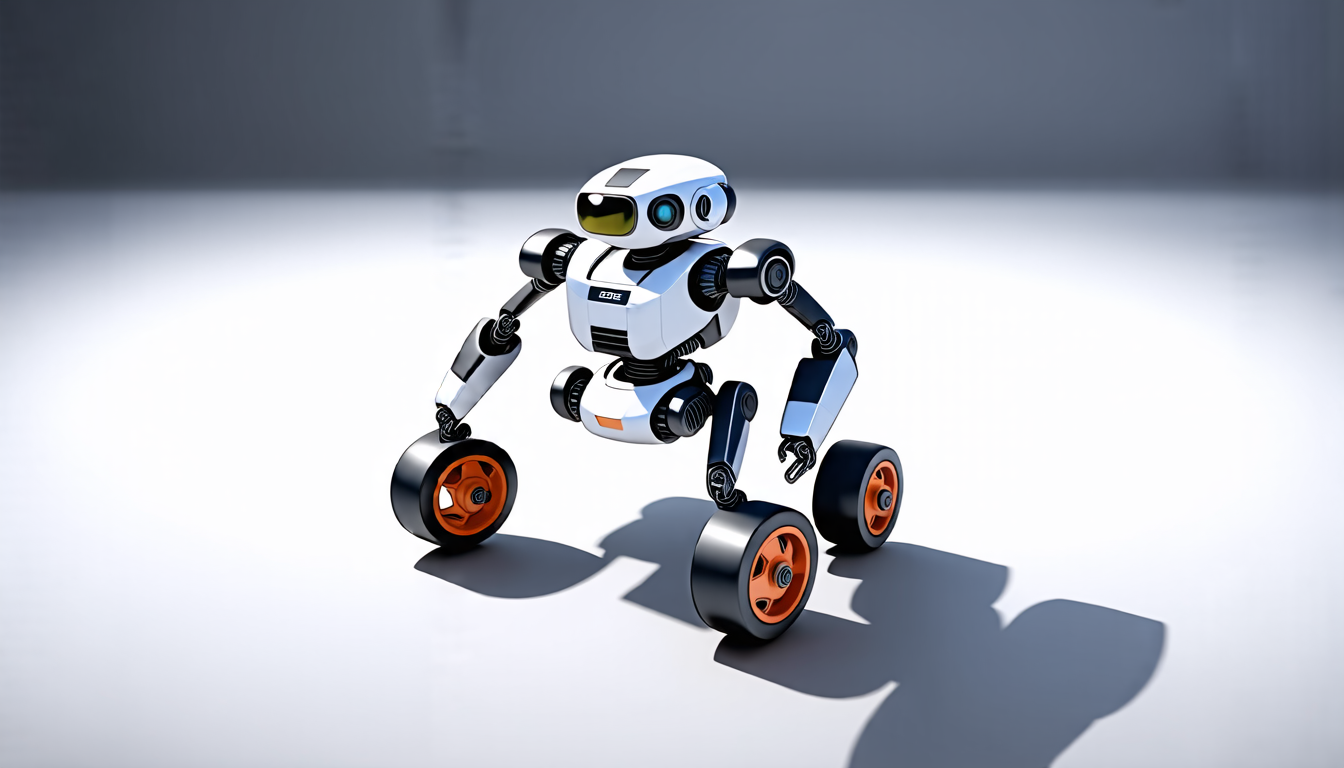
Scientists have been working on a new type of robot that can balance itself and even perform flips, all while navigating its surroundings with ease. This remarkable device is called the Mini Wheelbot, and it’s designed to test the limits of learning-based control algorithms.
The Mini Wheelbot is a small, symmetrical robot with a reaction wheel that allows it to stand up from any initial orientation. This means it can automatically reset itself after a fall, making it an ideal testing ground for new control methods. The robot’s wheels are also capable of powerful movements, enabling it to perform impressive stunts like flips.
The team behind the Mini Wheelbot is interested in validating learning-based control algorithms on this unique platform. These algorithms rely on real-world data to learn and adapt, rather than relying solely on pre-programmed rules. By testing these algorithms on the Mini Wheelbot, researchers hope to better understand how they work and improve their performance.
One of the key challenges faced by the Mini Wheelbot is its highly nonlinear and unstable dynamics. This means that small changes in its movements can have significant effects on its balance and overall behavior. To address this challenge, the team has developed a range of control algorithms that use advanced techniques like Bayesian optimization and imitation learning.
The Bayesian optimization algorithm uses machine learning to search for the optimal parameters for the Mini Wheelbot’s controller. This is done by simulating different scenarios and evaluating their performance, allowing the algorithm to refine its search over time.
Imitation learning, on the other hand, involves training a neural network to mimic the behavior of an expert controller. In this case, the expert controller is designed to stabilize the Mini Wheelbot and guide it through complex maneuvers.
The team has implemented both of these algorithms on the Mini Wheelbot, with impressive results. The robot is able to balance itself and perform flips with ease, all while adapting to new situations and environments.
The development of the Mini Wheelbot and its control algorithms has significant implications for robotics and artificial intelligence. By creating a platform that can learn and adapt in real-time, researchers are one step closer to building robots that can navigate complex environments and perform tasks that would be difficult or impossible for humans.
In the future, the team plans to continue refining their control algorithms and exploring new applications for the Mini Wheelbot. With its unique capabilities and advanced AI technology, this robot is sure to make a significant impact on the world of robotics and beyond.
Cite this article: “Mini Wheelbot: A Robot That Learns to Balance and Flip”, The Science Archive, 2025.
Robotics, Artificial Intelligence, Learning-Based Control Algorithms, Mini Wheelbot, Reaction Wheel, Flips, Balancing, Navigation, Bayesian Optimization, Imitation Learning





