

Friday 21 March 2025
Humanoid robots are notoriously difficult to program, requiring intricate coordination of their many limbs and joints to mimic human-like movement. But now, scientists have developed a new system that can automate the design of reward functions – crucial for training these robots – using artificial intelligence.
The challenge in designing reward functions lies in creating a balance between competing objectives, such as speed, stability, and energy efficiency. Traditionally, this process has been done manually by engineers, who must painstakingly adjust parameters to achieve optimal results. But with the rise of deep learning, researchers have sought to automate this task using AI.
The new system, called STRIDE, uses a combination of structured principles from agentic engineering and large language models to generate, evaluate, and refine reward functions for humanoid robot locomotion tasks. By analyzing the complex dynamics of human movement, the system can design rewards that mirror these movements, allowing robots to learn more efficiently.
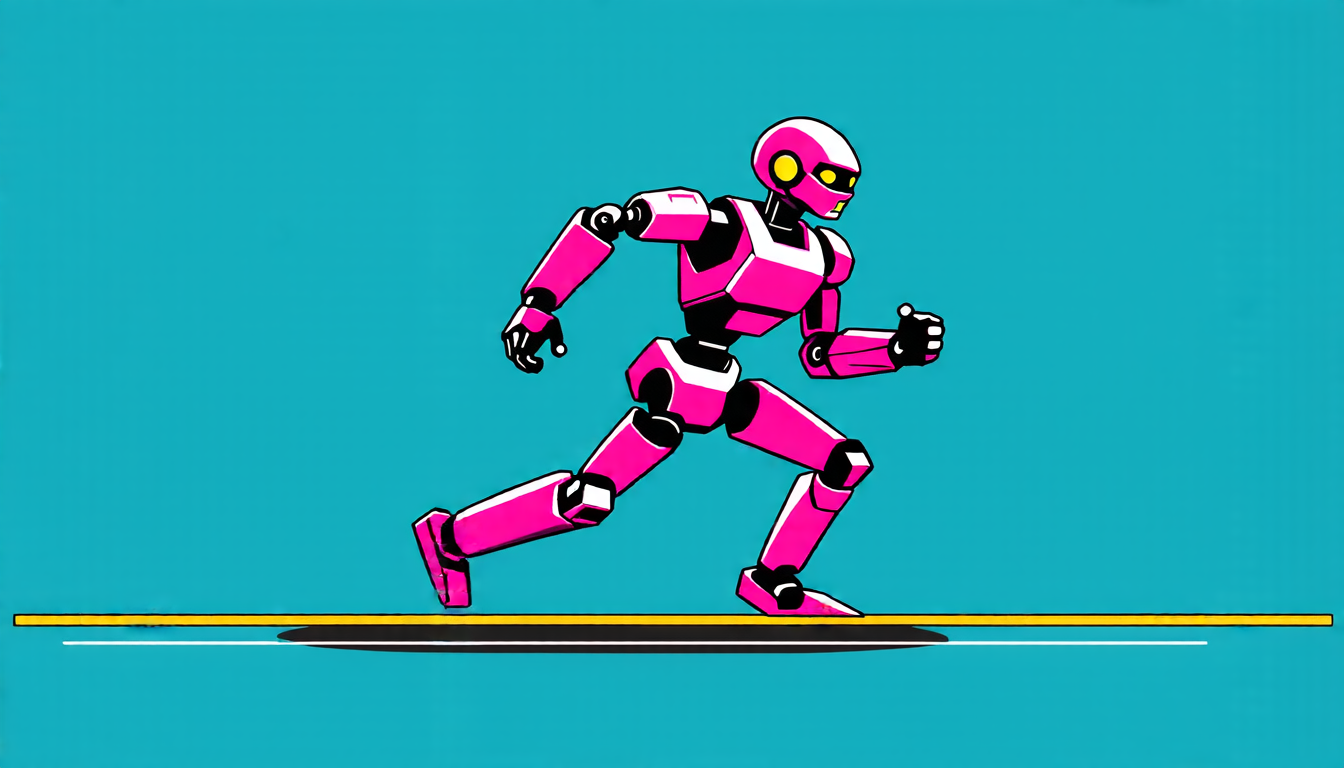
In a recent experiment, researchers tested STRIDE on a humanoid robot designed to mimic Usain Bolt’s sprinting style. The results were impressive: not only did the robot learn to run with remarkable speed and agility, but it also adapted to changing environments and terrain types. The system’s ability to balance competing objectives, such as maintaining stability while increasing speed, proved crucial in achieving these results.
One of the key innovations behind STRIDE is its use of large language models to generate code for the reward functions. These models can recognize patterns and relationships between variables, allowing them to create more complex and nuanced rewards than human engineers could achieve manually.
The system’s potential applications extend far beyond humanoid robotics. By automating the design of reward functions, researchers hope to accelerate progress in fields such as autonomous vehicles, drones, and even prosthetic limbs. With STRIDE, the possibilities for AI-powered automation seem endless.
But what does this mean for human engineers? While some may worry about losing their jobs to AI, others see STRIDE as a valuable tool that can free them up from tedious tasks and allow them to focus on higher-level design decisions. As the field of robotics continues to evolve, it’s likely that we’ll see even more innovative applications of AI in the years to come.
The implications of STRIDE are far-reaching, with potential benefits extending beyond humanoid robots to a wide range of fields. By harnessing the power of artificial intelligence, researchers may be able to create machines that learn and adapt with unprecedented speed and agility, opening up new possibilities for innovation and discovery.
Cite this article: “Automating Reward Functions for Humanoid Robots Using Artificial Intelligence”, The Science Archive, 2025.
Robotics, Artificial Intelligence, Humanoid Robots, Reward Functions, Automation, Deep Learning, Large Language Models, Agentic Engineering, Locomotion Tasks, Prosthetic Limbs





