

Friday 21 March 2025
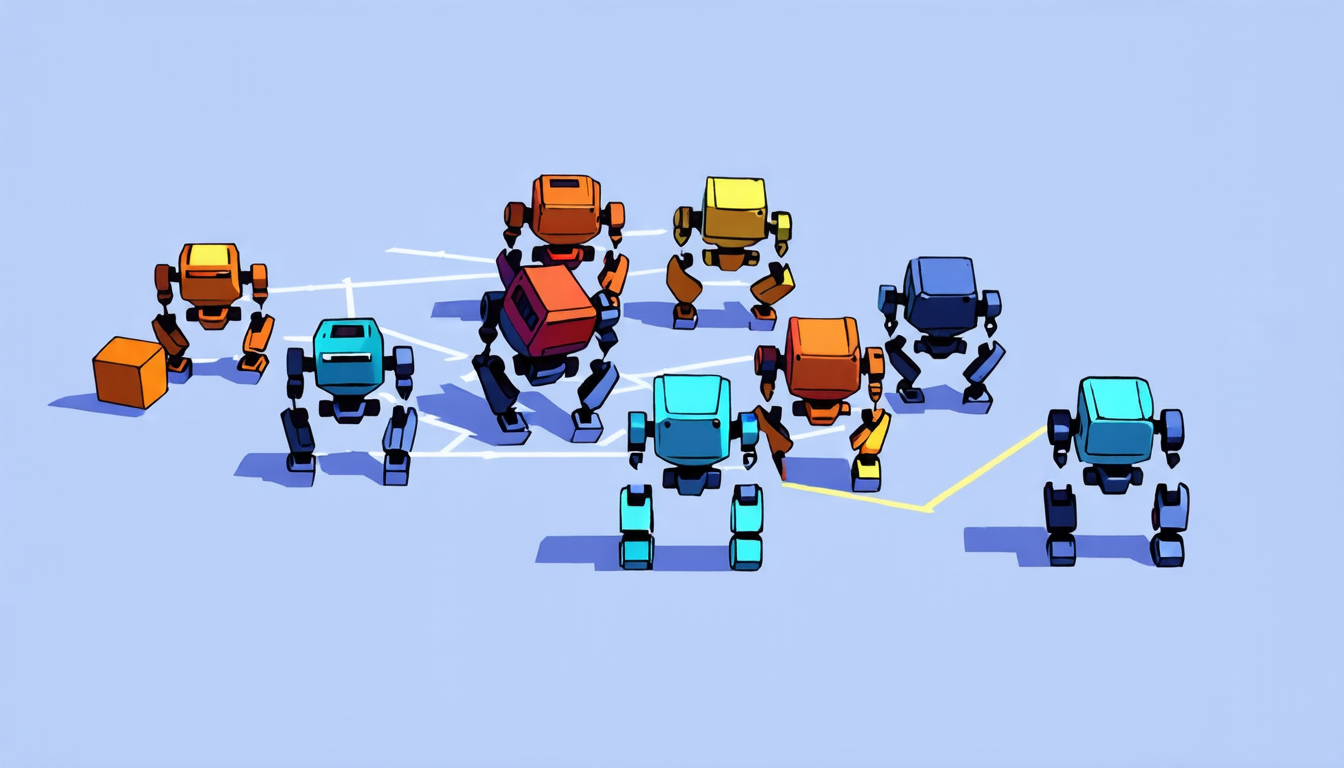
Researchers have made significant strides in developing a novel method for controlling multi-agent systems (MAS) that can efficiently and effectively cover non-convex regions, such as complex environments with obstacles or boundaries.
The challenge of covering non-convex regions has long been a major hurdle for MAS, which are networks of autonomous agents that work together to accomplish tasks. Traditional methods have relied on simple geometric shapes, like triangles or circles, to divide the coverage area into smaller sub-regions. However, these approaches often fail to account for the complexities of real-world environments, such as obstacles, boundaries, and varying terrain.
The new approach uses a technique called conformal mapping, which involves transforming the non-convex region into a simpler, star-shaped space. This allows the agents to move more efficiently and effectively, while also ensuring that every point in the original region is covered by at least one agent.
One of the key advantages of this method is its ability to adapt to changing environments. As obstacles or boundaries are introduced, the conformal mapping can be updated on the fly to reflect these changes, allowing the agents to adjust their movement patterns accordingly.
The researchers used a combination of mathematical techniques and computational methods to develop the new approach. They first developed a conformal map that transformed the non-convex region into a star-shaped space, which was then divided into smaller sub-regions using a Voronoi partition.
Next, they designed a distributed control strategy that allowed each agent to move independently, while still working together to cover the entire region. The agents used a combination of local and global information to determine their movement patterns, including the location of nearby obstacles and boundaries.
The results of the simulations were impressive. The new approach was able to efficiently and effectively cover non-convex regions with complex obstacles and boundaries, while also adapting to changing environments. In contrast, traditional methods often struggled to achieve complete coverage, particularly in areas with multiple obstacles or boundaries.
The implications of this research are significant. It has the potential to enable MAS to be used in a wide range of applications, from search and rescue missions to environmental monitoring and surveillance. By allowing agents to adapt to changing environments and efficiently cover non-convex regions, it could also improve the overall performance and effectiveness of these systems.
In addition, the new approach has potential applications in other fields, such as computer graphics and medical imaging.
Cite this article: “Efficient Coverage of Non-Convex Regions with Multi-Agent Systems”, The Science Archive, 2025.
Multi-Agent Systems, Non-Convex Regions, Conformal Mapping, Distributed Control, Voronoi Partition, Obstacle Avoidance, Boundary Detection, Autonomous Agents, Coverage Optimization, Adaptability.





