

Friday 21 March 2025
When you think of distributed systems, you might imagine a network of computers working together to achieve a common goal. But what happens when these computers need to access shared resources at the same time? That’s where mutual exclusion comes in – a crucial concept that ensures only one process can enter a critical section, like a database or a printer.
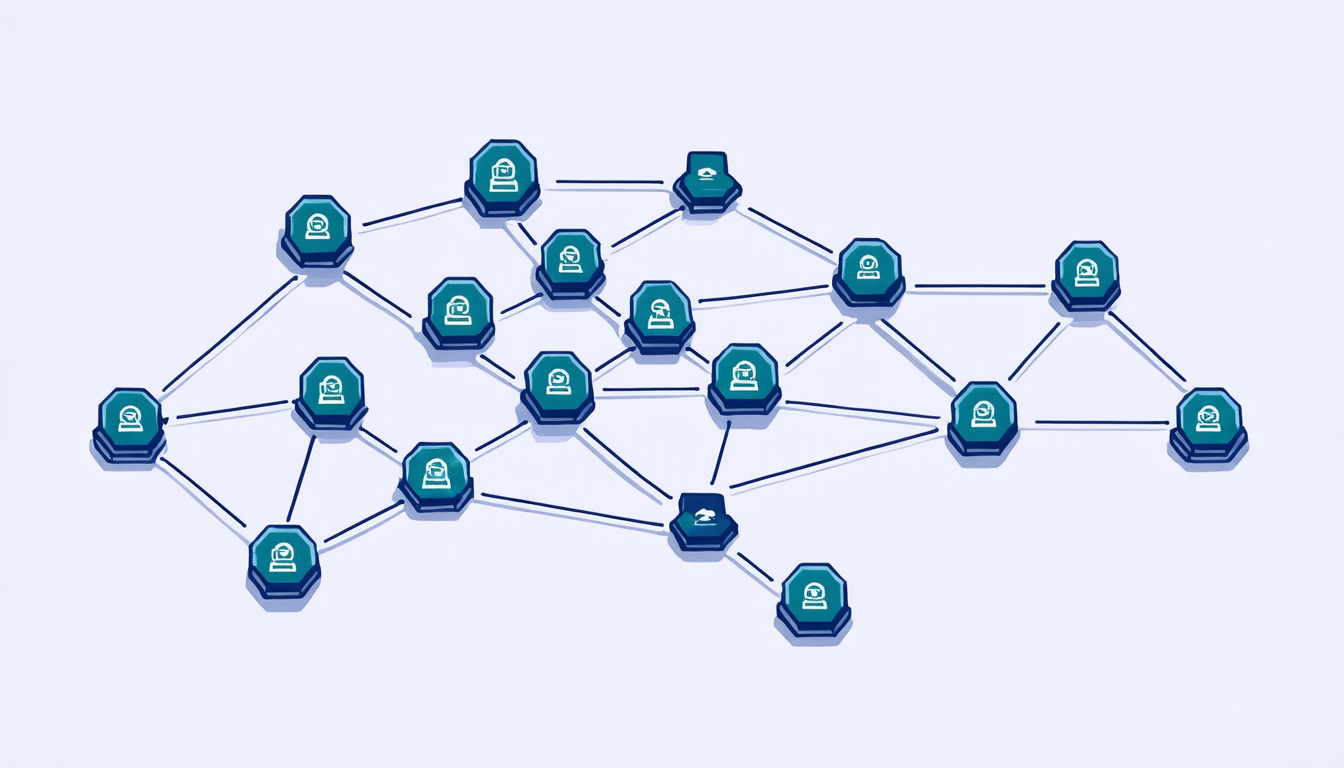
In traditional permission-based systems, a node needs to get approval from multiple other nodes before entering the critical section. This approach can be slow and inefficient, especially when dealing with large numbers of nodes. Token-based systems, on the other hand, use a single token that’s passed around the network, allowing only one node to enter the critical section at a time.
Researchers have developed various token-based algorithms for different types of networks. In fully connected networks, a simple broadcast-and-token-forward approach can be used. However, in tree-based or ring-based structures, more sophisticated techniques are needed to ensure efficient and fair access to the critical section.
One such algorithm is based on finite projective planes, which structure nodes into superior and inferior sets. This approach has been shown to achieve O(1) best-case messaging and O(sqrt(N)) worst-case performance – a significant improvement over traditional permission-based systems.
Another challenge in distributed systems is handling node failures or mobility. Token-based algorithms need to be able to recover from these events without breaking mutual exclusion. Researchers have developed fault-tolerant approaches that can regenerate tokens, reconfigure networks, and even adapt to changing network topologies.
In highly dynamic environments like flying ad hoc networks, traditional token-based algorithms may not be enough. New approaches are needed that can handle frequent disconnections and reconnections, while ensuring fair access to critical resources.
Machine learning techniques can also be used to improve token-based systems. For example, predictive models can forecast which nodes will need to access the critical section next, allowing tokens to be routed more efficiently. Similarly, adaptive timeouts can adjust to changing network conditions, reducing the risk of premature token loss.
As distributed systems continue to grow in scale and complexity, mutual exclusion remains a crucial challenge. By developing more efficient, fault-tolerant, and adaptable token-based algorithms, researchers can help ensure that these systems remain reliable and secure.
Cite this article: “Ensuring Mutual Exclusion in Distributed Systems”, The Science Archive, 2025.
Distributed Systems, Mutual Exclusion, Token-Based Algorithms, Permission-Based Systems, Critical Sections, Node Failures, Mobility, Fault-Tolerant Approaches, Machine Learning, Predictive Models.





