

Friday 21 March 2025
Scientists are one step closer to understanding the mysteries of gravity, thanks to a recent study that has shed new light on how gravitational waves behave in extreme environments.
For decades, physicists have been fascinated by the way that massive objects warp the fabric of space and time around them. This phenomenon is known as gravity, and it’s what keeps us firmly on the surface of the Earth instead of floating off into space.
But gravity isn’t just a force that affects large objects – it also plays a crucial role in the behavior of tiny particles like photons and gravitons. In recent years, scientists have discovered that these particles can be manipulated by gravitational waves, which are ripples in the fabric of spacetime that were predicted by Einstein’s theory of general relativity.
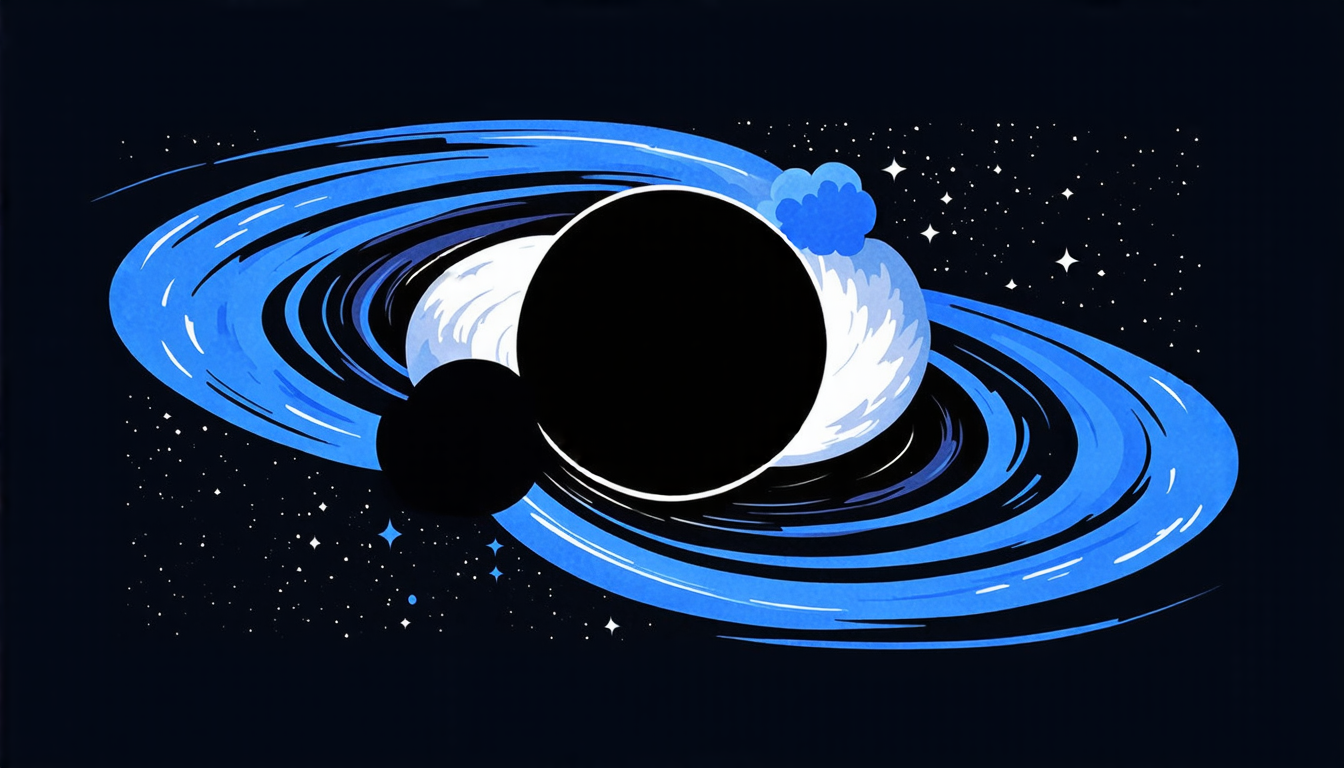
One of the biggest challenges facing scientists is understanding how gravitational waves behave in extreme environments. For example, what happens when a black hole collides with another massive object? Or when a star goes supernova and explodes?
To answer these questions, researchers have been using powerful computers to simulate the behavior of gravitational waves in these extreme scenarios. But even with these simulations, it’s still difficult to make accurate predictions about how gravity will behave.
That’s where the new study comes in. By analyzing data from recent observations of gravitational waves, scientists were able to develop a new model that can accurately predict how gravity behaves in extreme environments.
The model is based on a complex mathematical framework that takes into account the behavior of both massive objects and tiny particles. It’s like trying to solve a puzzle, where each piece fits together perfectly to reveal a complete picture of how gravity works.
One of the most exciting implications of this new model is its potential to help us better understand some of the most extreme events in the universe, such as black hole collisions and supernovae explosions. By studying these events in greater detail, scientists may be able to gain insights into some of the fundamental laws of physics that govern our universe.
The study also has implications for future gravitational wave detectors, which are designed to capture even fainter signals from distant objects. With this new model in place, scientists will be able to better analyze the data from these detectors and make more accurate predictions about what they’re seeing.
Overall, this new study is an important step forward in our understanding of gravity and its role in shaping the universe around us. By continuing to explore the mysteries of gravity, scientists are one step closer to unlocking some of the biggest secrets of the cosmos.
Cite this article: “Unlocking the Secrets of Gravity: New Study Reveals Insights into Extreme Environments”, The Science Archive, 2025.
Gravity, Gravitational Waves, Extreme Environments, Black Holes, Supernovae, Einstein’S Theory Of General Relativity, Simulations, Mathematical Framework, Puzzle, Physics.





