

Friday 21 March 2025
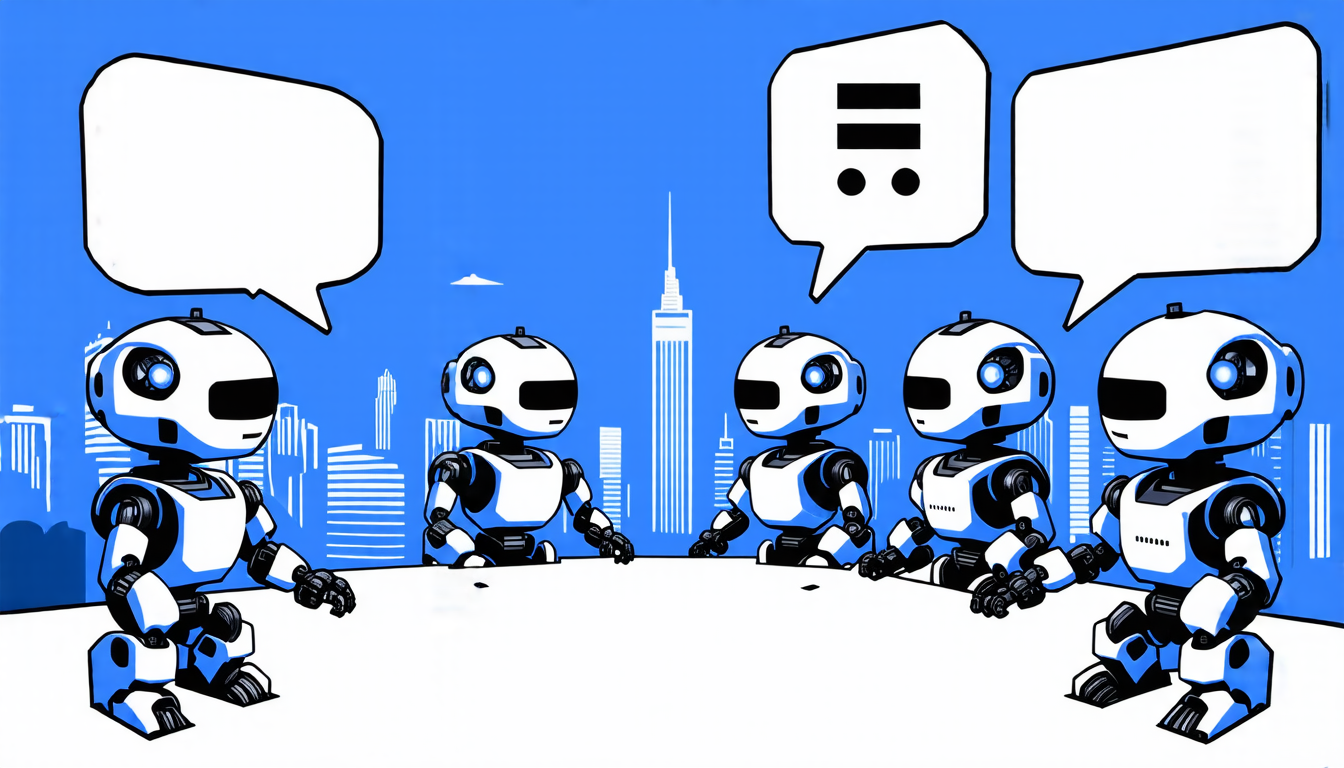
The quest for intelligent machines has long been a driving force in artificial intelligence research. One of the most promising approaches is multi-agent debate, where multiple AI systems engage in discussions to arrive at a consensus or solution. But this method comes with a significant challenge: as the number of agents increases, so does the amount of data and processing required, making it difficult to scale.
Enter S2-MAD, a new algorithm designed to address this issue by introducing a novel sparsification strategy that reduces token costs in multi-agent debate. The researchers behind S2-MAD aim to make AI more efficient and effective by minimizing unnecessary exchanges between agents, allowing them to focus on the most relevant information.
The approach works by dividing the debate process into three stages: initial thinking, intra-group discussion, and inter-group summary generation. In each stage, agents share their thoughts and opinions with one another, but S2-MAD limits the amount of data exchanged to reduce computational overhead. The algorithm also incorporates a redundancy filter that eliminates duplicate or redundant information, further reducing the load on the system.
To test S2-MAD, the researchers implemented it in several datasets and compared its performance to other multi-agent debate methods. The results were striking: not only did S2-MAD achieve higher accuracy rates than its competitors, but it also reduced token costs by as much as 94.5% in some cases.
The implications of this breakthrough are significant. With S2-MAD, AI systems can engage in more complex and nuanced debates, leading to better decision-making and problem-solving capabilities. This could have far-reaching applications in fields such as healthcare, finance, and education, where accurate and efficient decision-making is crucial.
But the benefits don’t stop there. By reducing token costs, S2-MAD also makes it possible for AI systems to scale more easily, allowing them to tackle larger and more complex problems than ever before. This could lead to breakthroughs in areas such as natural language processing, computer vision, and machine learning.
Of course, there’s still much work to be done before S2-MAD can be fully integrated into real-world applications. But the potential is vast, and researchers are already exploring ways to further improve and adapt the algorithm for specific use cases.
As AI continues to evolve and become an increasingly important part of our lives, it’s exciting to think about what the future might hold.
Cite this article: “Efficient Debate: S2-MAD Algorithm Revolutionizes Multi-Agent AI Research”, The Science Archive, 2025.
Artificial Intelligence, Multi-Agent Debate, S2-Mad, Sparsification, Token Costs, Algorithm, Efficiency, Accuracy, Machine Learning, Natural Language Processing





