

Friday 21 March 2025
For decades, scientists have been searching for a way to understand dark matter, a mysterious substance that makes up about 27% of our universe but is invisible to us. Now, researchers have made a significant breakthrough in their quest to uncover the secrets of this elusive force.
Using advanced computer simulations and observations from a dataset of 17 galaxies, scientists have developed a new model of dark matter that takes into account its ability to interact with itself. This self-interacting property was previously unknown, but it has a profound impact on how dark matter behaves in the universe.
The new model, known as gFDM (self-interacting fuzzy dark matter), is based on the idea that dark matter particles can interact with each other through a force similar to gravity or electromagnetism. This interaction causes the dark matter to behave differently than previously thought, leading to more accurate predictions about its behavior in galaxies.
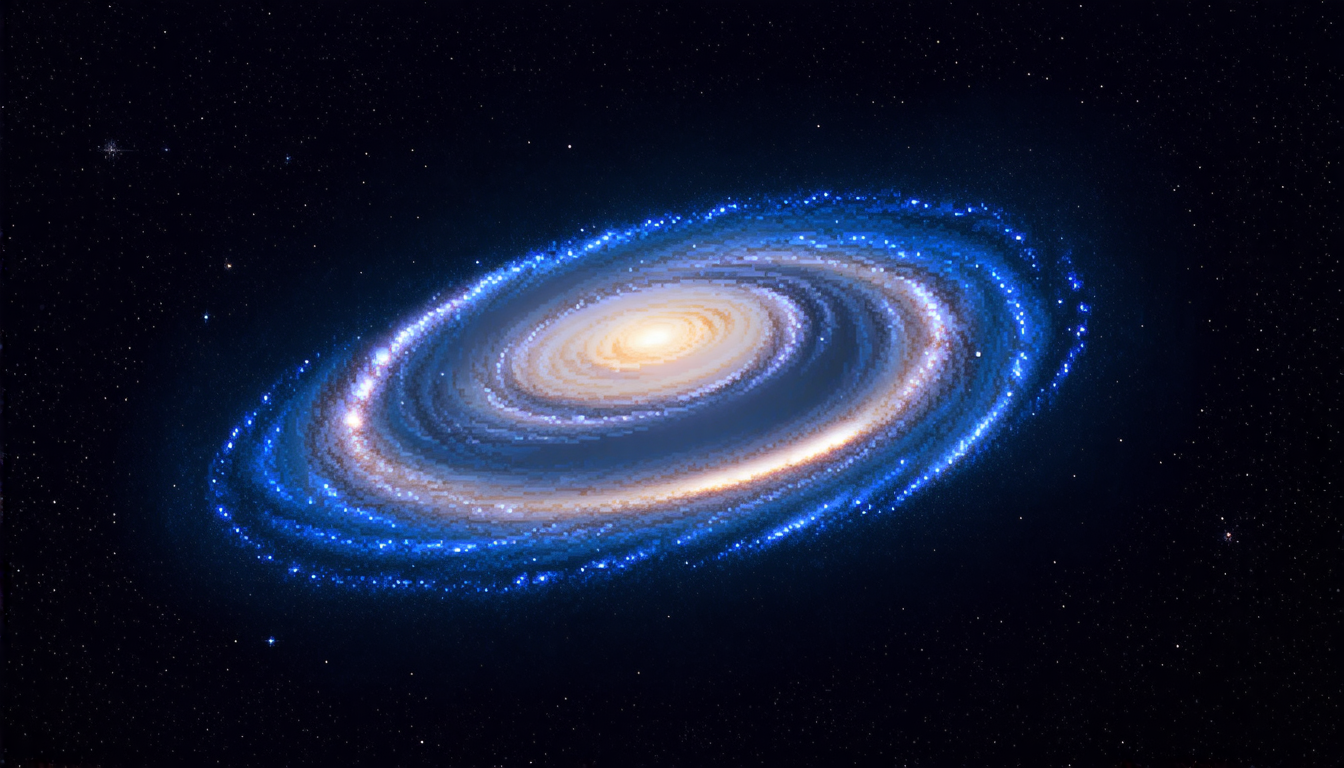
One of the key findings of the study is that gFDM can explain the rotation curves of galaxies much better than previous models. Rotation curves are graphs that show how the speed of stars orbiting a galaxy changes as they move further away from the center. In many galaxies, these curves flatten out at larger distances from the center, which was previously difficult to explain using traditional dark matter models.
The new gFDM model is able to reproduce this flattening effect by taking into account the self-interaction of dark matter particles. This interaction causes the dark matter to form a dense core in the center of the galaxy, surrounded by a less dense halo. As stars orbit the galaxy, they feel the gravitational pull of both the core and the halo, which affects their motion.
The researchers used advanced computer simulations to test their new model against observations from 17 galaxies. They found that gFDM is able to accurately predict the rotation curves of these galaxies, including the flattening effect at larger distances from the center.
While this breakthrough is an important step forward in our understanding of dark matter, it’s still just a model. Scientists will need to continue testing and refining their theories to get a better grasp of the fundamental nature of dark matter.
The discovery of gFDM has also opened up new avenues for research into dark matter. By studying how this self-interacting force affects the behavior of dark matter in galaxies, scientists can gain a deeper understanding of the universe’s mysterious forces.
In the coming years, researchers will continue to study dark matter using a combination of observations and computer simulations.
Cite this article: “Scientists Uncover New Clues About Dark Matters Behavior”, The Science Archive, 2025.
Dark Matter, Galaxies, Self-Interacting, Fuzzy Dark Matter, Gfdm, Rotation Curves, Computer Simulations, Observations, Astronomy, Physics





