
Friday 21 March 2025
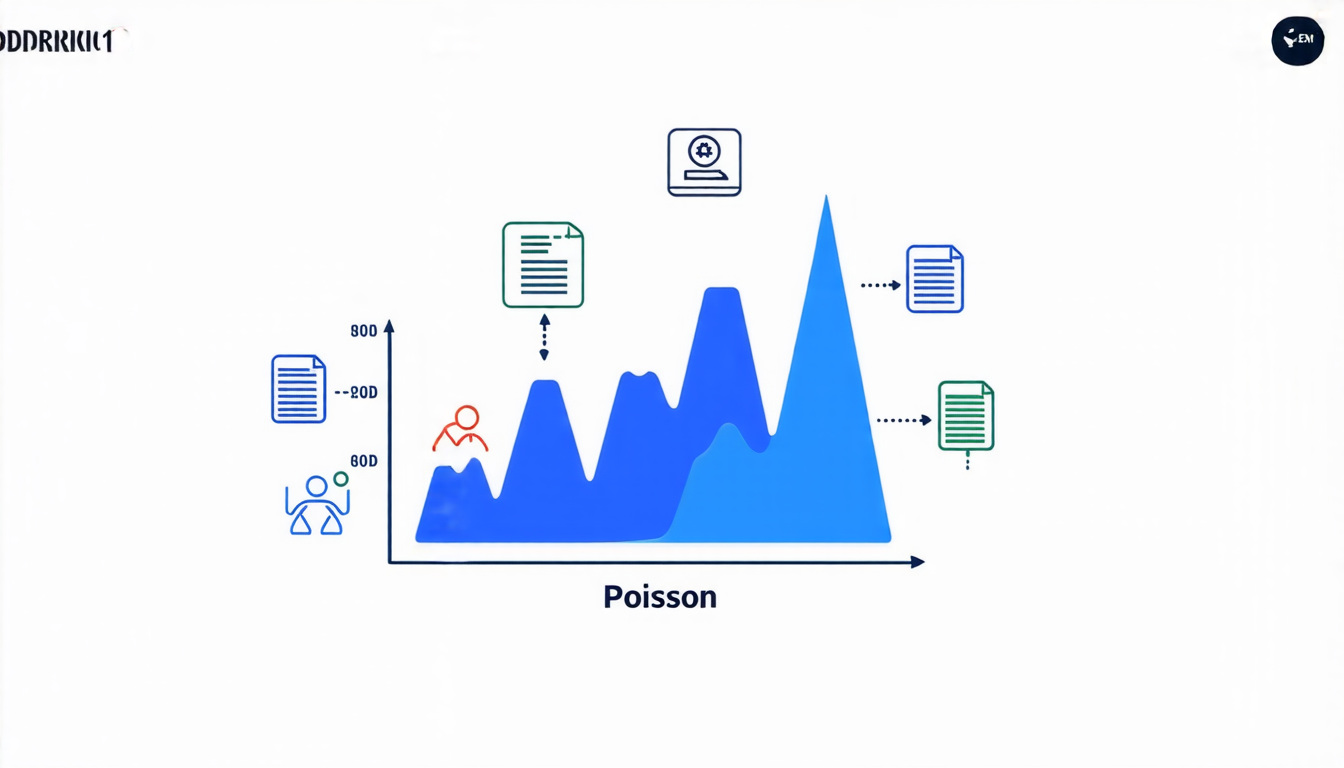
Researchers have made a significant breakthrough in developing a more efficient method for analyzing data that follows a Poisson distribution, commonly used in fields such as epidemiology and ecology.
The Poisson distribution is often employed to model count data, where the number of occurrences is typically small and the mean is finite. However, when dealing with large datasets or complex models, traditional methods can become computationally intensive and prone to errors.
To address this challenge, a new algorithm has been designed that leverages the concept of auxiliary mixture sampling (AMS). AMS is a statistical technique used to approximate the posterior distribution of complex models by introducing additional variables. In the case of Poisson regression, AMS involves generating auxiliary variables that mimic the behavior of the original data.
The new algorithm, called IAMS, builds upon this idea by incorporating an acceptance step during the sampling process. This allows for a more accurate approximation of the right tail of the distribution, which is crucial in cases where extreme residuals are present.
In traditional AMS methods, the mixture approximation can become inaccurate when dealing with large datasets or complex models. This can lead to poor mixing and inefficient sampling. The IAMS algorithm addresses this issue by incorporating an acceptance step that ensures the generated auxiliary variables are more likely to be accurate.
The results of the study demonstrate that the IAMS algorithm significantly improves the efficiency and accuracy of Poisson regression analysis. The algorithm is able to achieve faster convergence rates and reduced computational times compared to traditional AMS methods.
The implications of this research are far-reaching, particularly in fields where data analysis is critical for decision-making. For example, in epidemiology, accurate modeling of disease outbreaks can inform public health policy and resource allocation. In ecology, understanding population dynamics is crucial for conservation efforts.
While the IAMS algorithm shows promise, it is not without its limitations. The complexity of the model and the quality of the data are still critical factors that affect the algorithm’s performance. Additionally, further research is needed to fully explore the capabilities and limitations of this new method.
Nonetheless, the development of the IAMS algorithm marks an important step forward in the field of statistical analysis. As researchers continue to push the boundaries of what is possible with data science, algorithms like IAMS will play a crucial role in unlocking new insights and discoveries.
Cite this article: “Efficient Poisson Regression Analysis Through Innovative Algorithmic Design”, The Science Archive, 2025.
Poisson Distribution, Data Analysis, Statistical Modeling, Auxiliary Mixture Sampling, Algorithm Development, Epidemiology, Ecology, Public Health Policy, Conservation Efforts, Computational Efficiency.