

Saturday 22 March 2025
Language models, those behemoths of artificial intelligence, have long been touted as the key to unlocking human-like understanding and generation of text. But a new approach is shaking things up, one that swaps the traditional fixed-vector embeddings for probabilistic subspaces.
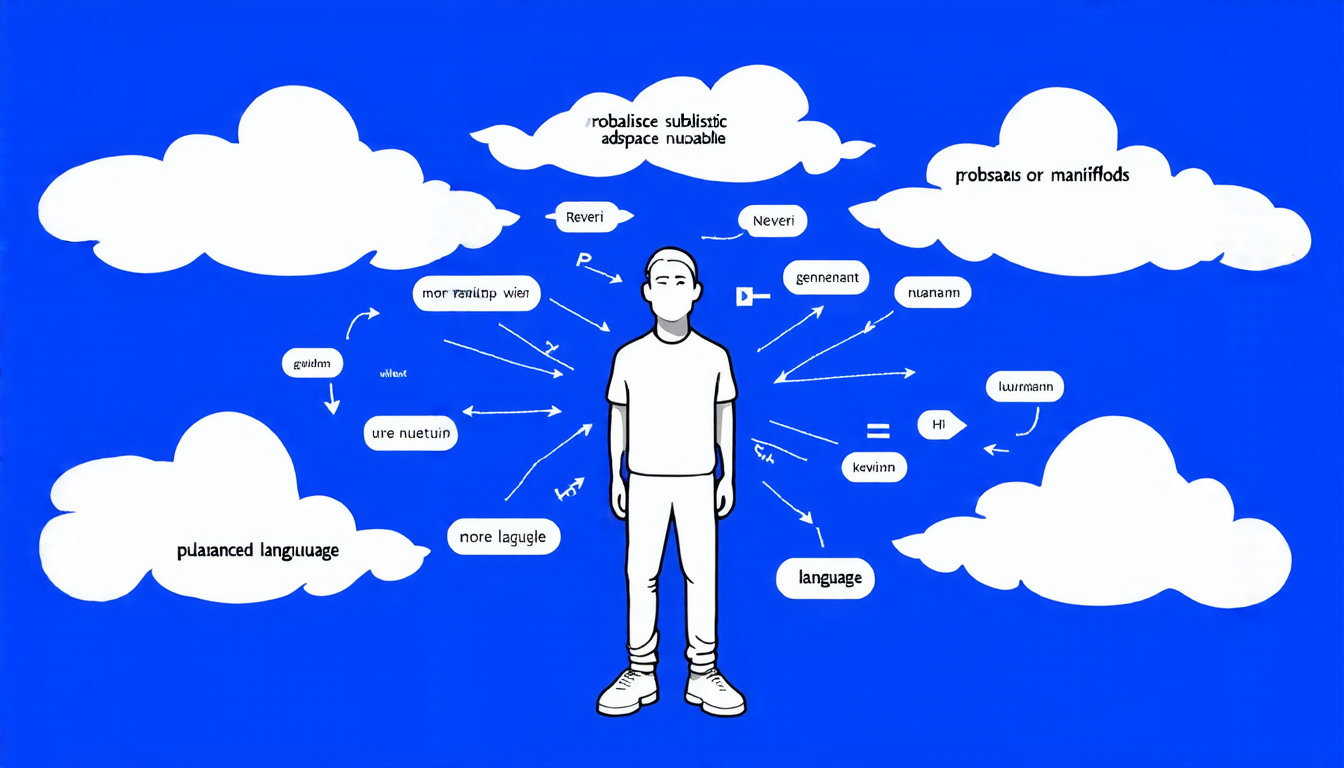
The idea behind this novel technique, dubbed Probabilistic Subspace Manifolds (PSMs), is to abandon the notion that words can be represented as fixed points in a high-dimensional space. Instead, each word is associated with a probability distribution over learned manifolds, allowing for a more nuanced and adaptable characterization of contextual dependencies.
The benefits are numerous. For one, PSMs exhibit improved semantic coherence, with token representations better retaining their meaning and relationships across different linguistic contexts. This means that language models built upon PSMs can generate text that is not only more accurate but also more coherent and natural-sounding.
But the advantages don’t stop there. PSMs also demonstrate greater adaptability to domain-specific linguistic variations, allowing large language models to learn and generalize more effectively across diverse textual corpora. This could have significant implications for applications such as machine translation, where the ability to adapt to different languages and dialects is crucial.
Another key advantage of PSMs is their resilience against adversarial perturbations. In an era where language models are increasingly being used in security-sensitive domains, this robustness is a welcome development. By incorporating probabilistic embeddings, PSMs can better withstand attempts to manipulate or deceive the model through input noise or other forms of tampering.
The increased expressiveness of PSMs also has implications for tasks such as sentiment analysis and named entity recognition. By capturing more subtle semantic relationships between words, language models built upon PSMs may be able to identify nuanced patterns and trends that would be lost with traditional fixed-vector embeddings.
But what’s most exciting about this development is the potential for further refinement and extension of the PSM approach. As researchers continue to explore the possibilities of probabilistic subspace manifolds, it’s likely that we’ll see even more sophisticated language models emerge, capable of generating text that is not only coherent but also creative and engaging.
Of course, there are still challenges to be addressed before PSMs can become a mainstream technology. For one, the increased computational requirements of probabilistic embedding generation may require significant resources and optimization efforts. Additionally, there’s still much to be learned about how to effectively train and fine-tune language models built upon PSMs.
Cite this article: “Revolutionizing Language Models with Probabilistic Subspace Manifolds”, The Science Archive, 2025.
Language Models, Probabilistic Subspace Manifolds, Artificial Intelligence, Fixed-Vector Embeddings, Natural Language Processing, Semantic Coherence, Machine Translation, Adversarial Perturbations, Sentiment Analysis, Named Entity Recognition





