

Saturday 22 March 2025
The pursuit of mapping out the world around us has long been a challenge for computer scientists and roboticists. From autonomous vehicles to household cleaning robots, the ability to efficiently navigate and create detailed maps of our surroundings is crucial for many applications. In recent years, researchers have made significant progress in this area, developing techniques that allow robots to quickly and accurately map out new environments.
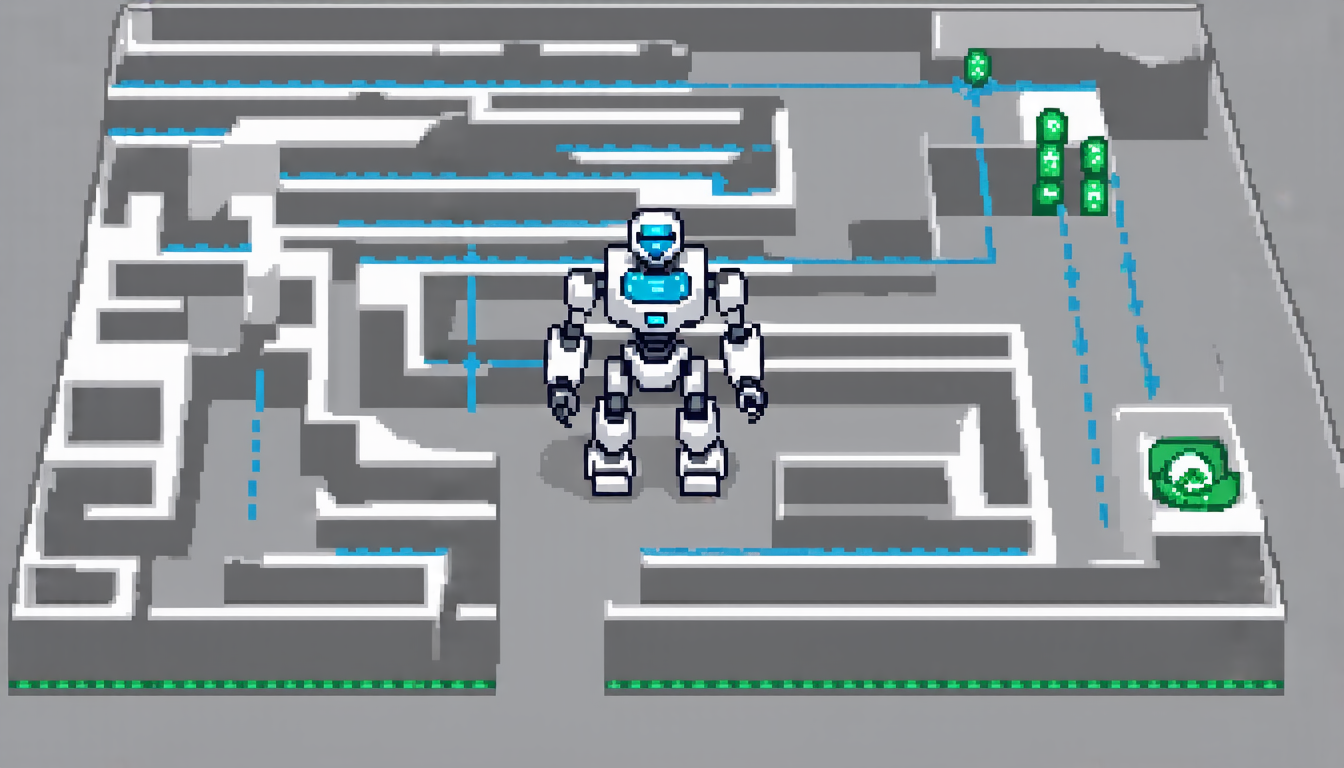
One such technique is known as next-best-path planning, or NBP for short. Developed by a team of scientists at LIGM, a research institution in France, NBP uses machine learning algorithms to predict the most efficient path for a robot to take when mapping out a new environment. By taking into account factors such as the distance between points, the likelihood of encountering obstacles, and the importance of certain areas, NBP can help robots navigate complex spaces more quickly and accurately.
The key innovation behind NBP is its ability to predict not just the next immediate step for a robot, but also its long-term goals. By considering the entire mapping process as a single task, rather than breaking it down into smaller, individual steps, NBP can create a more holistic understanding of the environment and make more informed decisions about which areas to explore first.
To test NBP, the researchers created a new dataset called AiMDoom, which consists of 16 indoor environments with varying levels of complexity. The team then used NBP to map out each environment, comparing its performance against several other mapping algorithms.
The results were impressive: NBP was able to achieve higher coverage rates and more accurate maps than the other algorithms, particularly in complex environments. This is because NBP’s ability to predict long-term goals allowed it to focus on the most important areas first, rather than getting bogged down in smaller details.
Of course, like any machine learning algorithm, NBP is not without its limitations. In very complex environments, the team found that NBP could struggle to achieve complete coverage, prioritizing certain areas over others. However, this is an issue that can be addressed through further development and refinement of the algorithm.
Despite these challenges, the potential applications of NBP are vast. Autonomous vehicles, for example, could use NBP to quickly and accurately map out new roads and environments, allowing them to navigate more efficiently and safely. Household robots could use NBP to create detailed maps of their surroundings, enabling them to perform tasks such as cleaning and maintenance with greater ease.
Cite this article: “Next-Best-Path Planning: A Breakthrough in Robot Navigation and Mapping”, The Science Archive, 2025.
Robotics, Navigation, Mapping, Machine Learning, Autonomous Vehicles, Household Robots, Next-Best-Path Planning, Nbp, Mapping Algorithms, Artificial Intelligence





