

Saturday 22 March 2025
A team of scientists has made a significant breakthrough in understanding the magnetic properties of a unique material, marcasite FeTe2. This substance, which is composed of iron and tellurium atoms, exhibits unusual magnetic behaviors that have puzzled researchers for years.
One of the most intriguing aspects of marcasite FeTe2 is its ability to exist in multiple magnetic states. In other words, it can be either magnetically ordered or disordered, depending on the conditions under which it’s prepared. This property makes it an ideal candidate for studying the fundamental principles of magnetism and how they relate to the material’s structure.
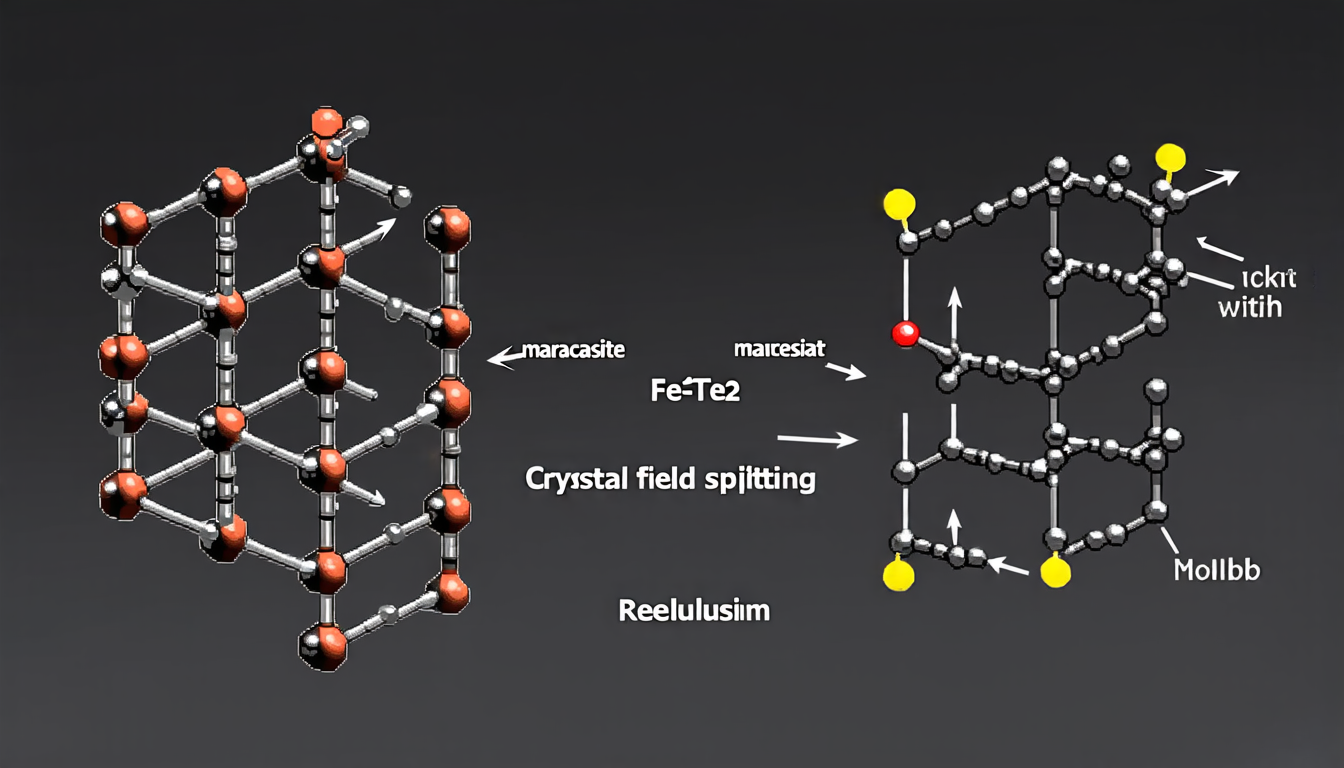
The researchers used a combination of theoretical calculations and experimental techniques to investigate the magnetic properties of marcasite FeTe2. They found that the material’s magnetic behavior is influenced by two competing factors: crystal field splitting (CF) and Coulomb repulsion.
Crystal field splitting refers to the way in which the electrons in the material are arranged within their atomic orbitals. This arrangement can affect the strength of the magnetic interactions between atoms, leading to different magnetic states. Coulomb repulsion, on the other hand, is a fundamental force that arises from the positive charge of the nuclei and the negative charge of the electrons.
The scientists discovered that CF splitting plays a crucial role in determining the magnetic state of marcasite FeTe2. When the material is prepared under certain conditions, the CF splitting leads to the formation of localized magnetic moments on the surface of the material. These moments are responsible for the observed magnetic behavior and can be either ferromagnetic (aligned parallel) or antiferromagnetic (aligned antiparallel).
In contrast, Coulomb repulsion tends to suppress the formation of these localized moments, leading to a non-magnetic state. This competition between CF splitting and Coulomb repulsion is thought to be responsible for the material’s ability to exist in multiple magnetic states.
The researchers also found that the magnetic properties of marcasite FeTe2 are sensitive to the shape and size of the material’s surface. For example, they discovered that the surface magnetic moments can be increased or decreased depending on the specific conditions under which the material is prepared.
These findings have important implications for our understanding of magnetism and its relationship to material structure. They also highlight the potential of marcasite FeTe2 as a model system for studying the fundamental principles of magnetism.
Cite this article: “Unlocking the Magnetic Secrets of Marcasite FeTe2: A Study on Material Structure and Properties”, The Science Archive, 2025.
Magnetism, Marcasite Fete2, Magnetic Properties, Crystal Field Splitting, Coulomb Repulsion, Ferromagnetic, Antiferromagnetic, Non-Magnetic State, Material Structure, Magnetism Research





