

Saturday 22 March 2025
In a major breakthrough in computer science, researchers have developed a new method for efficiently decomposing directed graphs into smaller regions, allowing for faster and more accurate calculations of shortest paths between nodes. This advance has significant implications for a wide range of applications, from optimizing traffic flow to improving the performance of complex algorithms.
Directed graphs are a fundamental concept in computer science, used to model everything from social networks to electrical circuits. However, working with these graphs can be challenging due to their complexity and size. In recent years, researchers have developed various techniques for decomposing directed graphs into smaller regions, known as low-diameter decompositions (LDDs). These LDDs are essential for many algorithms, including those used in network optimization, data compression, and machine learning.
The new method, developed by a team of researchers from Saarland University and the Max Planck Institute for Informatics, builds upon previous work in this area. By leveraging connections between directed graphs and expanders, they have created an LDD that is both efficient and accurate. The approach involves deleting edges from the graph while ensuring that each strongly connected component (a group of nodes that are reachable from one another) has a diameter no larger than a specified value.
One of the key advantages of this new method is its ability to handle large, complex graphs with ease. Previous LDDs were often limited in their scalability and accuracy, making them less effective for real-world applications. In contrast, the researchers’ approach can efficiently decompose even massive directed graphs into smaller regions, allowing for faster and more accurate calculations.
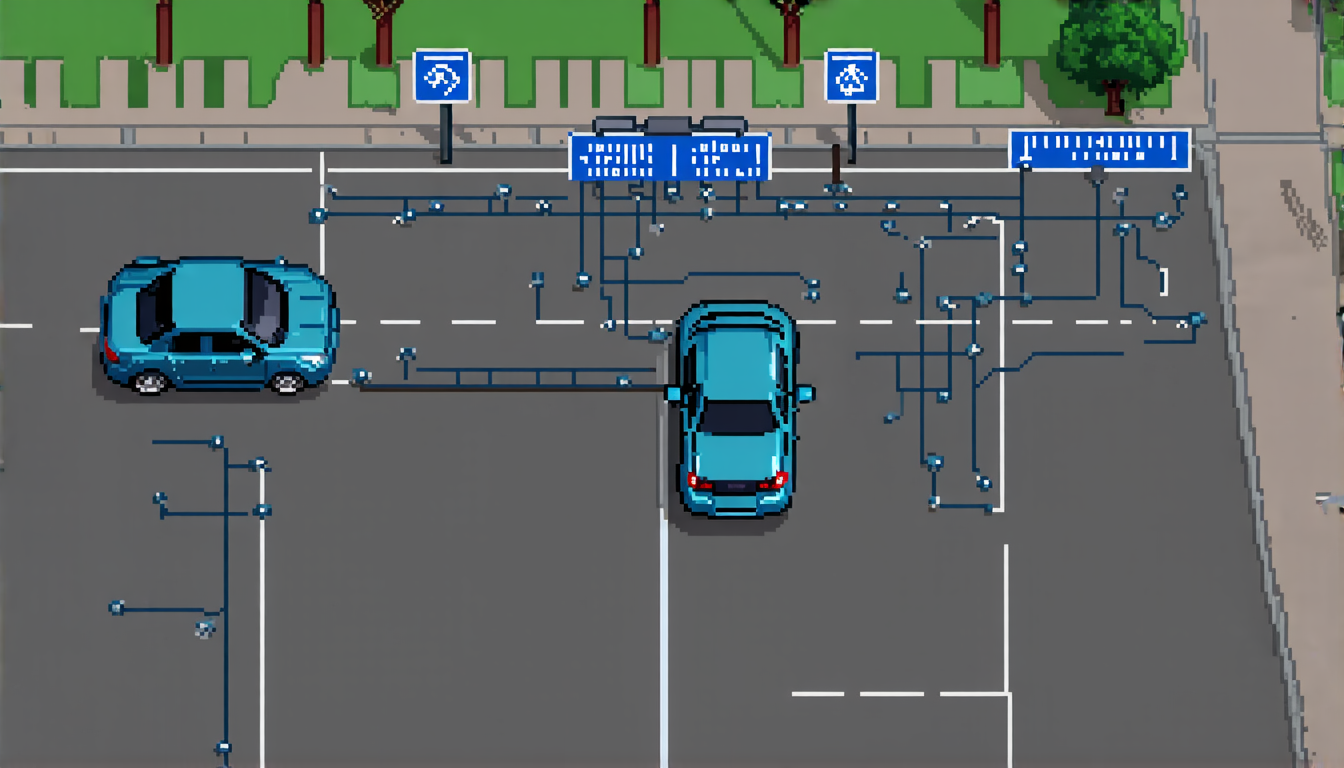
The implications of this breakthrough are far-reaching, with potential applications in a wide range of fields. For example, in traffic optimization, LDDs could be used to quickly identify the shortest paths between intersections, reducing congestion and improving travel times. In machine learning, efficient LDDs could enable faster training times for complex algorithms, allowing for more accurate predictions and better decision-making.
The researchers’ approach also has significant theoretical implications, as it provides a new framework for understanding the properties of directed graphs. By exploring the connections between expanders and LDDs, they have opened up new avenues for research in this area, paving the way for further advances in computer science.
Overall, this breakthrough is an important step forward in the development of efficient algorithms for working with directed graphs. Its potential applications are vast, and its implications for our understanding of complex systems will be far-reaching.
Cite this article: “Efficient Decomposition of Directed Graphs for Faster Shortest Path Calculations”, The Science Archive, 2025.
Computer Science, Directed Graphs, Low-Diameter Decompositions, Expanders, Shortest Paths, Traffic Optimization, Machine Learning, Algorithms, Complex Systems, Scalability.





