

Saturday 22 March 2025
The intricacies of particle physics have long fascinated scientists and the general public alike. Researchers have dedicated countless hours studying the behavior of subatomic particles, seeking a deeper understanding of the fundamental laws that govern our universe.
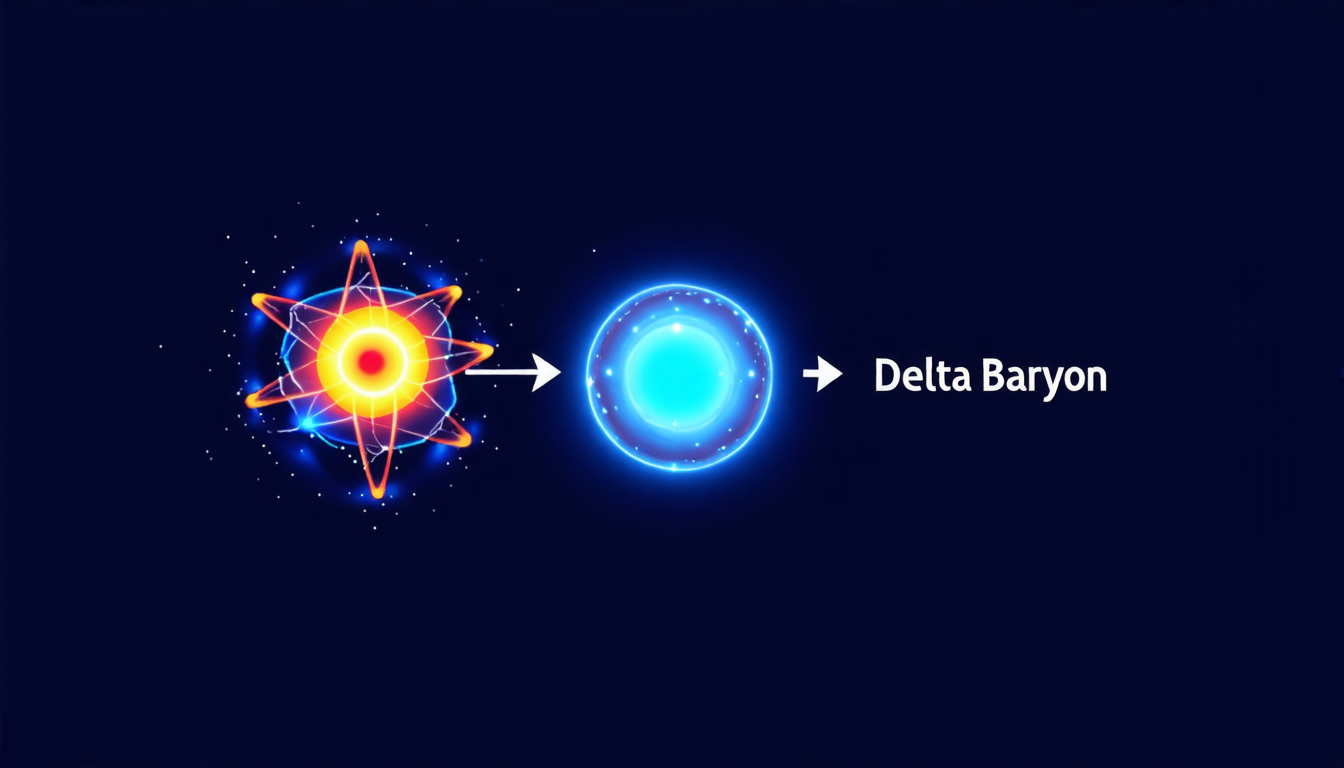
A recent study published in a leading scientific journal has shed new light on one such phenomenon: the γ(∗) + N(940) 1 2+ → ∆(1700)3 2- transition. This complex process involves the interaction between two fundamental particles, a photon and a nucleon, which ultimately leads to the formation of another particle, a delta baryon.
To grasp this concept, let’s take a step back. Photons are massless particles that mediate electromagnetic forces, while nucleons are the building blocks of atomic nuclei. In this particular scenario, the gamma ray (γ) interacts with the neutron (n) in a nucleus to produce an excited state, which then decays into a delta baryon (∆).
The researchers employed a novel approach to study this process, using a symmetry-preserving treatment of vector-vector contact interactions within the Dyson-Schwinger equations formalism. This method allowed them to analyze the internal structure of nucleons and delta baryons, revealing valuable insights into their behavior.
One key finding was the significant impact of non-pointlike quark-quark correlations on the transition process. These correlations, which are inherent in the Faddeev kernel, play a crucial role in shaping the properties of hadrons, including their masses and decay patterns.
The study also highlighted the importance of considering the internal structure of baryons when analyzing electromagnetic transitions. By normalizing the elastic electric form factor of these particles, researchers can gain a deeper understanding of the underlying physics driving these processes.
This research has far-reaching implications for our understanding of strong interactions and the behavior of subatomic particles. The findings have the potential to inform future studies on hadron spectroscopy, the study of the properties of hadrons, and may even shed light on the mysteries of quantum chromodynamics.
Ultimately, this study demonstrates the power of theoretical physics in unraveling the complexities of the universe. By pushing the boundaries of our understanding, scientists can continue to uncover new secrets about the fundamental laws that govern our reality.
Cite this article: “Unveiling the Secrets of Subatomic Interactions”, The Science Archive, 2025.
Particle Physics, Quantum Chromodynamics, Strong Interactions, Electromagnetic Transitions, Nucleons, Delta Baryon, Photons, Dyson-Schwinger Equations, Faddeev Kernel, Hadron Spectroscopy





