

Monday 24 March 2025
Scientists have long been fascinated by the mysteries of the universe, and a recent paper has shed new light on one of the most enduring enigmas: dark matter. For decades, researchers have struggled to understand the nature of this invisible substance that makes up approximately 27% of the universe’s mass-energy budget.
The problem is that dark matter doesn’t interact with light, making it impossible to directly observe or study. However, its presence can be inferred by the way it affects the motion of galaxies and galaxy clusters. By analyzing the subtle distortions in the cosmic web, scientists can map out the distribution of dark matter across the universe.
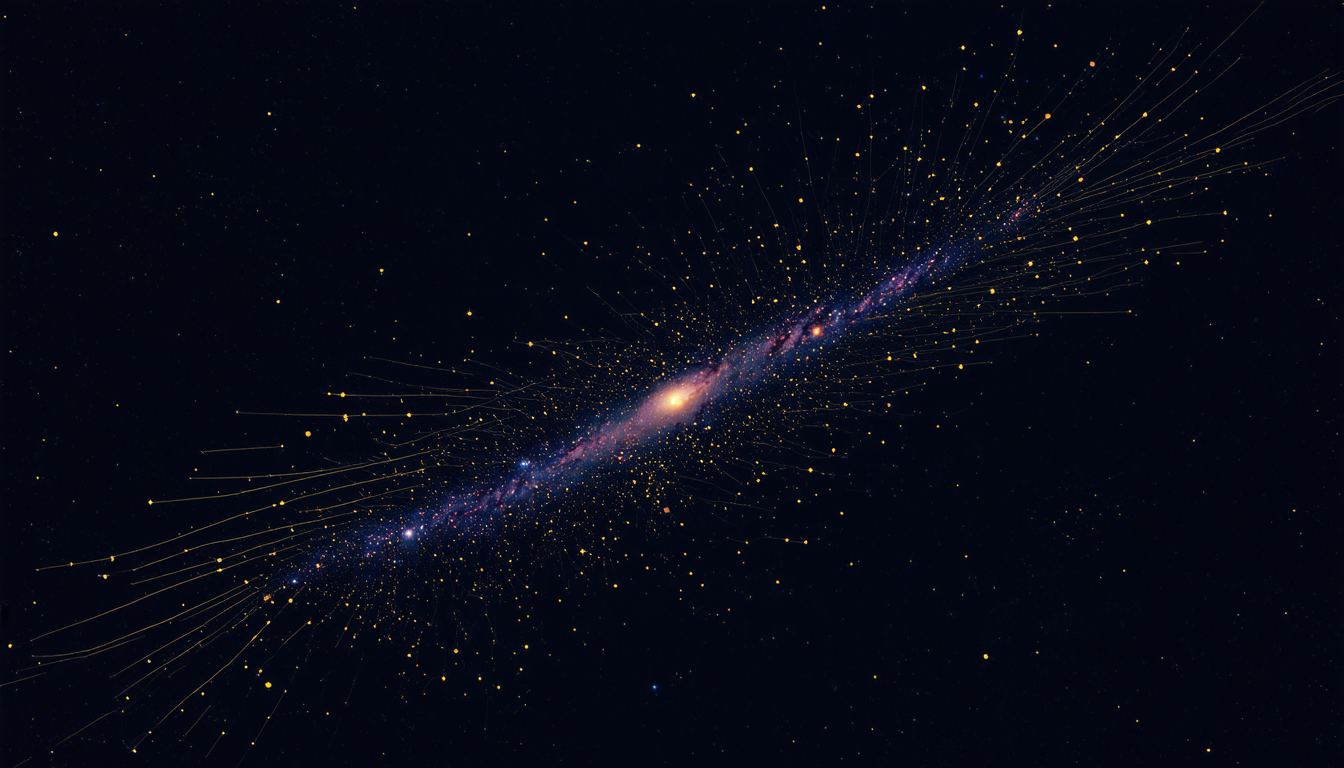
The new paper proposes a novel approach to understanding dark matter’s behavior. Instead of focusing on individual galaxies or clusters, researchers have turned their attention to the vast networks of filaments that crisscross the universe. These filaments are thought to be the result of gravitational collapse and can provide valuable insights into the properties of dark matter.
The team used a combination of computer simulations and observations from powerful telescopes to study these cosmic filaments. By analyzing the way they interact with normal matter, scientists were able to infer the presence of dark matter and even constrain its properties.
One of the most exciting findings is that dark matter’s behavior appears to be influenced by the surrounding environment. In areas where there are more galaxies and galaxy clusters, dark matter seems to behave differently than in less densely populated regions. This has significant implications for our understanding of how dark matter affects the large-scale structure of the universe.
The research also highlights the importance of observing the cosmic filaments themselves. While we’ve made tremendous progress in mapping out the distribution of normal matter, much remains unknown about these mysterious structures. By studying them more closely, scientists hope to gain a deeper understanding of how dark matter shapes our universe.
The findings have far-reaching implications for our understanding of the cosmos. Dark matter’s influence on the formation and evolution of galaxies is still not fully understood, and this research provides valuable new clues. The discovery could also shed light on the nature of dark energy, another mysterious force that drives the accelerating expansion of the universe.
As scientists continue to probe the mysteries of dark matter, they’re getting closer to unraveling its secrets. This latest study offers a fascinating glimpse into the complex dance between normal and dark matter in the universe’s vast expanse. With each new discovery, we’re one step closer to understanding the intricate web that underlies our cosmos.
Cite this article: “Unveiling Dark Matters Secrets: A New Perspective on the Universes Mysterious Substance”, The Science Archive, 2025.
Dark Matter, Universe, Galaxies, Galaxy Clusters, Filaments, Cosmic Web, Simulations, Observations, Gravitational Collapse, Normal Matter





