

Tuesday 25 March 2025
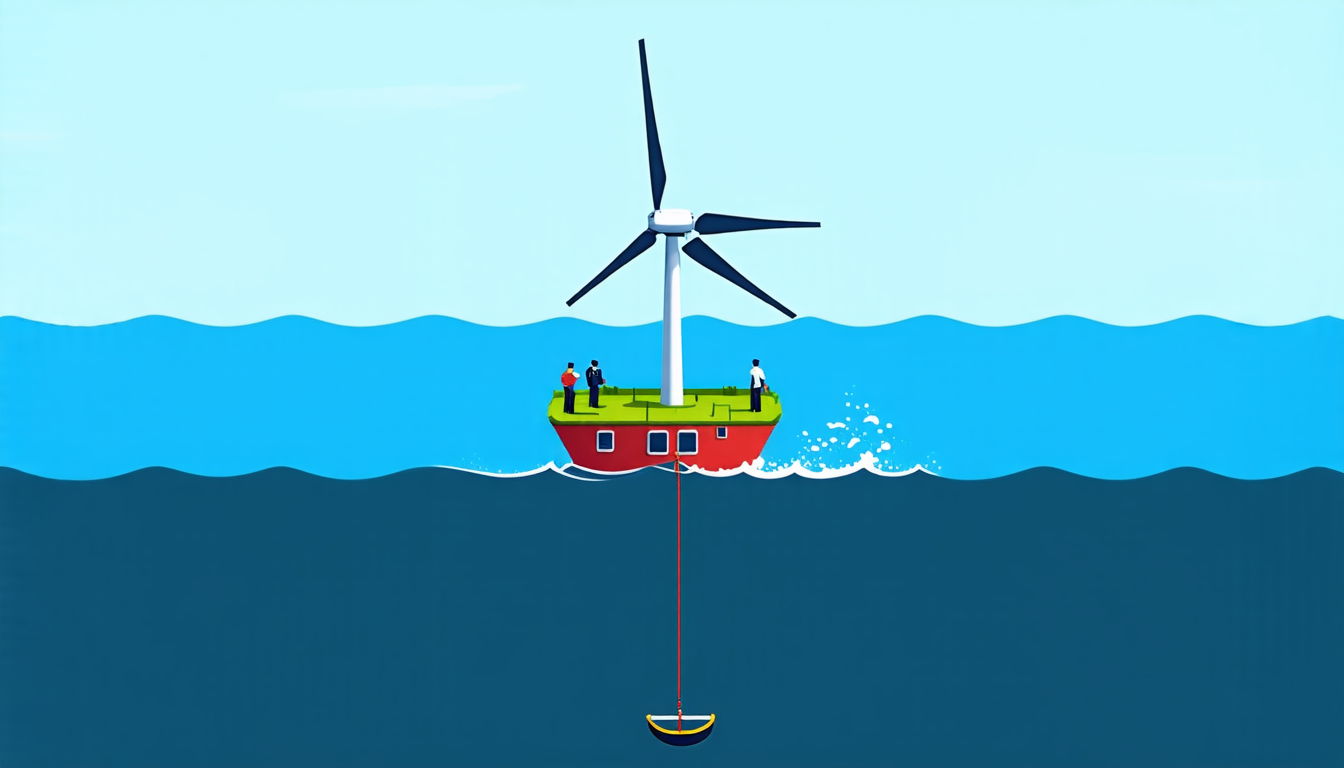
The quest for more efficient and sustainable energy production has led researchers to explore innovative solutions, including floating offshore wind turbines. These behemoths of engineering are designed to harness the power of ocean winds, which can be stronger and more consistent than those on land. However, their deployment is hindered by the complexities of mooring lines – the cables that keep them in place.
A team of scientists has tackled this problem by developing an advanced Kirchhoff rod model, a mathematical framework used to simulate the behavior of rods under various loads. By extending this model to include interactions with the seabed and surrounding flow, they’ve created a more accurate representation of mooring lines’ dynamic response.
The traditional approach to modeling mooring lines relies on simplifications and approximations, which can lead to inaccurate predictions. These new simulations, on the other hand, account for factors such as buoyancy, added mass (the force exerted by the surrounding fluid), tangential drag, and normal drag. This more comprehensive understanding will enable engineers to design more efficient and reliable mooring systems.
The team’s findings were validated against established solutions from the literature and industry-standard codes, demonstrating excellent agreement across various scenarios. The simulations also revealed interesting behaviors, such as the transition from a drag-dominated regime at low frequencies to an added-mass-dominated regime at higher frequencies under normal pulsating loads.
One of the most significant advantages of this approach is its ability to capture the complex interactions between the mooring line and the surrounding environment. This includes the effects of seabed friction, which can significantly impact the dynamics of the system. By accurately modeling these interactions, engineers will be better equipped to design mooring lines that can withstand harsh marine conditions.
The implications of this research are far-reaching, with potential applications in various fields beyond offshore wind energy. For instance, the model could be adapted for use in other floating structures, such as oil rigs or wave energy converters.
In the pursuit of a more sustainable future, innovations like these are crucial. By pushing the boundaries of what’s possible with computational modeling and simulation, researchers can help overcome the technical hurdles that stand between us and a cleaner, greener world.
Cite this article: “Advanced Modeling Yields More Accurate Simulations of Mooring Lines for Offshore Wind Turbines”, The Science Archive, 2025.
Offshore Wind Energy, Floating Structures, Mooring Lines, Kirchhoff Rod Model, Computational Modeling, Simulation, Seabed Friction, Added Mass, Normal Drag, Tangential Drag





