

Tuesday 25 March 2025
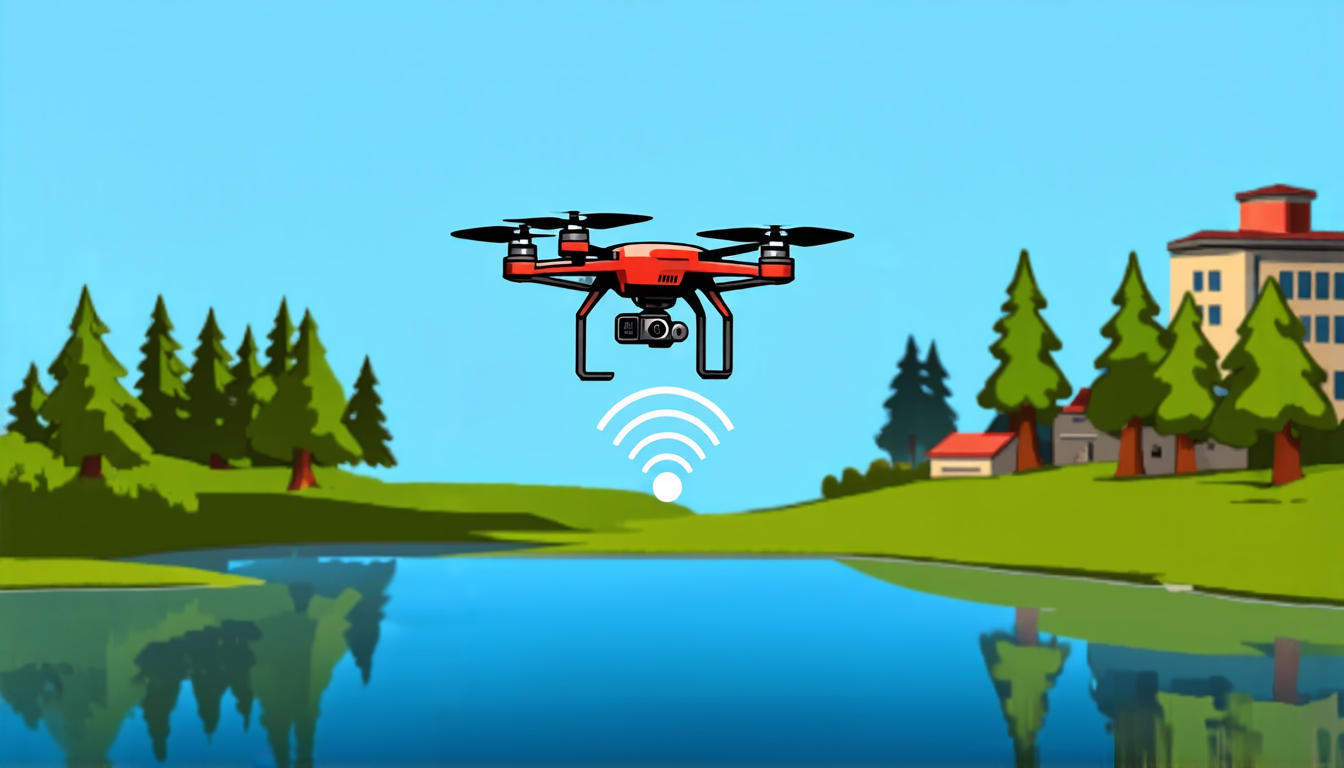
Unmanned aerial vehicles (UAVs), also known as drones, are becoming increasingly popular for a wide range of applications, from surveillance and mapping to cargo transport and medical delivery. However, one major challenge in using UAVs is ensuring reliable communication between the drone and its ground control station.
Traditional wireless communication systems were designed with fixed infrastructure in mind, such as cell towers and satellites. But UAVs operate in a more dynamic environment, where signal strength and quality can vary greatly depending on factors like altitude, distance from the transmitter, and even foliage density.
Researchers have been working to develop new communication technologies that can adapt to these changing conditions. One promising approach is the use of multi-input multi-output (MIMO) systems, which allow multiple antennas to transmit and receive signals simultaneously, improving data rates and reliability.
To test this technology in real-world scenarios, scientists conducted a study using a custom-built MIMO system and ray tracing simulations. They set up a series of experiments at Lake Wheeler Field Labs, where they measured the signal strength and channel rank (a measure of the quality of the wireless link) as UAVs flew over the area.
The results showed that tree-induced blockage significantly impacted RF coverage and channel rank at lower altitudes, while higher altitudes saw fewer obstacles and better communication performance. This suggests that MIMO systems could be particularly effective in environments with dense foliage, where traditional wireless technologies struggle to maintain a strong signal.
To further improve the accuracy of their predictions, researchers developed a Kriging interpolation-based 3D channel rank prediction scheme. By leveraging the observed spatial correlation of channel rank data, they were able to create detailed maps of expected communication performance across different environments and UAV positions.
In a final step, the team compared their ray tracing simulations with real-world measurements collected from the National Science Foundation’s AERPAW testbed. The results showed reasonable consistency between simulation results and actual measurements, validating the effectiveness of their approach.
These findings have significant implications for the development of reliable and efficient wireless communication systems for UAVs. By better understanding how MIMO technology performs in different environments and developing more accurate prediction tools, researchers can design more effective communication strategies that adapt to changing conditions on the fly. This could lead to improved data rates, reduced latency, and enhanced overall performance for a wide range of applications, from search-and-rescue missions to package delivery services.
Cite this article: “Wireless Communication Systems for Unmanned Aerial Vehicles: A Study on MIMO Technology and Environmental Factors”, The Science Archive, 2025.
Unmanned Aerial Vehicles, Wireless Communication, Mimo Systems, Signal Strength, Channel Rank, Ray Tracing Simulations, Kriging Interpolation, 3D Channel Rank Prediction, Aerpaw Testbed, Wireless Link Performance.





