

Tuesday 25 March 2025
The quest for artificial intelligence that never forgets has been a longstanding challenge in machine learning research. One of the most significant hurdles is catastrophic forgetting, where neural networks rapidly lose their ability to perform tasks they were previously trained on as new information is added.
Researchers have been exploring various strategies to combat this phenomenon, including techniques such as replay memory and synaptic intelligence. However, these methods often come with significant computational overhead or limitations in their applicability.
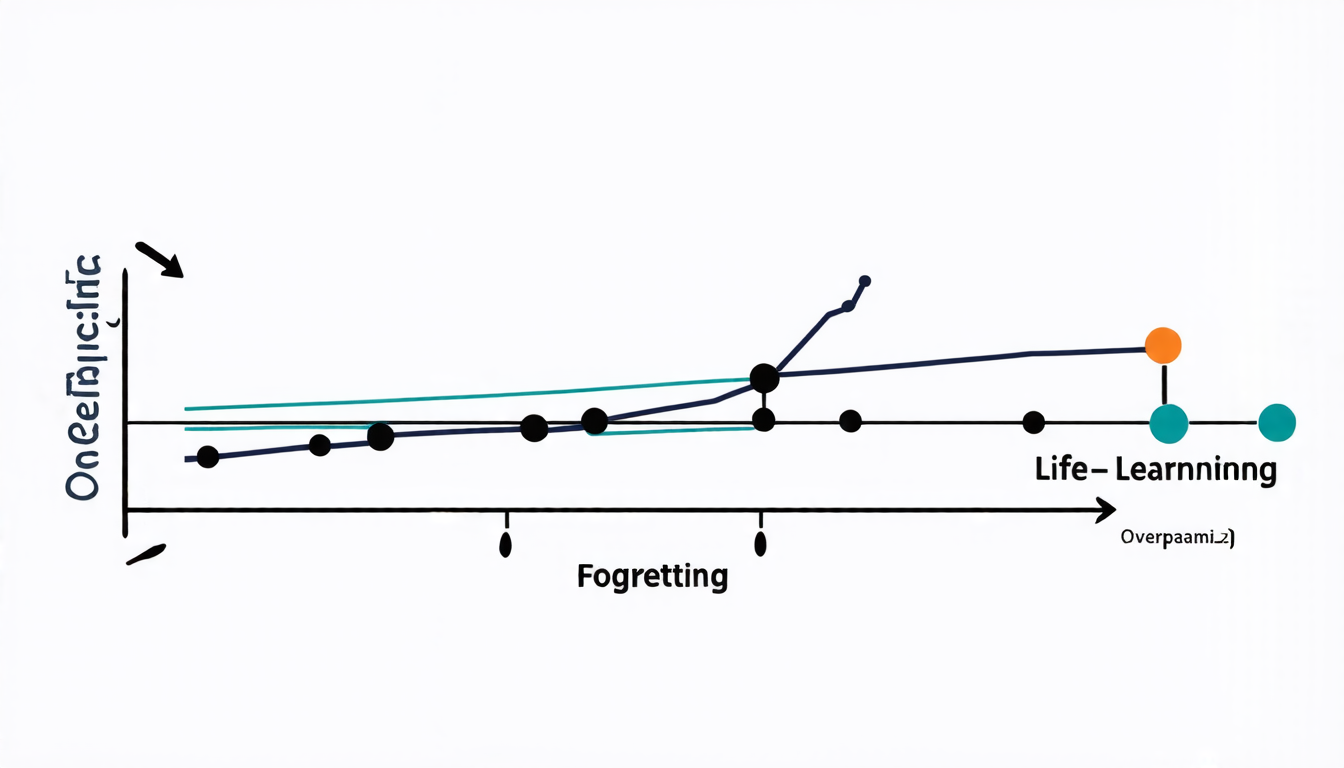
A recent paper published by Daniel Goldfarb and Paul Hand has shed new light on the problem of catastrophic forgetting. By analyzing a simple linear model, they’ve discovered that overparameterization can actually mitigate the effects of forgetting, allowing neural networks to retain knowledge from previous tasks even as new information is added.
The researchers’ findings rely on a series of mathematical proofs and simulations, which demonstrate that increasing the number of parameters in a linear regression model can reduce the risk of catastrophic forgetting. This may seem counterintuitive at first, given the common wisdom that overparameterization often leads to overfitting and poor generalization.
However, Goldfarb and Hand’s results suggest that in certain regimes, overparameterization can actually lead to more robust learning and improved generalization capabilities. The key insight is that as the number of parameters increases, the model becomes less sensitive to changes in the data distribution, making it less prone to catastrophic forgetting.
The implications of this research are significant, as they could potentially enable the development of neural networks that can learn multiple tasks sequentially without suffering from catastrophic forgetting. This has major applications in areas such as lifelong learning, where machines need to continuously adapt and improve their performance over time.
While the results may not be directly applicable to complex deep neural networks, they provide a promising direction for future research. By further exploring the properties of overparameterization and its relationship to catastrophic forgetting, researchers may uncover new strategies for building more robust and adaptable AI systems.
In practical terms, this means that developers could potentially design neural networks with more parameters than necessary, knowing that this excess capacity can help mitigate the effects of forgetting. This could be particularly useful in applications where data is limited or noisy, as it would allow the model to adapt and learn from new information without sacrificing its ability to perform previous tasks.
Overall, Goldfarb and Hand’s research offers a fresh perspective on the problem of catastrophic forgetting, highlighting the potential benefits of overparameterization in certain regimes.
Cite this article: “Overparameterization as a Solution to Catastrophic Forgetting”, The Science Archive, 2025.
Artificial Intelligence, Machine Learning, Catastrophic Forgetting, Neural Networks, Overparameterization, Linear Regression Model, Lifelong Learning, Sequential Learning, Robust Learning, Generalization Capabilities.





